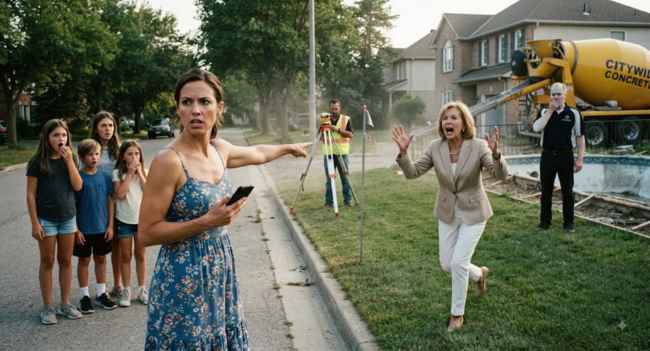
MY NEIGHBOR POURED CONCRETE INTO THE POOL MY LATE HUSBAND BUILT—BUT THE SURVEY SHE FORCED ME TO ORDER EXPOSED WHAT SHE AND HER HUSBAND HAD BEEN HIDING FOR YEARS
The original property map was spread across my attorney’s desk when he pointed to a thin black line running behind Katherine’s garage.
“Your pool is going to be expensive to fix,” he said. “But I think your neighbor has a much bigger problem.”
I leaned closer.
According to the survey recorded when my husband and I bought our house, my property extended almost nine feet farther toward Katherine’s side than the fence suggested.
That meant part of her stone driveway crossed onto my land.
But that wasn’t what made Katherine panic.
Behind her garage stood a large cedar structure she called her “garden studio.”
I’d seen it hundreds of times.
Katherine spent almost every afternoon there.
She had expensive landscaping around it, security cameras above the doors, and a separate paved entrance connecting it to the driveway.
I always assumed it was some kind of elaborate shed.
My attorney tapped the map.
“That structure appears to be partially on your property.”
I stared at him.
“Partially?”
“Possibly several feet.”
Then he added:
“And I can’t find a permit for it.”
Suddenly Katherine’s reaction made sense.
But we still didn’t know the whole story.
So I told my attorney to keep looking.
I wasn’t interested in taking Katherine’s building.
I wanted my pool restored.
Nothing more.
If she had apologized, paid for the damage, and promised to stay off my property, I probably would have stopped there.
Instead, Katherine came to my door that evening.
Her husband, Greg, stood several feet behind her.
“I think everyone got emotional yesterday,” she said.
I almost laughed.
“You filled my swimming pool with concrete.”
“Because your children were disturbing us.”
“At five in the morning?”
She ignored that.
Then she offered me $5,000.
I told her the preliminary estimate for removing the concrete, inspecting the shell, repairing any structural damage, and restoring the pool was already many times that.
Her expression hardened.
“You don’t need some fancy swimming pool.”
That sentence ended the conversation.
“It isn’t your decision what my children need.”
I started closing the door.
Then Greg spoke.
“What do you want for the strip?”
I stopped.
“What strip?”
“The land beside the driveway.”
So they knew.
Maybe not the exact measurements.
But they knew there was a boundary problem.
“I haven’t offered to sell anything.”
Greg looked at Katherine.
She suddenly seemed nervous again.
“We’ll give you twenty thousand.”
“No.”
“Thirty.”
“No.”
“Fifty.”
That got my attention.
Not because I wanted the money.
Because nobody offers $50,000 for a narrow strip of suburban land unless something else depends on owning it.
I looked at Greg.
“Why is it so important?”
Neither answered.
I closed the door.
The following morning, my attorney called.
He had found the answer.
The “garden studio” wasn’t a garden studio.
Several years earlier, Greg had converted the structure into a luxury short-term rental.
Bedroom.
Bathroom.
Kitchenette.
Separate entrance.
It had apparently been advertised privately through a property-management company rather than prominently under Katherine’s name.
And according to the survey, a significant corner of the structure crossed the recorded property line.
But there was an even bigger issue.
Access.
The driveway used by guests to reach the rental also crossed my land.
My attorney explained that if Katherine and Greg couldn’t establish a legal easement or another valid right to use that strip, their rental arrangement had a serious problem.
Then he found something else.
The permit records for the structure described it as storage.
Not residential accommodation.
I stared at him.
“So what happens now?”
“That depends on the county.”
I remembered Katherine standing beside my ruined pool.
Now there will finally be some peace and quiet.
For two years, she’d complained about my children laughing in their own backyard.
Meanwhile, she and Greg had apparently been bringing paying guests onto a structure accessed partly across land that wasn’t theirs.
The irony would have been funny if my children weren’t still asking why Daddy’s pool had disappeared beneath concrete.
So I didn’t retaliate.
I documented.
I gave the police the security footage from my backyard.
The footage showed the truck entering.
Greg operating it.
Katherine directing him.
And both of them remaining after I ordered them to stop.
My attorney sent formal notice demanding that they preserve all relevant records and cease entering my property without permission.
We also notified the appropriate local authorities about the disputed boundary and unpermitted-use concerns so they could determine what, if anything, violated local rules.
That afternoon, Katherine came running over again.
This time she wasn’t angry.
She was crying.
“You reported us?”
“I reported what happened.”
“You’re going to destroy Greg’s business.”
I looked toward my backyard.
Gray concrete covered the place where my husband had taught our oldest child to float.
“No, Katherine. Greg drove a concrete truck onto someone else’s property and filled their swimming pool.”
She wiped her face.
“This is revenge.”
“No. Revenge would be me doing to your property what you did to mine.”
I pointed toward the security camera.
“This is evidence.”
She stared at me for several seconds.
Then she said something unexpected.
“You don’t understand. We need the rental income.”
And suddenly I understood why she had offered so much money.
They weren’t merely protecting a driveway.
They were protecting income.
The following weeks became expensive for everyone.
My insurance company documented the damage but pursued responsibility for the deliberate act.
Contractors determined that simply scooping out the concrete wasn’t realistic.
The pool had suffered significant damage.
Sections had to be demolished and rebuilt.
The estimate was enormous.
Greg’s construction insurer initially disputed coverage because the truck had allegedly been used outside legitimate contracted work.
That created another fight between Greg, his company, and the insurer.
Meanwhile, county inspectors visited Katherine’s property.
I watched from my kitchen window.
Katherine did not wave.
Eventually, use of the backyard structure as accommodation stopped while the permitting and boundary issues were addressed.
My attorney made something very clear to me throughout the process:
The land dispute didn’t mean I could simply tear down whatever crossed the line.
Everything had to be handled properly.
Surveys.
Title records.
Notices.
Negotiation.
And, if necessary, court.
That was fine with me.
I had already learned what happened when people decided property rights could be enforced with concrete trucks.
Months later, Katherine and Greg finally agreed to mediation.
They came with an attorney.
So did I.
Greg barely spoke.
Katherine spent the first twenty minutes explaining how difficult it had been living beside four children.
Then the mediator asked:
“Were the children violating any noise ordinance at five o’clock in the morning when the concrete was poured?”
Katherine went silent.
Their attorney whispered something to her.
The conversation changed quickly after that.
The final resolution covered the cost of rebuilding my pool and associated property damage, subject to the agreements reached between the parties.
The disputed boundary was formally addressed rather than ignored.
Any future use of Katherine’s structure would have to comply with whatever property and local requirements applied.
Most importantly, neither Katherine nor Greg was permitted to simply enter my backyard again because they disliked what my children were doing.
The following spring, construction on my pool was finally completed.
I changed one thing.
At the shallow end, I had a small stone installed.
Nothing dramatic.
Just my husband’s name and the years of his life.
The first warm Saturday, my children stood around the edge wearing goggles.
My youngest looked toward Katherine’s house.
“Are we allowed to laugh?”
That question broke my heart.
I crouched beside him.
“Yes.”
“Even loud?”
I smiled.
“You’re allowed to be children.”
Then all four jumped.
Water exploded across the patio.
They laughed.
They splashed.
And for several seconds I closed my eyes and remembered my husband standing in that same place, covered in construction dust, telling me the pool would be worth every exhausting weekend once he heard the kids playing in it.
He had been right.
Katherine wanted silence.
Instead, by destroying something that never belonged to her, she forced every document, camera recording, property line, and decision into the light.
And that was the part she never expected.
I didn’t have to destroy her property.
I didn’t have to threaten her.
I didn’t need a concrete truck of my own.
I simply made her answer for what she’d done.
And sometimes consequences make far more noise than children ever could.