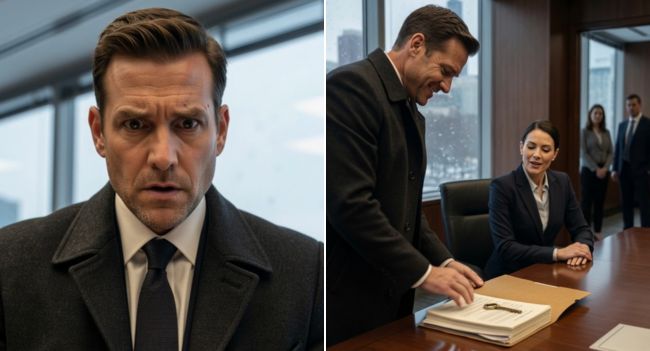
The chair scraped backward before anyone understood my answer. At our holiday dinner, Mom ordered me to leave and stop relying on the family—without realizing the bills, the lake house, and their carefully polished life had always relied on me.
By six that evening, snow had begun dusting the stone walls around my parents’ neighborhood outside Minneapolis. I drove through Wexley Heights watching warm rectangles of light pass behind bare trees, each house prepared for a magazine spread and my parents’ colonial trying hardest.
White lights traced the roofline, fresh pine framed the windows, and a wreath the size of a wagon wheel hung above the front door. Three weeks earlier, Mom had texted me the decorator’s invoice with one sentence: Can you take care of this before they cancel?
I had taken care of it, because I took care of most things in the Whitmore family. The property-tax installment, the winter furnace repair, and the wine being served that night had all come through accounts with my name on them.
None of that appeared in our family’s version of itself. In that version, Dad was the steady retired provider, Mom the elegant center, Brandon an entrepreneur near his breakthrough, Jessica a devoted mother building a beautiful life, and I was Lauren, the cautious one.
At thirty-eight, I was a senior forensic accountant at Northline Advisory, where corporations hired me to find missing money and expose the small discrepancy hiding a larger pattern. At home, I used those same skills to make discrepancies disappear.
Before getting out of the car, I reached into my purse for my keys and felt the dark green leather fob, softened at the edges from years of use. Beside my apartment key hung an old brass key to the family lake house on Pineglass Lake.
Dad had given me that key after I rescued the property from a tax auction five years earlier. “Every Whitmore should always have a way in,” he had said, and I had believed him.
The front door opened before I knocked, revealing Mom beneath the foyer chandelier in a cream dress with a narrow gold belt. Her blond hair was swept into the smooth twist she wore whenever she expected photographs.
“You’re late,” she said.
“Traffic was bad coming out of the city.”
“Traffic is always bad when people fail to plan.”
She stepped aside as if I were a delivery she had decided not to return. The foyer smelled of balsam candles and slow-roasted beef, and when my coat brushed a silk ribbon loose from the garland, Mom fixed it before looking at me again.
“You could have worn the blue dress,” she said. “The green washes you out.”
“I like this one.”
“Yes, well.”
Dad sat at the head of the oak table, rolling a wineglass between his palms, while Brandon poured cabernet with the confidence of a sommelier. Dad praised his choice, and Brandon grinned as though the case had not been ordered and paid for by me.
Jessica sat on Dad’s right, checking her phone while her new diamond bracelet caught the chandelier light. I had spent the previous six months covering her mortgage after her husband lost his job, partly so her children would not have to change schools midyear.
“Lauren,” she said, looking up. “You made it.”
My assigned seat waited at the far end near the kitchen door, where cold air slipped beneath the threshold. It had been my place since college—close enough to refill water, carry plates, or fetch whatever Mom realized she had forgotten. I placed my purse beside the chair, and the brass lake-house key clicked softly against the wooden leg. For reasons I could not yet explain, I noticed the sound.
Dinner began with its familiar performance: Jessica described her children’s gifted program, Brandon explained an app that would predict when pet owners needed more food, and Dad asked serious questions about investors. Mom watched them with the approving smile she saved for choices that made sense to her.
I cut my roast into neat squares and tried not to calculate the meal. The butcher’s invoice alone had been three hundred eighty-six dollars.
“How is work?” Jessica asked during a pause.
“Busy. Year-end audits start next week.”
Brandon gave a sympathetic laugh. “Audits? I don’t know how you do it—sitting under fluorescent lights, checking other people’s math all day.”
“My office has windows.”
“You know what I mean. You should take a risk for once.”
“Risk requires capital.”
“Risk requires guts,” Dad said, pleased with the line. “Look at your brother. He isn’t afraid to put himself out there.”
The cashmere sweater on Dad’s shoulders had arrived from me on his birthday, and Brandon’s last landlord had stopped threatening legal action only after I settled the unpaid balance. Neither man had ever asked what kept the floor beneath Brandon’s risks from collapsing. Mom lowered herself into her chair. “Lauren has always preferred safety nets.”
Her eyes met mine for less than a second, and the old reflex rose inside me: smile, soften, keep the room comfortable. I reached for my water instead. The conversation moved on, but something in the room had shifted. I could feel Mom arranging a sentence in her mind the way she arranged place settings—carefully, symmetrically, with no room left for anyone else’s preference.
She dabbed the corner of her mouth with her napkin and set her fork down. “I’ve been thinking about your situation.”
“My situation?”
“You seem unhappy.” Her voice had gone soft, which was always more dangerous than anger. “You come here tense, you ask too many questions, and you bring a heaviness into family gatherings.”
I looked toward Jessica, expecting at least confusion, but she studied the ice in her water. Brandon rolled his wine in the glass, and Dad began buttering a dinner roll with slow, unnecessary attention.
“I’m tired,” I said. “That isn’t the same thing as unhappy.”
Mom folded her napkin into a perfect white square. “I think you’ve become too dependent on us emotionally.” The grandfather clock in the foyer marked three seconds before I could answer. Each tick seemed to move the room farther away from me.
“Dependent on you?”
“There,” Brandon muttered. “That defensive tone.”
Mom kept her gaze on mine. She said I used the family as a crutch, that I relied on their approval and stability because I had not built a full life of my own, and that my constant involvement had become unhealthy for everyone.
I waited for the absurdity to break across someone’s face. Surely Dad would remember the tax payment, Jessica the mortgage transfers, or Brandon the legal settlement whose “anonymous investor” had been me. No one moved. Then Mom delivered the sentence she had apparently rehearsed.
“You should leave, Lauren, tonight—and learn to stop relying on this family.”
The words were quiet enough that the candles continued to flicker without disturbance, but something inside me went still. The insult was not simply that she misunderstood; it was that the people at the table were allowing her version to become official.
Dad kept buttering his roll. Jessica lifted her glass without drinking, and Brandon stared toward the ceiling with the weary expression of a man being inconvenienced by someone else’s pain. Their silence answered every question I had refused to ask for years. I was useful enough to finance the room, but not important enough for anyone in it to tell the truth.
“Please don’t make a scene. It’s for your own good.”
For one brief moment, I felt the old machinery start: explain the invoices, list the transfers, remind them of every emergency, and prove that I belonged. That was how I had handled every wound in our family—by offering evidence and then paying the next bill. But if I defended myself, I would still be applying for a position they had already denied me.
“Okay.”
Mom blinked.
“Okay?” she repeated.
“Okay.”
I pushed my chair back, and the legs scraped hard across the polished floor. Jessica flinched, Brandon finally looked at me, and Dad’s knife stopped halfway through the roll.
I lifted my purse, slipped on my coat, and felt the leather key fob settle into my palm. Mom’s expression held triumph for half a second, followed by the smallest crease between her brows when I did not ask when I could come back.
“Good night,” I said.
No one answered. I crossed the foyer past the candles I had bought and the garland I had financed, opened the heavy front door, and stepped into honest cold. Snow touched my cheeks before the door closed behind me with a clean metallic click. They expected me to return before I reached the highway. I knew that because my phone began vibrating before I had backed out of the driveway.
Jessica wrote first: Mom is upset. You should apologize before this gets worse. Brandon followed: Seriously? Fix the mood and come back. Dad’s message was shortest: Call your mother. Not one of them asked whether I had reached my car safely, and not one mentioned what Mom had said. Their concern was not that I had been hurt; it was that I had interrupted the evening.
I placed the phone face down in the passenger seat and drove toward Minneapolis. The brass key tapped against the console whenever I turned, a small persistent sound from a house they considered theirs and I had nearly lost my retirement savings to preserve.
The city lights appeared through the snow like a second horizon. Somewhere between the suburbs and the interstate, I realized Mom had accidentally told the truth about one thing: I had been relying on the family.
I had relied on the hope that one more rescue would produce gratitude, that usefulness might eventually become love, and that if I kept the structure standing, someone would notice the person holding it up. By the time I entered my parking garage, that hope felt less like loyalty and more like a debt I no longer intended to service.
My apartment occupied the top floor of a converted warehouse overlooking the river, and Mom had visited it only twice in six years. Both times, she had perched on the edge of my sofa with her purse clutched in both hands and asked when I planned to move somewhere “more settled.”
That night, the rooms did not feel temporary or cramped. They felt like the first space in which no one was waiting for me to solve a problem. I set my purse on the kitchen island, and the keys landed beside it. The dark green fob looked ordinary under the pendant light, but the brass lake-house key seemed suddenly heavier than the rest. My phone lit again. Mom calling.
The screen went dark, then brightened with Brandon’s name, then Jessica’s. Their persistence followed the same rhythm as every earlier family emergency: pressure first, guilt second, affection only if the first two failed. I powered the phone off.
The silence that followed was so complete that I could hear the refrigerator cycle on. Usually, after a family dinner, I spent hours replaying my tone and deciding what payment or favor might restore peace. Instead, I poured a glass of water and opened the drawer where I kept old family photographs.
The first showed Jessica and me in her kitchen two years earlier, both smiling beside a birthday cake. That afternoon she had cried into a paper towel because her husband’s layoff meant their health insurance would end before her son’s scheduled tonsil surgery.
I told her my company had an extended-family program that could cover the gap. No such program existed; I simply paid eight months of continuation premiums from my savings, then let her thank luck and her husband’s persistence when the crisis passed. The second photograph showed Dad standing proudly beneath the new roof on the colonial. He had told neighbors he won a senior discount from the contractor.
I invented that story after finding him gray-faced over an estimate he could not afford. The contractor agreed to preserve the fiction because I paid twelve thousand six hundred dollars in advance. The third photograph had been taken at Pineglass Lake after the dock repairs. Brandon held a bottle of beer in one hand and called the cabin “our inheritance” while I stood at the edge of the frame.
Five years before that photograph, county notices had nearly sent the property to auction. Dad had stopped paying taxes, convinced a recovery in his investments would solve everything before anyone noticed. Mom called me forty-eight hours before the deadline. She did not ask for a loan. She said, “You are good with numbers. Find a way.”
I liquidated part of my retirement account, paid the arrears and penalties, and covered the legal work necessary to preserve the property. I did one thing differently that time: on the advice of David Mercer, a contract attorney I was dating then, I documented the money as an equity purchase and secured loan. My parents signed because the alternative was losing the cabin.
They promised repayment within two years, then behaved as though the promise had dissolved with the emergency. I continued paying taxes and repairs because I could not bear to watch the place fall into danger again. Brandon’s history followed the same pattern on a smaller scale. Five companies, five confident launches, and five moments when suppliers, landlords, or credit cards stopped accepting confidence as currency.
I settled twenty-two thousand dollars in debts from his failed brewery and told him an anonymous investor wanted his slate cleared before considering another venture. He never asked who the investor was. Jessica accepted help more quietly, but just as consistently. Mortgage payments became school tuition, car repairs, groceries, and one month of her nanny’s wages when she said she was “drowning.”
Dad knew enough to suspect the truth because he managed the household account. Yet acknowledging my support would have required him to admit that the life he presented as his achievement had become dependent on his daughter. Mom’s denial was different. She treated money as part of the atmosphere—something that should arrive around her without visible machinery—and she resented any question that reminded her someone was supplying it.
I had protected all four of them from embarrassment so thoroughly that I had erased myself from the rescue. That realization did not absolve them, but it did expose my part in the system. By hiding every transfer and inventing every graceful explanation, I had helped them believe the lie that they stood alone. I had also trained them to expect care without accountability.
The photographs did not make me angry so much as tired. I returned them to the drawer, except for the lake-house picture, which I placed beside the keys on the counter. For years, that brass key had meant access to the one place where our family sometimes seemed almost real. We grilled beside the water, played cards during storms, and told stories that left out every invoice.
Now it represented the cost of belonging to a story that required me to remain invisible. I showered, changed into an old cotton shirt, and went to bed without sending an apology. Sleep came slowly, but it came without the familiar bargain that I would fix everything in the morning. When dawn reached the bedroom windows, I had lost a family dinner and perhaps my place in the family itself.
What I had gained was smaller, quieter, and more valuable: the first uncommitted morning I could remember. I made coffee at ten and opened my laptop at the kitchen island.
The spreadsheet was called Whitmore Overhead, a title I had chosen years earlier because naming the problem Family Support felt too emotional. It contained every recurring payment I made on behalf of my parents and siblings, along with the emergencies I told myself would never happen twice.
The annual total startled me even though I had entered every number: seventy-seven thousand four hundred dollars before one-time rescues, gifts, travel, or the lake-house expenses. I stared at the figure until it stopped looking like money and began looking like time. It represented late nights, postponed trips, a smaller retirement contribution, and all the hours I had spent managing lives whose owners called my concern dependence.
My first impulse was to cancel everything at once. My second was the one I trusted. I sorted the list into three columns: accounts that belonged legally to me, accounts that belonged to them but used my payment method, and obligations that could create immediate harm if interrupted without notice. I was ending a subsidy, not trying to manufacture a crisis.
The family phone plan came first. All five additional lines were on my account because Dad’s earlier late payments had made the carrier unwilling to extend him credit. I initiated a transfer of billing responsibility for each adult line, giving them forty-eight hours to accept ownership. The service would continue during that window, and every person would receive the same automated notice. Next came the authorized credit cards.
Mom’s card had been issued for emergencies but showed recent charges at a boutique, a salon, and an eighty-five-dollar lunch. Brandon’s “business card” had paid for ski tickets, electronics, and a bar tab. I froze both cards and requested their removal as authorized users. I did not dispute the existing charges because I had approved their access; I simply ended it.
The cable, internet, streaming subscriptions, delivery memberships, and cloud storage were less dramatic. I removed my payment information where the accounts belonged to them and signed their devices out of services that belonged to me. Then I canceled the recurring thousand-dollar monthly transfer into the household account Dad called the family reserve. The next payment had been scheduled for January first.
I left the utility accounts untouched until written billing changes could reach the people living in the houses. I also left Dad’s pharmacy arrangement alone and emailed him the insurer’s customer-service number, because a boundary did not require me to be reckless with someone’s health. The entire process took fifty-three minutes.
When I finished, the spreadsheet remained open, but its future column had changed from red to black. For the first time, I saw what my own finances might look like if they served my life. The first bank alert arrived before my coffee cooled. A twelve-dollar purchase on Brandon’s card had been declined at a café. Seven minutes later, Mom’s grocery charge failed because the authorized card was frozen.
Then Jessica texted from a number that still worked. Did you change the tablet password? The kids can’t open their show. I did not answer. Mom called twice, and Brandon left a voicemail accusing me of embarrassing him in front of a client. He did not mention the dinner or ask why I had reached a limit. By noon, the language changed.
Dad wrote that family problems should be discussed “like adults.” Jessica said the children missed me. Mom said everyone was worried that my behavior indicated a breakdown. Their concern had appeared only after the cards stopped working. That sequence was the first proof I allowed myself to accept without explaining it away. They noticed the interruption of access before they noticed the absence of a person.
I closed the messaging app and saved screenshots of the account transfers, not as ammunition but as a record. My work had taught me that facts become harder to distort when preserved before everyone begins revising the story. At the bottom of the spreadsheet sat a category I had not yet addressed: Pineglass Lake.
I turned toward the built-in shelves in my study, where a gray fireproof box rested behind old tax binders. The brass key lay beside my laptop. When I picked it up, the teeth pressed into my palm, and I remembered Dad’s promise that every Whitmore would always have a way in. For the first time, I wondered whether the document attached to that key told a different story.
The fireproof box landed on my desk with a dull thud. Inside were birth certificates, insurance papers, my will, and a thick manila envelope labeled PINEGLASS PROPERTY—2019 in David’s block printing.
The dark green key fob had been tucked into the same envelope on the day we signed, before Dad reclaimed it and later presented it to me as though access were his gift. I set the key on top of the folder and began reading from the beginning.
Five years earlier, Pineglass Lake had been forty-eight hours from a county auction. Dad had ignored three years of tax notices while waiting for an investment to recover, and the accumulated taxes, penalties, legal fees, and urgent maintenance totaled nearly eighty-five thousand dollars.
I could still see Mom pacing the small conference room in David’s office, furious that the rescue required paperwork. “This is family property,” she had said. “Lauren knows we would repay her.” David had answered without raising his voice. “Then the agreement will protect everyone when you do.”
The structure was straightforward: my initial payment purchased a recorded ownership interest, later taxes and capital repairs increased that interest, and my parents retained broad use of the cabin as long as they honored my management and access rights. Any attempt to exclude the majority holder could terminate their license to use the property and permit a title action.
At the time, I saw those clauses as emergency protection I would never use. My parents saw them as obstacles between panic and the check they needed, so they signed every page, accepted the funds, and drove to the county office before lunch. They never repaid the loan portion.
Instead, I paid for a roof replacement, a dock stabilization, insurance increases, winterization, landscaping, and four more years of property taxes. Each payment converted under the formula David had included, and every receipt was filed behind the agreement. I opened a new worksheet and entered the numbers one at a time.
The percentage increased from forty-one to fifty-three, then sixty-two, then just over seventy after the most recent tax and roof payments. The result was not a secret windfall created by clever wording; it was an ownership share purchased by money I had actually contributed while everyone else used the cabin without cost. The final calculation made my chest tighten. I controlled the property.
My parents still had permission to use it under the agreement, but they could not lawfully bar me, alter access without consent, sell it, mortgage it, or represent themselves as sole owners. The old deed Dad kept in his home safe had been superseded years earlier by the recorded arrangement. I called David shortly after one.
We had ended our relationship amicably long ago, but he remained the attorney of record for the property and still sent annual reminders that my parents had never satisfied the note. He answered from his home office with the wary tone of a man expecting holiday trouble.
“Tell me you finally read the whole file,” he said after I explained the dinner.
“I read it. I also calculated the current percentages.”
A pause followed. “Then you know you have options.”
“I know I control the cabin. I don’t know what I want to do with that.”
David asked whether my parents had denied me access or threatened to change the property. I told him no, not yet, and he said the agreement did not justify treating ordinary family conflict as a breach.
“That matters,” he said. “You can stop paying their bills today because those accounts are yours. The cabin is different. Do not turn it into punishment.”
The distinction steadied me. I had spent the morning closing financial doors, and anger could easily have persuaded me that every door should close at once.
“So I wait?”
“You preserve records. You send no threat, make no surprise visit, and do nothing with the locks while their use rights remain active. If they try to exclude you, call me before responding.”
I looked at the brass key on the folder. “You think they will?”
“I think people who lose financial control often reach for symbolic control. Pineglass is symbolic to your family.”
He was right. The lake house was where Dad hosted old colleagues, where Mom held white-linen summer dinners, where Brandon took investors he hoped to impress, and where Jessica photographed her children on the dock. To them, the cabin proved the Whitmores still occupied a certain place in the world. To me, it had once proved I could save something.
After the call, I returned the papers to order but left the envelope on my desk. I did not contact my family, and I did not announce what I had discovered. That silence carried a cost I had underestimated. By evening, there were no invitations, no familiar holiday noise, and no illusion that someone might call simply because they missed me.
I ate soup alone beside the window while snow erased the roofs below. Peace and grief occupied the room together, neither canceling the other. Before bed, I attached a note to the spreadsheet: Assistance ended December 25. No new commitments without written terms. It was the first boundary I had ever documented for myself.
The family’s messages continued for two days, changing tone whenever the previous strategy failed. Anger became concern, concern became nostalgia, and nostalgia hardened into accusation when I did not restore the cards or accept the phone bills again.
Brandon wrote that losing his number could destroy his business, although the carrier had given him a transfer link and two full days to enter his own payment information. Jessica said I was punishing her children because a streaming service asked for a password, and Dad warned that Mom’s blood pressure was rising because of my “stunt.”
Mom’s messages were the most revealing. At first she demanded that I undo everything immediately; by the second evening, she wrote, We love you and want to understand what happened. It was the first expression of love in the entire thread, arriving only after the cost of living without my support became clear.
I saved the messages and answered none of them. Silence was not a game designed to make them chase me; it was the only way I knew to avoid being pulled back into proving, explaining, and eventually paying.
On the third morning, an email appeared from Dad with the subject NOTICE REGARDING FAMILY PROPERTY. The language sounded copied from a legal website, but the intention was unmistakable: because of my “financial hostility” and “emotional instability,” I was forbidden from entering Pineglass Lake, and they planned to change the locks.
The email threatened to notify neighbors and report me for trespassing if I approached the cabin. It ended by suggesting that exclusion from the property might encourage me to “seek the help necessary to become part of the family again.”
I read it twice, not with satisfaction but with a hollow sense of recognition. They had selected the one place they believed they could remove from me, exactly as David predicted, and they had put the decision in writing. I forwarded the message to him with the original agreement attached.
He called within twenty minutes. “Do not reply to them yet,” he said. “Their email is a direct attempt to restrict the majority owner’s access, and the proposed lock change is an unauthorized alteration. The clause applies, but we still follow process.”
Following process meant filing a notice of breach, updating the county record to reflect the ownership calculation, terminating my parents’ conditional use rights, and serving them formally. It also meant paying legal fees, changing insurance, arranging security, and accepting that a family reconciliation might become impossible.
“Are you sure?” David asked. “Once we enforce this, the cabin stops being a shared symbol. It becomes an asset you control, and they will experience that as a loss.”
“They already made it an instrument of control,” I said. “I’m not willing to keep financing a place they can use to threaten me.”
David filed the documents that afternoon. The cabin was empty, drained for winter, and scheduled for no authorized occupancy, so a licensed locksmith replaced the cylinders while a property manager documented every room and posted the required notice inside the covered entry.
A duplicate notice went by certified delivery to my parents’ colonial and by email to every adult named in the agreement. The delivery record showed that someone accepted the envelope Friday morning, though no one opened the electronic copy.
Later that day, Brandon posted a photograph announcing a family weekend at Pineglass. Mom commented that they deserved peace after “removing negativity,” and Jessica added that she was packing the children’s snow gear.
I called David again, unsettled by the storm warning moving across northern Minnesota. He confirmed that the notice had been served and advised me not to confront them at the property, but he also reminded me that the cabin was winterized, the driveway service had been paused for the season, and no one had permission to enter.
“They may turn around when the key fails,” he said. “If they call, direct them to me.”
I placed my phone on the desk beside the old brass key. For years, that key had made me feel responsible for keeping Pineglass available to everyone; now the responsible choice was refusing to override a lawful boundary simply because they had ignored it. They reached Pineglass shortly after sunset.
I knew the timeline from the voicemails that arrived while my phone sat face down. At first Brandon blamed the key, then Dad blamed the locksmith, and finally Mom blamed me when the back door and mudroom entrance also refused to open.
The storm had not yet reached its worst, and all three vehicles remained warm. Jessica kept her children buckled inside with their father while the adults stood beneath the covered porch, calling the number posted on the notice and insisting the paper could not be valid.
A local locksmith arrived after checking the county record, but he refused to open the cabin when the names on their identification did not match the current controlling owner. He directed them to the property manager and advised them to leave before the roads worsened. They called me nineteen times.
I listened to one voicemail from Dad, who moved from command to disbelief in less than a minute. “Open this house, Lauren. Whatever point you think you’re making, you have made it.” I did not have a remote lock to open, and even if I had, doing so would have reversed the legal action David had just completed. I texted one sentence to the group: Contact David Mercer regarding Pineglass.
Brandon replied with a string of demands. Mom wrote that I had humiliated them, and Jessica said the children would remember being turned away from their family home. They drove back before the heaviest snow arrived, angry but safe. By Sunday afternoon, Dad had left a message saying all four adults would come to my office Monday morning whether I agreed or not. I agreed.
Northline occupied the forty-second floor of a glass tower downtown, where the hallways were quiet and every conference room was designed to make numbers feel more important than emotion. I reserved the largest room and told reception to send my family directly in.
Before they arrived, I placed a thin file at the center of the mahogany table. It contained the original agreement, the contribution schedule, the breach notice, the certified-delivery record, their email, and the updated county filing. I set the brass lake-house key on top.
The old key no longer opened Pineglass, but it still opened something in me: the memory of Dad pressing it into my hand and promising I would always belong. I understood now that belonging granted at someone else’s discretion was only permission, not security. At eight fifty-eight, I saw them through the glass wall.
Mom’s hair was pulled into an uneven knot, Dad’s winter jacket was wrinkled, Brandon had not shaved, and Jessica held her purse against her ribs. They looked less like villains than people whose preferred explanation for the world had failed. That made the next choice harder, not easier.
I could restore the familiar arrangement, accept an apology shaped by panic, and preserve access to people I still loved. Or I could insist that love without accountability was not enough and risk losing them completely. The conference-room door opened before I had resolved the grief. The boundary, however, was already clear. Dad entered first and pointed at me before the glass door finished closing.
“Do you understand what you did to your mother?” he demanded. “We stood outside that house in the snow while a stranger told us we had no right to enter.”
“You received legal notice before you left,” I said. “Sit down, and I’ll explain the record.”
“We are not sitting,” Mom replied. Her voice shook, but the old authority remained inside it. “You changed locks on a family property during a holiday weekend. You embarrassed us in front of a locksmith and frightened Jessica’s children.”
Jessica looked at the carpet. “They stayed in the car,” she said quietly. “They weren’t in danger, Mom.” Brandon shot her a warning glance, then planted both palms on the table. He said I would reimburse their travel, restore the cabin immediately, and sign a release surrendering every claim I had made.
“You’re done using money to control this family,” he said. “You will sign it today.”
I listened until he finished. Then I opened the folder in front of me. I slid the folder across the mahogany table, set the brass lake-house key on top, and watched Brandon’s smirk flatten as his eyes dropped to the first line.
His fingers stopped halfway to the key, then shifted toward the paper as though touching it might confirm something he was not ready to know. He read the county heading twice, and the anger in his face did not disappear; it simply lost its direction.
“What does it say?” Mom asked.
Brandon looked at Dad instead of answering, so I indicated the second page, where the recorded ownership percentages and access clause appeared in plain language. Every signature was years old, including theirs. Dad pulled the document closer. “We never gave you the lake house.”
“You accepted my money to save it,” I said. “Then you signed an agreement protecting the share that money purchased.”
Mom gripped the back of a chair. Her polished confidence cracked when she recognized her own signature beneath Dad’s, and for the first time since entering the room she seemed unsure where to stand. I placed their email beside the agreement—the one barring me from Pineglass, threatening a trespassing report, and promising new locks. David’s filing notice showed that their written restriction terminated the conditional access they had retained.
“You evicted yourselves,” I said.
No one demanded an apology after that. The brass key lay between us, no longer proof of my place in the Whitmore family but evidence of a door they could not order me away from. Dad finally lowered himself into the nearest chair and asked the question none of them had asked at dinner.
“How much?”
I knew exactly what he meant. I turned the contribution schedule toward him and explained the numbers without drama: eighty-five thousand dollars to stop the auction, twenty-two thousand for the roof, twelve thousand for the dock, thirty-six thousand in later taxes, plus insurance, winterization, landscaping, and emergency repairs.
My total contributions had purchased just over seventy percent of the property before their email triggered the termination clause. The updated filing, supported by the agreement they had signed, placed full management and title control in my name pending final administrative confirmation. Dad read each line as if the amounts belonged to a stranger. Then I answered the larger question.
I told them about the twelve-thousand-dollar property-tax payment on the colonial, the furnace, the monthly household transfers, the family phone plan, the authorized credit cards, and the payments that had kept Brandon’s creditors and Jessica’s mortgage company from their doors. Jessica’s face changed first. “The insurance program wasn’t real, was it?”
“No.”
“You paid the premiums?”
“For eight months.”
Her eyes filled, not entirely with gratitude. Shame and anger moved through her together because my secrecy had protected her and deprived her of the chance to understand what she owed. Brandon pushed away from the table. “So this is what you wanted? A list you could hold over us when we disappointed you?”
“No,” I said. “If I wanted leverage, I would have told you the truth every time I paid. I hid it because I thought protecting your pride was love.”
“That sounds very noble,” Mom said, recovering some of her sharpness. “But you made choices without asking us. You created this dependency and now punish us for it.”
The accusation landed because part of it was true.
“I did help create it,” I said. “I lied about discounts, anonymous investors, and special programs. I made support invisible, then resented you for not seeing it.”
The room went quiet.
“But I did not make you tell me to leave. I did not make all four of you sit silently while Mom called me dependent, and I did not write the email threatening police if I entered a property I saved.”
Dad rubbed both hands over his face. He looked suddenly older, not because I had defeated him, but because the role he had protected for years no longer fit the facts.
“That house is our family legacy,” he said.
“It was nearly sold for unpaid taxes,” I replied. “The legacy survived because I paid for it.”
Mom lowered herself into a chair beside him. “What do you want from us?” A week earlier, I would have had a list: recognition, gratitude, an apology, perhaps one honest sentence about what I had meant to them. Sitting across from them, I understood that demanding those things would keep my life tied to their response.
“I want the financial arrangement to end,” I said. “Your accounts remain yours, my accounts remain mine, and Pineglass will be managed through David until I decide whether to keep or sell it.”
Brandon laughed once, without humor. “You would sell our lake house?”
“My lake house,” I said, then regretted the possessive satisfaction in my tone. “The property I control. I haven’t made the decision yet.”
Dad reached toward the old key but stopped before touching it. “Lauren, we can fix this.”
“Fixing it would require more than restoring the old system.”
Mom looked at me with wet, furious eyes. “I barely recognize you.” I felt the sentence strike the place where her approval had once governed me, but it did not knock me backward. “That may be because I spent years disappearing inside what all of you needed.” I stood and closed the folder.
“Future questions about Pineglass go through David. I will not discuss money by phone, and no one is coming to my apartment uninvited.”
Jessica whispered my name, but she did not ask me to reverse the decision. I picked up the brass key, removed it from the top of the papers, and placed it in my purse. “The meeting is over.” They remained around the table as I walked out, four adults confronting numbers that had always existed and a boundary they could no longer bill to someone else.
For several days after the meeting, no one contacted me directly. Then flowers arrived at my building—white lilies and hydrangeas arranged as if for a funeral. Mom’s card read, To new beginnings. We forgive you. Love, Mom and Dad. I stood in the lobby holding the card and almost laughed, but the feeling that followed was sadness. Even their apology had been written as a pardon.
Messages began arriving from unfamiliar numbers and new email addresses. Dad sent an old photograph from the Grand Canyon, Jessica said the children had drawn pictures for me, and Brandon wrote that families fought but always found their way back. For a moment, nostalgia did what pressure could not.
I remembered Jessica squeezing my hand near the canyon rail, Dad teaching me to cast a fishing line at Pineglass, and Mom sitting beside my bed when I had the flu at twelve. The family had not been false in every moment; that was what made leaving painful. Then January approached.
The colonial mortgage was due, Brandon’s minimum payments had accumulated, and the monthly transfer I had canceled would not arrive. The timing of their warmth did not prove they felt nothing, but it showed what had made reconciliation urgent.
When Dad asked to meet at a diner halfway between the city and Wexley Heights, I agreed. I wanted one conversation on neutral ground, without a family table, a corporate boardroom, or a property deed between us.
Mom and Dad arrived together and slid into the booth opposite me. Dad’s shirt cuffs were frayed, and Mom wore the pearl necklace I had bought for her sixtieth birthday, touching it whenever the silence lengthened.
“We have been thinking,” Dad began. “We handled the dinner badly.”
Mom nodded. “We were worried about you, and worry came out as criticism.” It was not the truth, but it was closer than anything they had offered before.
“I’m listening,” I said.
Dad proposed a reset: Sunday dinners, no more hostile emails, and a family budget managed openly. Mom said they could accept my title to Pineglass if I allowed them to use it for a nominal fee and helped with the colonial “during the transition.” The conversation moved from missing me to needing money in less than five minutes.
“You’re afraid,” I said.
Mom’s hand left the pearls. “Of course we are. Everything changed overnight.”
“Everything stopped being hidden overnight. The bills were there before.”
Dad leaned forward. “Families help each other.”
“Families support each other. Support includes truth, limits, and responsibility. What we had was me absorbing consequences so nobody else had to change.”
Mom’s face tightened. “Your father may have to sell the house.”
“I’m sorry. But I will not pay to keep a house you cannot afford so we can continue pretending nothing happened.”
She invoked Dad’s health, Brandon’s business, Jessica’s children, and the years they had raised me. Each point contained a real human concern, which made the boundary harder to hold. I wrapped both hands around my coffee cup until the heat reached my palms. “I can care about what happens to you without financing every solution.” Dad’s expression closed. “So you will watch us lose everything.”
“No. I will watch you decide what you can keep with your own income.”
The waitress placed the check near the center of the table. My hand moved toward it by reflex, then stopped. I took six dollars from my wallet—enough for my coffee and share of the tip—and placed it beside my cup. Mom stared at the bills as though they were a declaration of war.
“They’re my portion,” I said.
Dad asked what I planned to do with Pineglass. I told them I had accepted a cash offer that morning, subject to the final title confirmation and inspection. The buyers were a couple who wanted a quiet place for their dogs and had no interest in the Whitmore history attached to the walls. Mom’s face folded. “You cannot sell our memories.”
“I’m not selling the memories. I’m selling the property.”
Dad looked through the diner window toward the parking lot. “And after that?”
“After that, you make a budget. Brandon finds income that is not another family loan. Jessica and her husband choose the school and house they can pay for. You and Mom decide whether the colonial still fits your life.”
“And you?” Mom asked.
The question was so simple that I almost missed its importance.
“I decide what fits mine.”
I stood, leaving my six dollars on the table. Mom told me that if I walked out, I should not return when loneliness taught me what family meant. I looked at her and felt no triumph, only the ache of finally accepting what she could not offer.
“I have been lonely inside this family for years,” I said. “Leaving is how I stop calling that company.”
Outside, the winter air smelled of exhaust and snow. Through the diner window, I saw Dad reach slowly for his wallet while Mom spoke with both hands. I got into my car and drove toward Minneapolis without checking whether they watched me leave. The sale closed thirty-two days later.
At the title office, I signed the final papers across from the buyers, a quiet couple in their forties who asked practical questions about the well, the dock, and the winter road. To them, Pineglass was not a throne or a family verdict; it was a cabin they hoped to fill with ordinary weekends.
When the transfer was complete, I removed the old brass key from the dark green fob and placed it in the envelope of keys for the buyers. It no longer opened the new locks, but handing it over still felt like ending a sentence I had been writing for years.
The proceeds reimbursed the money I had invested and left enough to strengthen my retirement account, take a long-delayed trip, and make a down payment on a brownstone closer to the river. I did not feel rich because of the number; I felt solvent in a way that had nothing to do with money. My parents sold the colonial in March.
They moved into a two-bedroom condominium in a nearby town, not because I forced them from their home, but because the house had always cost more than their retirement income could support. Mom stopped hosting enormous holiday dinners, and Dad learned to read every bill before the due date.
Brandon took a sales job at a car dealership after his phone line and rent became his responsibility. He complained about the schedule, according to a cousin, but he showed up, earned commissions, and paid his own expenses.
Jessica and her husband moved their children to the public school near their home and rebuilt their budget together. Months later, she sent one letter—not asking for money, not demanding forgiveness—acknowledging that my secrecy had confused help with magic and her silence at dinner had been cowardly. I did not answer immediately.
When I finally wrote back, I said I was open to a slow conversation if it contained no requests, no messages carried from Mom, and no assumption that access to me could be restored by pretending the past was small. My parents and I did not reconcile.
For a while, that fact felt like a failure hiding beneath every other improvement. With time, I understood that a boundary cannot guarantee a repaired relationship; it only creates the conditions under which an honest one might someday exist.
That summer, I traveled to Tuscany alone and discovered that solitude chosen freely felt nothing like abandonment. I ate late dinners, read on sunlit terraces, and spent entire days without checking whether someone else’s emergency had become mine. By autumn, the brownstone was ready.
On the night I hosted my first dinner there, friends arrived carrying wine, bread, flowers, and questions about my life. They helped clear plates without being asked, listened to my answers, and left no invoices disguised as affection. After the last guest departed, I stood in the entryway beneath the soft porch light.
The dark green leather fob was still in my hand, now holding only the new brass key to my own front door. I locked the door, tested it once, and walked back toward the warm table without waiting for anyone’s permission to belong there.