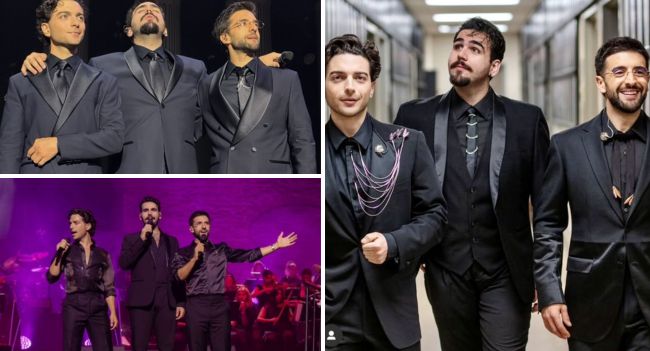
Numerous record labels and music producers across Hollywood and Europe have attempted to recreate the young Pop-Opera boy band formula, yet every single attempt has failed. What makes Il Volo an unshakeable, truly “one-of-a-kind” fortress?
In today’s modern music industry, whenever a successful formula emerges, the market is quickly flooded with replicas. K-Pop produces endless boy groups following the same training model, while Western singing competitions continuously generate artists with near-identical vocal tones.

Yet, since Il Volo broke onto the global scene in 2009, the music industry has failed to create a “second Il Volo” over the past 15 years. The complete absence of competitors in this niche is no coincidence—it stems from the rare, irreplaceable values held by the Italian trio.
1. The “Golden” Combination of 3 Distinct Vocal Ranges When forming classical crossover groups, many producers make the mistake of picking singers with similar vocal tones for easier harmonies. Il Volo took the exact opposite approach: they are a fusion of three completely distinct yet perfectly complementary voices.
-
Gianluca Ginoble: A warm, deep Baritone providing a solid foundation in the lower frequencies.
-
Ignazio Boschetto: A soft, agile Pop Tenor delivering smooth, nuanced transitions.
-
Piero Barone: A Dramatic Tenor with striking power, responsible for the high-note “knockouts.”

Finding three distinct voices is hard enough; finding three teenagers who can blend seamlessly without overpowering each other’s egos is a once-in-a-lifetime miracle.
2. Authentic “Italian DNA” You can train vocal technique, but you cannot “implant” a soul for Italian Opera into someone not born to it. The raw emotion, fiery passion, and delicate Italian diction (Bel Canto) flow naturally in the veins of Piero, Ignazio, and Gianluca. Replica groups from the US or UK are often criticized by experts as feeling “forced” or lacking authentic soul when attempting Italian operatic pieces.
3. Teenage Chemistry Il Volo was not assembled in adulthood through calculated commercial motives. They met at ages 14–15 on the show Ti lascio una canzone, went through their voice changes together, and grew up under the same roof. Fifteen years of brotherhood means they don’t even need to look at each other on stage to know when the other is taking a breath or shifting harmonies. This genuine, unscripted chemistry creates an atmosphere of pure energy and trust—something short-term project bands can never replicate.

Il Volo is not merely a successful group; they are a rare “celestial phenomenon” in the music world—where raw talent, cultural heritage, and lifelong brotherhood aligned at the perfect moment.