He Thought the Rain Would Keep Me Home. He Was Wrong About More Than the Weather.
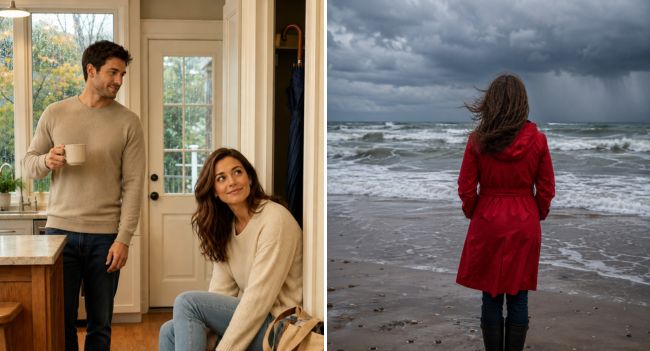
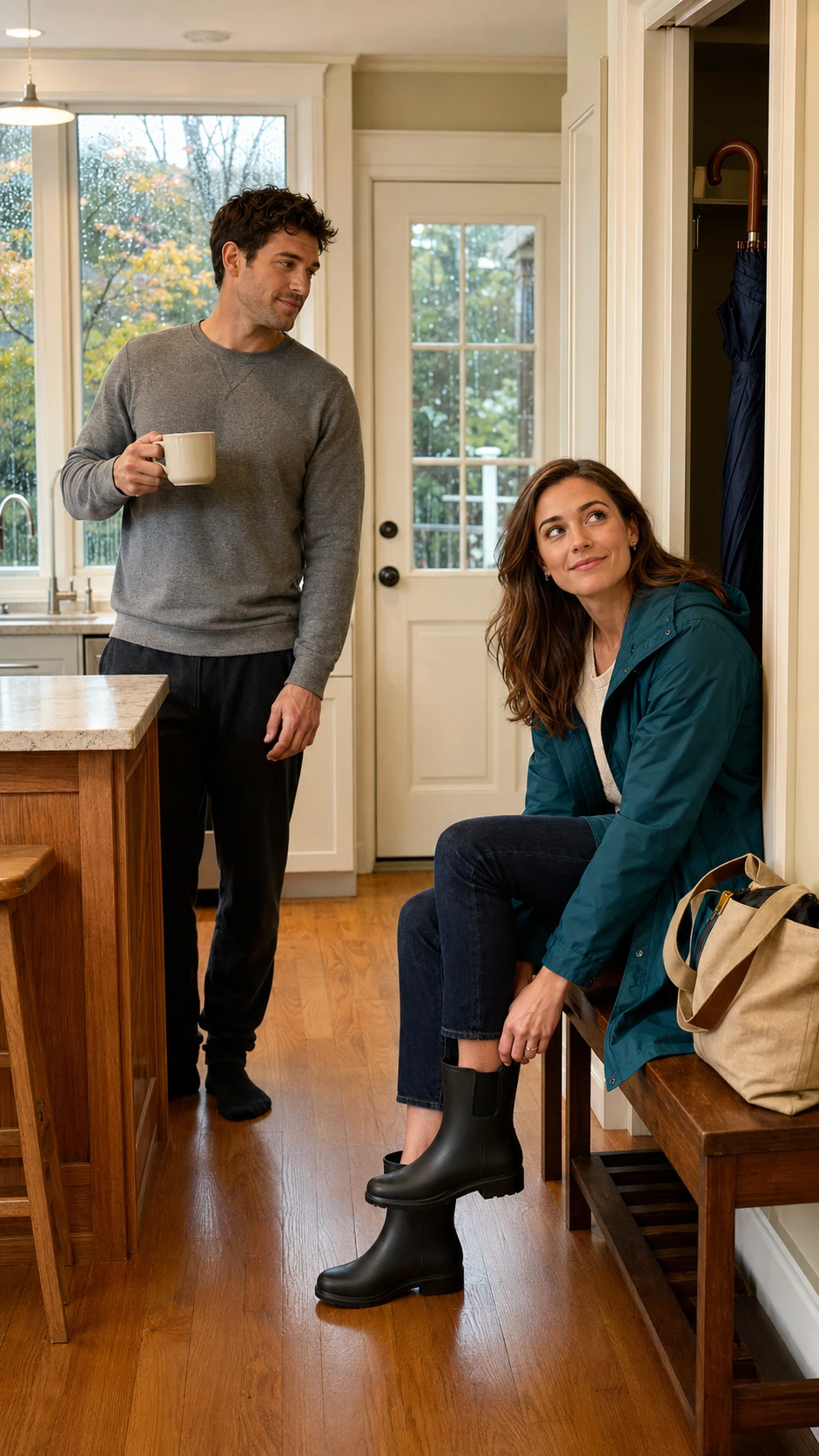
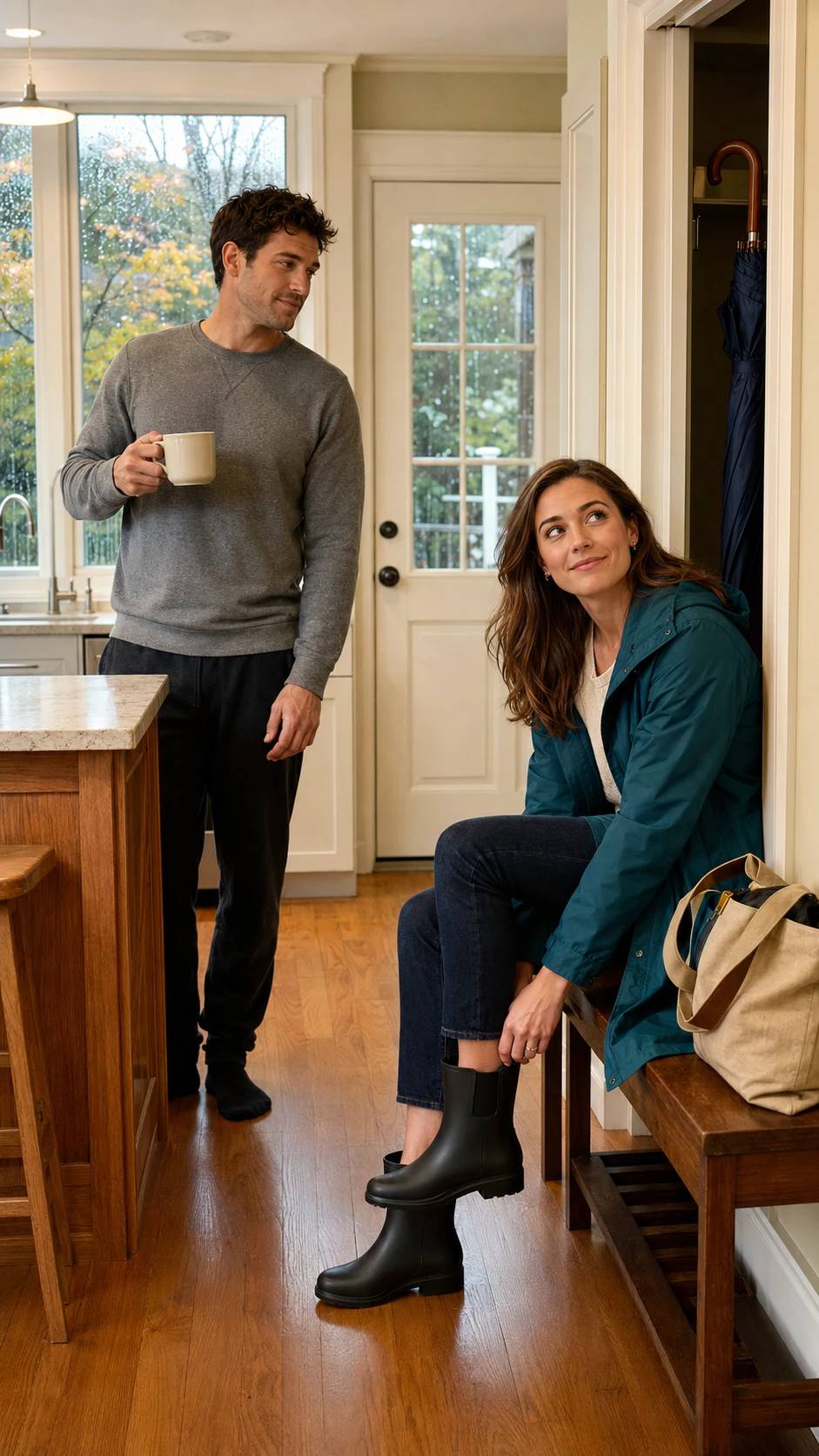
Rain streaked the kitchen windows so hard that Mark glanced outside, then at the boots I was pulling on.
“Guess you’re not going anywhere after all,” he said.
I opened the hall closet and reached for my umbrella.
“Actually, I’m heading to the coast.”
He stared at me as if I had announced I was walking there.
“In this?”
I smiled.
“It’s only rain.”
CHAPTER 1 — The Weather He Expected Me to Obey
For several seconds, Mark didn’t say anything.
He stood beside the kitchen island with one hand wrapped around his coffee mug, wearing the gray sweatshirt he had slept in and the expression of a man waiting for reality to correct itself.
Outside, October rain struck the deck in silver sheets.
The gutters were overflowing near the corner of the garage, and wind shook drops from the maple tree until the whole backyard seemed to be moving.
It was exactly the kind of Sunday Mark loved.
Not because he loved rain.
Because rain gave him permission to do absolutely nothing.
He would make coffee, turn on football before noon, complain about the forecast, and spend the day moving between the couch and the refrigerator.
For years, I had spent those Sundays beside him.
Not because that was what I wanted.
Because somehow his dislike of bad weather had become a household rule.
“Claire,” he said, finally. “The roads are going to be awful.”
“They’re wet.”
“They said there could be standing water.”
“I’ll drive carefully.”
He frowned.
“Why would you even want to go?”
That question almost made me laugh.
Not because it was funny.
Because after twenty-three years of marriage, my husband still thought wanting something required a defense if he didn’t want it too.
I zipped my raincoat.
“There’s a little art market in Rockport.”
“In the rain?”
“It’s indoors.”
“But you’ll have to drive there.”
“Yes.”
He set his mug down.
“You could go next weekend.”
Maybe that was the sentence that changed everything.
Not because it was cruel.
Mark was rarely cruel in ways that would have sounded dramatic if I repeated them to someone else.
He didn’t forbid me from leaving the house.
He didn’t take my keys.
He didn’t shout that I wasn’t allowed to go.
He simply had a way of presenting everything I wanted as something that made more sense later.
Next weekend.
Next month.
When traffic was better.
When it wasn’t so cold.
When it wasn’t so hot.
When parking would be easier.
When we weren’t tired.
When there wasn’t a game on.
When the restaurant wasn’t crowded.
When the forecast improved.
And because I loved him, I had spent years agreeing.
I picked up my canvas tote from the bench by the door.
“I already bought the ticket.”
He blinked.
“You bought a ticket?”
“It was twelve dollars.”
“That’s not what I meant.”
I knew.
What he meant was that I had made a plan without first arranging it around his preferences.
Mark rubbed a hand over his face.
“I just don’t understand why you’d make yourself miserable for an art market.”
There it was again.
His discomfort, translated automatically into mine.
“I don’t think I’ll be miserable.”
“You hate driving in heavy rain.”
“I don’t love it.”
“Exactly.”
I looked at him.
“Not loving something isn’t the same as being unable to do it.”
He stared at me strangely.
There had been a time when that expression would have made me rush to soften the moment.
I would have smiled.
I would have said, “You’re probably right.”
I would have removed my coat.
Then I would have spent the afternoon pretending I had chosen the couch.
Instead, I opened the front door.
Cold air rushed inside.
“Do you want me to bring you anything back?” I asked.
Mark looked toward the rain.
Then at me.
“No.”
“All right.”
I stepped onto the porch.
“Claire.”
I turned.
For half a second, I thought he might surprise me.
Maybe he would say he’d come.
Maybe he would grab his jacket.
Maybe he would laugh at himself and say, “Fine. Let’s go see some art.”
Instead, he said, “Don’t blame me when you’re soaked.”
Something inside me went very still.
“I won’t.”
Then I closed the door behind me.
The rain was colder than I expected.
By the time I reached the car, water had darkened the shoulders of my coat.
I laughed.
Actually laughed.
There was no triumph in it.
No revenge.
I was simply wet.
And alive.
I backed out of the driveway while Mark stood behind the living-room window.
For years, I had interpreted that window as home.
That morning, for the first time, it looked like glass.
The highway north was slower than usual.
Cars threw mist behind them, and my windshield wipers clicked back and forth like a metronome.
Twenty years earlier, I would have spent the drive anxious.
Not about the road.
About proving Mark right.
If I encountered traffic, he had been right.
If parking was difficult, he had been right.
If I got cold, he had been right.
If the coffee at the market was bad, he had been right.
Marriage had somehow turned ordinary inconvenience into evidence against my own desires.
That realization embarrassed me.
Not because Mark had done something enormous.
Because he hadn’t.
No single Sunday had stolen my life.
It had happened twenty minutes at a time.
An hour here.
An afternoon there.
A lunch postponed.
A walk canceled.
A weekend shortened.
A friend I didn’t visit because the interstate might be busy on the way home.
A daughter I told, “Maybe another day,” because her father didn’t feel like driving across town.
A Christmas market I had wanted to see for nine years.
A beach at dawn.
A concert in the park.
A bookstore two towns away.
A hundred small places.
Nothing dramatic enough to mourn individually.
Together, they formed a map of where I had not gone.
The art market was held inside an old brick building near the harbor.
When I arrived, I sat in the car for a moment listening to the rain drum against the roof.
Then I noticed people crossing the parking lot.
Women in rain boots.
Couples under umbrellas.
A father carrying a little girl beneath his coat.
An elderly man in a bright yellow slicker.
Nobody looked miserable.
They just looked wet.
I laughed again.
Inside, the building smelled of coffee, wool coats, and cedar.
Someone had hung strings of warm lights along the exposed beams.
There were handmade bowls, coastal photographs, knitted scarves, paintings, silver jewelry, and tiny carved birds made from driftwood.
I moved slowly.
Nobody rushed me.
Nobody asked how long I planned to stay.
Nobody checked the weather app and suggested leaving early.
At one table, a woman about my age had framed photographs of Maine in winter.
Storm clouds.
Empty beaches.
Black rocks under white waves.
One photograph stopped me.
A woman in a red coat stood alone near the edge of a beach beneath a gray sky.
Her back was turned to the camera.
The wind lifted her coat.
The photograph was called Weather Coming In.
“It looks lonely,” I said.
The photographer smiled.
“People say that.”
She tilted her head.
“I don’t think she is.”
I looked again.
“No?”
“She knows where she is.”
Something about those words followed me for the rest of the afternoon.
I bought the photograph.
It cost more than the market ticket and less than most of the things Mark had purchased over the years without asking whether they made sense.
When I carried it back to my car wrapped in brown paper, the rain had softened.
I could see the harbor through the mist.
I should have gone home.
That was what the old Claire would have done.
The official plan was finished.
The weather remained inconvenient.
Mark would be wondering when I was coming back.
Instead, I drove toward the water.
I parked near a small public beach and walked down the wooden steps.
The ocean was wild.
Wind pushed my umbrella sideways almost immediately, so I closed it and tucked it beneath my arm.
My hair stuck to my cheeks.
Rain soaked through the knees of my jeans.
The waves were enormous and gray-white.
There were three gulls on the sand and no one else.
I stood there laughing like an idiot.
Not because the beach was beautiful despite the weather.
Because it was beautiful because of it.
For twenty-three years, I had allowed someone else to tell me the conditions under which life was worth participating in.
That morning, soaked through and standing alone beside the Atlantic, I finally understood how ridiculous that had been.
My phone buzzed.
MARK.
Are you coming home soon?
I looked at the message.
Then at the ocean.
For years, that question would have pulled me back like a rope.
I typed:
Eventually.
Then I put the phone in my pocket and kept walking.
CHAPTER 2 — The Life We Had Canceled Together
It would be easy to make Mark sound selfish.
Sometimes he was.
So was I.
That was part of what made our marriage difficult to explain.
There had been no single catastrophe.
No secret second family.
No shattered plates.
No neighbors hearing us scream through the walls.
Mark worked hard.
He remembered my birthday.
He changed the oil in my car.
When my mother died, he handled phone calls because I couldn’t speak to anyone without crying.
When our son Ben broke his wrist at fourteen, Mark spent the entire night beside him in the emergency room.
When our daughter Sophie moved into her first apartment, he assembled every piece of furniture she owned while complaining cheerfully about the instructions.
There was love between us.
That was what had kept me confused for so long.
I thought unhappiness required the absence of love.
It doesn’t.
Sometimes unhappiness grows inside love when one person’s comfort becomes more important than the other person’s life.
Mark preferred predictability.
He liked restaurants where he understood the menu.
Hotels where parking was easy.
Vacations where the weather report promised sunshine.
He hated crowds.
He hated detours.
He hated being cold.
He hated waiting in lines.
He hated driving after dark.
At first, I found it almost endearing.
When we were young, I teased him about it.
“You’re eighty years old,” I would say when he wanted to leave a concert before the encore to beat traffic.
He would grin.
“An eighty-year-old who’ll be home before everyone else.”
Then children came.
Life became complicated.
Someone had to consider naps, homework, groceries, soccer practice, weather, bedtimes, and money.
Mark’s caution began to look like responsibility.
I adapted.
It made sense at the time.
The trouble was, the children grew up.
Our responsibilities changed.
My habits didn’t.
I kept asking what Mark wanted before allowing myself to know what I wanted.
One memory returned to me during that first drive home from the coast.
Sophie had been seventeen.
There was a holiday market downtown that she had wanted us to visit.
She had seen photographs of it online—little wooden stalls, hot cider, handmade ornaments, strings of lights across the square.
The Saturday we planned to go, freezing rain appeared in the forecast.
Not even freezing rain during the afternoon.
Possibly freezing rain late that evening.
Mark looked at the weather app.
“No chance.”
Sophie had looked at me.
“What if Mom and I go?”
I remember exactly what happened next.
Mark shrugged.
“You can. I wouldn’t.”
That should have been the end of it.
Instead, I looked at the gray sky.
Then at him.
Then at Sophie.
“Maybe next year.”
Her face changed for only a moment.
“All right.”
Next year she was at college.
We never went.
I had forgotten that afternoon completely until the rainy Sunday at the coast.
That was the frightening part.
I remembered the large disappointments of my life.
I had misplaced the small ones.
There were too many.
When I returned home, Mark was stretched across the couch watching football.
My wet boots squeaked against the hardwood floor.
He looked up.
“You’re drenched.”
“Pretty much.”
“Was it worth it?”
I removed my coat.
“Yes.”
The speed of my answer bothered him.
I could see it.
“Really?”
“Really.”
“What did you even do?”
“I went to the market.”
“And?”
“I bought a photograph.”
“You drove two hours for a photograph?”
“Then I walked on the beach.”
He muted the television.
“In that weather?”
“Yes, Mark. It was raining when I got there too.”
He didn’t smile.
I carried the wrapped frame into the dining room.
He followed me.
“Let me see.”
I removed the paper.
The woman in the red coat appeared between us.
Mark stared.
“How much?”
“Eighty-five dollars.”
His eyebrows rose.
“For that?”
I almost defended it.
I felt the explanation forming automatically.
The photographer made the frame herself.
It was archival paper.
I hadn’t bought anything else.
Then I stopped.
“I liked it.”
Mark studied my face.
“I didn’t say you couldn’t buy it.”
“No.”
“You’re acting like I did.”
“I’m not.”
“You kind of are.”
I leaned the photograph against the wall.
For years, conversations like that had exhausted me because I tried to make Mark understand something he had not experienced.
I would build careful arguments.
Collect examples.
Explain tone.
Explain patterns.
Explain why one sentence felt connected to fifty earlier sentences.
Then he would point out that technically he had not forbidden me from anything.
Technically, he was right.
That Sunday, I didn’t argue.
“I’m going upstairs to change.”
“Claire.”
I stopped.
“Did I do something?”
The question was sincere.
That almost hurt more.
I looked at the man I had married.
Gray beginning at his temples.
Reading glasses resting crooked on his head.
A tiny coffee stain on his sweatshirt.
The familiar face of someone who had shared more than half my adult life.
“No,” I said quietly. “That’s sort of the problem.”
He frowned.
I went upstairs.
That evening, Sophie called.
She lived forty minutes away with her husband, Nate, and their two-year-old daughter, Lily.
I told her about the coast.
“You went alone?” she asked.
“Yes.”
“In today’s weather?”
I smiled.
“You sound like your father.”
“No, I’m impressed.”
Then she laughed.
“Mom, you used to cancel plans if Dad thought the parking lot might be annoying.”
There was no accusation in her voice.
That made it worse.
“You noticed that?”
“Everyone noticed that.”
I sat down on the edge of the bed.
“What do you mean, everyone?”
Sophie became quiet.
“Nothing.”
“Sophie.”
“Mom.”
“Tell me.”
She sighed.
“You always checked with Dad.”
“About plans?”
“About everything.”
I stared toward the window.
Rain still moved across the glass, gentler now.
“I thought I was being considerate.”
“You were.”
The pause that followed was careful.
“Maybe too considerate.”
After we hung up, I remained sitting there for a long time.
Mark was downstairs.
The television audience cheered faintly through the floor.
I had spent years thinking my accommodations were invisible acts of love.
They hadn’t been invisible.
Our children had watched them.
Maybe worse, they had learned from them.
The next weekend, I called Sophie.
“Are you busy Saturday?”
“Morning or afternoon?”
“Most of the day.”
There was a pause.
“Why?”
“Holiday market.”
She laughed so loudly I had to move the phone away from my ear.
“Mom, it’s October.”
“I know. I’m practicing.”
“For December?”
“Exactly.”
“All right.”
“And Sophie?”
“Yeah?”
“If it rains, we’re still going.”
She was quiet for a second.
Then she said, very softly, “Good.”
CHAPTER 3 — The First Time He Had to Stay Home Alone
My changes were so small that I didn’t recognize them as changes at first.
I stopped asking Mark whether he wanted to come before deciding whether I wanted to go.
That was all.
On Tuesday, I met my friend Ellen for lunch.
On Thursday evening, I attended a lecture at the library about coastal conservation.
On Saturday morning, I walked at the botanical garden even though temperatures had dropped into the forties.
Mark was invited to all of it.
He declined all of it.
That was fine.
The difference was that his refusal no longer became mine.
At first, he seemed relieved.
“Have fun,” he would say.
I think he believed I had discovered a hobby phase.
Some women took pottery.
Some joined book clubs.
His wife had apparently developed an interest in leaving the house.
He assumed it would pass.
It didn’t.
The following Sunday was sunny.
Mark woke at nine-thirty and found me in the kitchen filling a thermos.
“Where are you going?”
“Hiking.”
His face brightened slightly.
“The weather’s decent.”
I stared at him.
He didn’t notice the irony.
“Ellen told me about a trail near Camden.”
“How long?”
“Three or four hours.”
“That’s a lot.”
“I know.”
He opened the refrigerator.
“Are you going to be back for dinner?”
“I’m not sure.”
“What does that mean?”
“It means I might stop somewhere afterward.”
“With Ellen?”
“No. She’s visiting her sister. I’m going alone.”
Mark slowly shut the refrigerator.
“You’re doing a four-hour hike alone?”
“There will be people on the trail.”
He studied me.
“Since when do you hike?”
“Since today.”
That afternoon was harder than the rainy beach.
There were steep sections where my thighs burned.
I took the wrong turn once and added nearly a mile.
Halfway up, I wondered whether Mark had been right about this one.
Then I sat on a rock, ate an apple, and realized something important.
I was allowed to dislike parts of an experience and still value the experience.
A difficult drive did not ruin a destination.
Cold hands did not ruin a walk.
A long line did not ruin a concert.
An expensive coffee did not ruin a morning.
Getting lost did not mean I should have stayed home.
For years, Mark had treated enjoyment as something that counted only if nothing inconvenient happened along the way.
I had absorbed the same rule.
It was an impossible standard.
Life was inconvenient.
Children got carsick.
Restaurants lost reservations.
Shoes caused blisters.
Museums closed early.
Flights were delayed.
Weather changed.
People got tired.
If perfection was the requirement for participation, staying home would always win.
At the top of the trail, I could see water beyond miles of orange and red trees.
I took a picture.
Then another.
I almost sent one to Mark.
I stopped.
Not because I was punishing him.
Because I realized I didn’t need him to validate what I was seeing.
I put the phone away.
When I came home, the kitchen was dark.
Mark was eating cereal at the island.
“Cereal?”
He looked irritated.
“I didn’t know when you’d be home.”
There were eggs in the refrigerator.
Soup in the freezer.
Leftovers from Friday.
Mark was fifty-one years old.
I knew all of those things.
I also knew what he meant.
For most of our marriage, if I left for more than a few hours, I planned his absence around him.
I made lunch.
I texted dinner instructions.
I reminded him what was in the refrigerator.
I returned before he became inconvenienced.
“I told you I might stop for dinner.”
“I know.”
He ate another spoonful.
“Where did you go?”
I showed him the photograph from the overlook.
“That’s beautiful,” he said.
“It was.”
“You could’ve waited until next weekend. I might’ve gone.”
The sentence landed differently now.
Months earlier, it would have filled me with hope.
I would have rearranged everything.
“Do you want to hike next weekend?”
He glanced toward the dark windows.
“What’s the weather supposed to be?”
And there it was.
I smiled.
“I don’t know.”
He frowned.
“Well, shouldn’t we check?”
“If you want to go, we’ll check before we leave.”
“And if it rains?”
“I’ll probably still go.”
He stared at me.
“You’re really serious about this.”
“About what?”
“Going places.”
I nearly laughed.
“Yes, Mark.”
“I’m serious about going places.”
The following Saturday, it rained.
Mark did not hike.
I did.
Something shifted after that.
He started noticing every departure.
Not because I was gone constantly.
I wasn’t.
I still worked.
I still bought groceries.
I still watched television some nights.
I still cooked dinners because I enjoyed cooking.
I still sat across from him at the kitchen table and asked about his day.
The marriage had not transformed into war.
That would have been easier for him to understand.
Instead, I simply stopped arranging the edges of my life around his resistance.
He began standing in doorways.
“Where are you going?”
“To lunch.”
“When will you be back?”
“I don’t know.”
“Who are you meeting?”
“Sophie.”
“Why didn’t you tell me?”
“I just did.”
Another week:
“You’re going out again?”
“Yes.”
“I thought we might watch that movie.”
“You didn’t mention it.”
“I shouldn’t have to schedule everything.”
The sentence was so astonishing that I went silent.
Mark seemed to realize it too.
For decades, I had been the one scheduling everything.
Restaurants.
Birthdays.
Family visits.
Weekends.
Holidays.
Doctors.
Dinner with friends.
Trips.
If I didn’t organize something, it generally didn’t happen.
Then he resented being asked.
Now that I was organizing only my own time, he missed being included automatically.
“I’m free tomorrow night,” I said.
He shook his head.
“That’s not the point.”
“What is the point?”
He opened his mouth.
Then closed it.
Neither of us knew how to say it yet.
He missed being the center of decisions he had rarely participated in making.
December arrived cold and wet.
On the first Saturday, Sophie and I went to the holiday market.
It rained.
Of course it did.
Not freezing rain.
Just steady, miserable December drizzle.
Sophie picked me up at eight.
Mark was in the kitchen.
“You’re still going?”
Sophie and I looked at each other.
Then we both started laughing.
Mark’s expression tightened.
“What?”
“Nothing,” I said.
Sophie hugged her father.
“Love you, Dad.”
“Love you too.”
He looked at her coat.
“You two are going to freeze.”
“We’ll buy cider,” Sophie said.
“The parking downtown will be impossible.”
“We’ll park farther away.”
“You hate walking in the cold.”
Sophie smiled.
“Then I’ll complain while I walk.”
Mark looked from his daughter to me.
Something in his face changed.
He had heard his own logic spoken back to him and discovered that it no longer carried authority.
At the market, Sophie bought a wooden ornament shaped like a little house.
We drank cider.
We waited twenty-five minutes for cinnamon pastries.
My gloves got soaked.
Parking was awful.
At one point, wind turned my umbrella inside out and Sophie laughed so hard she had to lean against a lamppost.
It was not a perfect day.
It was one of the best days I had experienced in years.
On the drive home, Sophie rested her head against the passenger window.
“I wish we’d done this when I was seventeen.”
My throat tightened.
“So do I.”
She turned toward me.
“You know I wasn’t mad at you, right?”
“I think maybe you should have been.”
“Mom.”
“I was the adult.”
“So was Dad.”
“Yes.”
We drove another mile.
Then she said something I would remember for a long time.
“You always acted like Dad was the weather.”
I glanced at her.
“What?”
She shrugged.
“You know. Like if Dad didn’t want to go, that was just the condition we had to live around. Like rain.”
I looked through the windshield.
The wipers moved back and forth.
For years, Mark had blamed the weather.
I had never realized that eventually, everyone else had begun treating him like part of the forecast.
CHAPTER 4 — When Regret Finally Left the Couch
Mark began trying in January.
Not dramatically.
That wouldn’t have been him.
One Saturday morning, I came downstairs and found him standing beside the front door in a jacket.
“What are you doing?”
He held up his car keys.
“There’s that bookstore in Brunswick you keep talking about.”
I stared at him.
He looked uncomfortable.
“I thought we could go.”
For a moment, the old instinct rushed through me.
Joy.
Hope.
Gratitude so immediate it embarrassed me.
He wants to go.
He finally wants to go.
Then another thought followed.
It should not feel like winning the lottery when your husband offers to spend an afternoon doing something you enjoy.
Still, I smiled.
“All right.”
We went.
The bookstore was crowded.
Mark didn’t complain.
The café had a thirty-minute wait.
Mark didn’t suggest leaving.
It snowed lightly while we were inside.
He didn’t check the roads every five minutes.
I noticed every effort.
That was the problem.
I noticed them because they had once been so rare.
We had coffee.
We browsed.
He bought a history book.
I bought a novel and a collection of essays.
On the way home, Mark said, “That was nice.”
“It was.”
“We should do things like that more often.”
I turned toward the passenger window.
Trees passed beneath snow.
“We could have.”
Mark tightened his hands on the steering wheel.
“I know.”
It was the first time he said it without defending himself.
That night, we sat in the kitchen after dinner.
The house was quiet.
He looked at the photograph I had bought in October.
Weather Coming In now hung beside the dining-room doorway.
“You really like that picture.”
“Yes.”
“Why?”
I thought about it.
“Because she’s out there.”
“Who?”
“The woman.”
He studied the photograph.
“She looks cold.”
“She probably is.”
“And that’s good?”
“No.”
I smiled slightly.
“It’s just not fatal.”
Mark leaned back.
For several seconds, neither of us spoke.
Then he said, “Did I really keep you from doing that much?”
There are moments in a marriage when you can choose kindness or truth.
For years, I had confused the two.
I looked at him.
“You didn’t keep me from doing anything.”
His shoulders relaxed.
Then I continued.
“You just made not going easier than going.”
He frowned.
“I don’t understand.”
“If I wanted to do something you didn’t want to do, there was always a reason it was inconvenient.”
“Sometimes things are inconvenient.”
“I know.”
“Traffic is real. Weather is real. Money is real.”
“Yes.”
“So I wasn’t making things up.”
“No.”
He leaned forward.
“Then what exactly did I do?”
I folded my hands.
“You treated inconvenience like a veto.”
His expression changed.
“If you didn’t want to drive, we didn’t go.”
“I never said you couldn’t drive.”
“I know.”
“If you wanted to see Sophie, you could see Sophie.”
“I know.”
“If you wanted to go to a market, you could go to a market.”
“I know.”
His frustration grew.
“Then why are you blaming me?”
“I’m not blaming you for every place I didn’t go.”
“Sounds like you are.”
“I’m blaming myself too.”
That stopped him.
I swallowed.
“I kept waiting for you to want my life.”
His face softened.
“Claire.”
“I thought marriage meant we were supposed to want the same things. So whenever you didn’t want something, I assumed my wanting it wasn’t enough.”
Mark looked down at the table.
“I didn’t know.”
“I know.”
“Why didn’t you tell me?”
I laughed once.
It was not a happy sound.
“I did.”
He looked up.
“When?”
“Do you remember the botanical garden Christmas lights?”
He frowned.
“Sort of.”
“I asked for six years.”
Mark opened his mouth.
I continued.
“The outdoor Shakespeare festival?”
“I don’t—”
“The ferry to the islands when Ben was twelve?”
“It was supposed to storm.”
“It didn’t.”
“Well, the forecast—”
“The concert in Boston for our twentieth anniversary?”
“Claire, those tickets were ridiculous.”
“The Sunday brunch Sophie invited us to after Lily was born?”
“You know I hate driving into the city.”
“I know.”
Silence settled over the table.
I wasn’t angry.
That surprised me.
A year earlier, listing those moments might have become an argument.
Now they sounded like entries in an old ledger I no longer needed balanced.
Mark rubbed his thumb against the edge of the table.
“You should’ve gone without me.”
“Yes.”
The answer startled him.
Then I said, “I should have.”
He looked toward the photograph.
“So what happens now?”
I knew what he was really asking.
Can I fix it?
Can we go back?
Is this phase almost finished?
I answered the only part I understood.
“Now I go.”
For several weeks, Mark came with me more often.
A movie he normally would have waited to stream.
Dinner at a small Thai restaurant where he complained once about parking and then caught himself.
A winter walk along the river.
Coffee with Sophie and Nate.
An afternoon at a museum.
He tried.
I need to say that clearly.
He tried.
And I enjoyed some of those days.
That made everything harder.
Because I had imagined for years that if Mark ever changed, my feelings would return automatically.
They didn’t.
Sometimes we would be sitting together somewhere I had once begged him to visit, and I would look at him and feel tenderness.
History.
Affection.
Gratitude.
But not the desperate hope I used to carry.
That version of love had exhausted itself while waiting.
Mark noticed.
One evening after dinner, he said, “I’m doing everything you wanted.”
I was rinsing plates.
“I know.”
“And you’re still unhappy.”
I turned off the faucet.
“I’m not unhappy.”
“That’s worse.”
I looked at him.
He stood on the other side of the kitchen holding a dish towel.
His face looked tired.
“You’re happier,” he said.
“Yes.”
“And it has almost nothing to do with me.”
There was nothing safe to say.
So I said nothing.
Mark looked away.
For the first time, I understood what regret actually looked like.
It was not a man sobbing on his knees.
It was a husband standing in an ordinary kitchen, finally realizing that the woman he loved had learned to build good days without waiting for him to participate.
CHAPTER 5 — The Sunday He Finally Came Into the Rain
Spring arrived slowly.
Gray mornings.
Cold rain.
Mud beside the driveway.
Then suddenly there were daffodils near the porch and tiny green leaves on the maple tree.
My life had become fuller without becoming extraordinary.
That mattered to me.
I hadn’t transformed into another person.
I didn’t quit my job.
I didn’t sell the house and move to Paris.
I didn’t suddenly run marathons or climb mountains.
I simply started going.
Lunch with Ellen.
Markets with Sophie.
Walks alone.
A pottery class on Wednesday nights.
The library.
The coast.
Sometimes Mark came.
Sometimes he didn’t.
We became two adults making actual choices instead of one adult deciding what seemed sensible and another adapting around him.
You might think that would save a marriage.
Maybe it saves some.
For us, it revealed what remained after accommodation was removed.
One Sunday in April, rain hit the windows almost exactly as it had the morning everything changed.
I stood in the kitchen making coffee.
Mark came downstairs.
He looked outside.
“Bad one.”
“Looks like it.”
“What are you doing today?”
“Coast.”
He smiled faintly.
“Of course.”
I smiled too.
There was no sharpness between us.
That was another change.
Fewer fights.
More truth.
I poured coffee into a travel mug.
Mark leaned against the counter.
“Claire?”
“Yeah?”
“Can I come?”
My hand stopped.
It would have been easy to say yes.
Part of me wanted to.
Another part of me needed to know why.
“Do you want to?”
He looked toward the rain.
“No.”
I laughed.
To my surprise, he did too.
Then his face grew serious.
“But I want to be with you.”
There it was.
Months earlier, those words might have healed everything.
Instead, they broke my heart gently.
Because they were sincere.
And late.
I rested my hands on the counter.
“Mark.”
“I know.”
“No, let me finish.”
He nodded.
“I spent years trying to get you to want the things I wanted.”
“I know.”
“And now you’re trying to want them because you’re scared of losing me.”
His eyes dropped.
“Maybe.”
“That isn’t fair to either of us.”
He looked up.
“What am I supposed to do?”
It was the first time he asked without irritation.
Without defense.
Without treating my answer as a problem he needed to defeat.
“I don’t know.”
“You’ve known what you wanted for months.”
“Yes.”
“What do you want now?”
I looked around our kitchen.
The fruit bowl I had bought in Vermont.
Lily’s drawing still held to the refrigerator by a magnet.
Mark’s coffee mug.
The table where Sophie had done homework.
The cabinet door Ben had broken with a baseball when he was eleven.
A whole marriage lived inside ordinary objects.
“I want to stop feeling like every good thing between us has to be rescued.”
Mark closed his eyes briefly.
“Is that what you think I’m doing?”
“Yes.”
He nodded.
Rain tapped against the windows.
Then he said, “I’m afraid if I stop trying, you’ll leave.”
The truth of it sat between us.
I swallowed.
“Mark, I might leave even if you keep trying.”
His face crumpled for only a second.
Then he recovered.
“Are you seeing someone?”
“No.”
“Do you want to?”
“No.”
“Then why?”
Because sometimes a marriage does not end because another love begins.
Sometimes it ends because one person finally becomes visible to herself.
“I don’t know if I can go back to loving you the way I did.”
Mark stared at me.
“You love me.”
“Yes.”
It was the truth.
Just not the truth he needed.
“I love you,” I said again. “But I don’t know if I want to keep being married to you.”
He turned away.
For several moments, he stood with both hands on the counter.
Then he said, “I thought we were getting better.”
“So did I.”
“That doesn’t make any sense.”
“It does to me.”
He faced me.
“Explain it.”
I took a slow breath.
“I’m not angry enough anymore to keep fighting for what I wanted us to be.”
He stared at me.
That was the sentence that finally frightened him.
Not divorce.
Not another man.
Not my plans.
My absence of anger.
For years, Mark had interpreted arguments as evidence that something was wrong.
He had never understood they were also evidence that I still believed something could be repaired.
Now there was no argument.
Only sadness.
And clarity.
He sat at the table.
“Are you leaving today?”
The question was so vulnerable that I almost cried.
“No.”
“I mean leaving me.”
“Not today.”
He nodded.
I put my travel mug into my bag.
“I still want to go to the coast.”
“I know.”
I hesitated.
“You can come if you want.”
Mark looked toward the rain again.
Then he stood.
“Give me five minutes.”
I expected him to change his mind.
He didn’t.
He came downstairs wearing hiking shoes, his old navy raincoat, and a baseball cap.
“You don’t have proper boots,” I said.
“I’ll survive.”
We drove north.
The highway was messy.
At one point, traffic slowed because water had pooled across a lane.
Mark gripped the door handle.
I noticed.
He noticed me noticing.
Then he laughed quietly.
“Don’t say it.”
“I wasn’t going to.”
“Yes, you were.”
“I really wasn’t.”
“You were thinking it.”
“Maybe.”
He shook his head.
“Twenty years of me acting like rainwater was lava.”
“Twenty-three.”
“Ouch.”
We stopped for coffee.
The line was long.
Mark waited.
We reached the beach near noon.
Wind came straight off the water.
Rain blew sideways.
The beach was almost empty.
Mark stepped from the car and immediately pulled his hood tighter.
“This is horrible.”
I burst out laughing.
He started laughing too.
“I’m serious,” he said. “This is objectively terrible.”
“You can stay in the car.”
“No.”
“You don’t have to prove anything.”
“I know.”
We walked.
At first, Mark stayed beside me.
Then I drifted closer to the water.
He followed.
A wave came farther up the beach than expected and soaked both of his shoes.
He shouted something I couldn’t hear over the wind.
I laughed so hard my stomach hurt.
He looked at me.
And suddenly he stopped laughing.
“What?”
He shook his head.
“Nothing.”
“Mark.”
He looked toward the ocean.
“I haven’t heard you laugh like that in years.”
The rain ran down his face.
I didn’t know whether some of it was tears.
Neither of us mentioned it.
We kept walking.
After twenty minutes, we sat beneath the shallow shelter of a rocky outcrop.
Mark removed one shoe and poured water from it.
“This may be the worst Sunday activity you’ve ever chosen.”
I laughed.
“Probably.”
He smiled.
Then his expression changed.
“I wish I’d come sooner.”
I knew he didn’t mean that morning.
“So do I.”
“I thought you were always asking me to do things because you needed me there.”
“Sometimes I did.”
“And sometimes?”
“I wanted you there.”
“That’s different?”
“Yes.”
He nodded slowly.
“I made you responsible for convincing me.”
I looked at him.
That was as close as Mark had ever come to naming the problem himself.
“Yes.”
He stared at the wet sand between his shoes.
“You’d say, ‘Let’s go,’ and I’d tell you why it was annoying.”
“Yes.”
“And then you’d have to sell it to me.”
“Yes.”
“And if you couldn’t make it sound convenient enough, we stayed home.”
I swallowed.
“Yes.”
He rubbed both hands over his face.
“God.”
There was no satisfaction in hearing him understand.
Only grief.
He turned toward me.
“I thought I was practical.”
“You were.”
“That’s not a compliment.”
“It isn’t an insult either.”
He looked confused.
I continued.
“There’s nothing wrong with liking home.”
“Then what was wrong?”
“You made home the price of being with you.”
He looked away.
The ocean pounded the shore.
A gull flew low through the rain.
Mark’s voice was almost lost beneath the wind.
“I’m sorry.”
“I know.”
“No.”
He looked at me.
“I’m sorry for every time I made you feel stupid for wanting something.”
My eyes filled.
“I’m sorry I waited for permission you weren’t actually responsible for giving.”
For a while, we said nothing.
There was no dramatic reconciliation.
No promise.
No kiss in the rain.
Just two middle-aged people sitting beside an ocean, finally honest about the years behind them.
And maybe that was more meaningful.
On the drive home, Mark asked, “Do you think there’s any chance?”
I knew what he meant.
I took my time answering.
“I think there’s a chance we can become people who are honest with each other.”
He nodded.
“That wasn’t my question.”
“I know.”
Another mile passed.
“I can’t promise the answer you want.”
His jaw tightened, but he didn’t argue.
“All right.”
That was new too.
CONCLUSION — It Was Never Really About the Rain
We separated in June.
There was no explosive ending.
No one cheated.
No one emptied a bank account.
No one screamed in the driveway.
Mark rented a small townhouse fifteen minutes away.
I remained in the house for the time being.
We divided furniture carefully.
He took the leather chair he loved.
I kept the dining table.
He took half the books.
I kept Weather Coming In.
When Sophie learned we were separating, she cried.
So did Ben.
So did I.
There is no version of ending a twenty-three-year marriage that doesn’t contain grief when there was real love inside it.
But our children did not ask me to stay.
That surprised me.
One night Sophie sat with me on the porch after Lily had fallen asleep upstairs.
“Are you okay?” she asked.
“Sometimes.”
“Do you regret it?”
I thought about the question.
“No.”
She nodded.
Then she said, “Dad’s different.”
“I know.”
“He goes places now.”
I smiled.
“Good.”
“He took Ben to that baseball game in the rain last weekend.”
I laughed.
“No.”
“He bought a poncho.”
“That’s serious growth.”
Sophie smiled.
Then her eyes became sad.
“Does it bother you that he’s doing everything now?”
I looked through the screen toward the dark yard.
Once, the answer would have been yes.
It would have felt like injustice.
Why couldn’t he have changed when I was still waiting?
Why couldn’t he have listened when the cost of listening was smaller?
But healing had changed the question.
“No,” I said. “I’m glad he learned.”
“Even if somebody else gets the better version of him someday?”
That one hurt.
I didn’t pretend otherwise.
“Even then.”
Sophie rested her head against my shoulder.
“Why?”
“Because loving someone for twenty-three years doesn’t mean I need him to be miserable for the next twenty-three.”
Summer came.
Then autumn.
The first October Sunday that brought heavy rain woke me before seven.
I lay in bed listening to it.
For a moment, memory was so strong I could almost hear Mark downstairs making coffee.
Then I remembered.
Different life.
Different Sunday.
I got up.
I pulled on jeans.
Rain boots.
The red waterproof coat Sophie had given me for my birthday.
In the kitchen, I made coffee and looked at Weather Coming In.
The woman in the photograph no longer seemed mysterious to me.
She still looked small against the landscape.
But she did not look lonely.
The photographer had been right.
She knew where she was.
My phone buzzed.
A message from Mark.
Weather’s awful.
A second message appeared.
Thought you’d probably love it.
I smiled.
Then another.
Drive safe if you’re heading out.
No question about where.
No suggestion that I stay home.
No assumption that my plans had disappeared because clouds arrived.
I typed:
I will.
Then I hesitated.
You too.
A few seconds later, he sent a photograph.
His hiking boots.
I laughed.
Where are you going?
His reply came almost immediately.
Ben talked me into some trail that is apparently “better in the rain.” This feels like a family conspiracy.
I smiled.
There was warmth in my chest.
Not longing.
Not regret.
Something gentler.
We had failed at being husband and wife.
Maybe we could still succeed at becoming two people who had learned something important from the failure.
I put my phone away and grabbed my umbrella.
My plan was simple.
Drive north.
Coffee at the little place near the harbor.
Walk the beach.
Maybe visit the art market if it was open.
Maybe keep driving if something farther up the road caught my attention.
No schedule.
No guarantee of good weather.
No promise that parking would be easy.
When I stepped outside, rain immediately struck the hood of my coat.
Wind pushed the umbrella backward.
My jeans were wet before I reached the car.
I laughed.
A year earlier, I might have called the day ruined before it began.
Now I understood something Mark and I had both taken far too long to learn.
A good life is not a life without inconvenience.
It is a life large enough to include it.
There would always be rain.
Traffic.
Cold mornings.
Long lines.
Wrong turns.
People who disappointed me.
Plans that failed.
Shoes that got wet.
Days that looked easier from the couch.
For years, I had thought courage belonged to people who survived enormous things.
I knew better now.
Sometimes courage was a woman standing in her own hallway with an umbrella in her hand while the person she loved gave her ten perfectly reasonable reasons to stay.
Sometimes freedom was realizing he wasn’t wrong about the rain.
He was simply wrong about what the rain should decide.
I started the car.
The windshield disappeared beneath water.
The wipers cleared it.
Then the rain covered it again.
Clear.
Blurred.
Clear.
Blurred.
I backed slowly out of the driveway.
There was no one standing at the window this time.
No one asking where I was going.
No one waiting for me to return.
I thought that might feel lonely.
Instead, it felt peaceful.
I drove toward the coast.
And somewhere between home and the ocean, with rain striking the windshield and the road opening ahead of me, I finally understood what those lost years had been trying to teach me.
He had spent years convincing me inconvenience was a reason not to live.
I no longer needed perfect weather to prove him wrong.