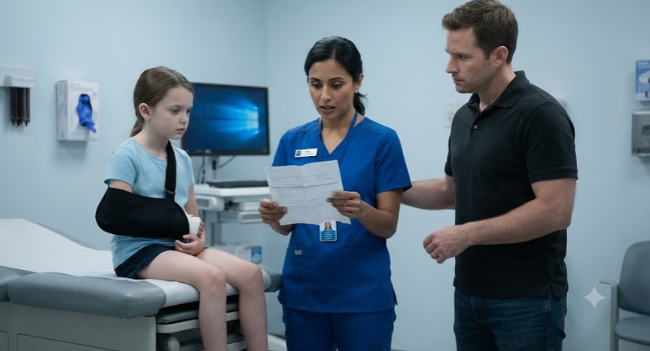
Maya unfolded the registration form slowly.
Her eyes stopped halfway down the page.
Then she looked at Nora.
“Sweetheart, did you tell Claire this is how you hurt your arm?”
Nora shook her head.
Maya turned the paper toward me.
Under “Mechanism of Injury,” Claire had written:
Fell while playing at home. Parent present. No significant trauma.
I read it twice.
Nora had not been home.
I had not been present.
And Claire knew both things.
“What else did she tell you to say?” Maya asked.
Nora stared at the floor.
“That I fell off my bed.”
My stomach dropped.
Maya didn’t react dramatically. She simply placed the form on the counter instead of returning it to me.
“Did you fall off your bed?”
“No.”
“Where did you fall?”
“At Claire’s work.”
“And what did you fall from?”
“The stool.”
Maya documented every answer.
Then she asked when the fall happened.
“After nine.”
I checked my phone.
It was nearly four in the afternoon.
My daughter had been sitting with an increasingly painful arm for almost seven hours.
The X-ray technician came for her before I could ask anything else.
I followed Nora down the hallway.
While we waited outside radiology, Claire called.
I declined it.
She called again.
Then another message appeared.
Bring that form back. It contains clinic information.
I took a screenshot.
A minute later another arrived.
You are seriously overreacting. Nora is fine.
I screenshotted that too.
Nora returned from the X-ray looking exhausted.
Twenty minutes later, the physician came into the room.
“It’s fractured.”
Everything inside me went still.
Not a bruise.
Not a minor sprain.
A fracture.
The doctor explained what needed to happen next, and Maya began arranging the appropriate care.
I barely heard the first few sentences.
All I could think about was Claire dragging Nora toward her clinic while saying she could bandage the arm in five minutes.
She was not guessing anymore.
She had already known Nora had fallen hard enough that she couldn’t comfortably move her wrist.
And instead of calling me, she had waited until her schedule had room.
I stepped into the hallway and called Claire.
She answered immediately.
“Finally.”
“Nora’s arm is fractured.”
Silence.
Then:
“Well, obviously I didn’t know that.”
“You didn’t know because you didn’t have her properly evaluated.”
“I was going to.”
“Seven hours later?”
“She could move her fingers.”
I closed my eyes.
“You also wrote that she fell at home.”
Another silence.
This one lasted longer.
Claire finally said, “It was easier for the paperwork.”
“Easier for whom?”
“Please don’t start.”
I looked through the examination-room window at Nora.
She was watching me.
So I stopped arguing.
“I’m not bringing the form back.”
Claire’s voice sharpened.
“That document belongs to my clinic.”
“No. A copy of it is staying with us.”
She hung up.
When I returned to the room, Maya was sitting beside Nora.
My daughter looked frightened.
“I’m sorry,” she said.
“For what?”
“For getting Claire in trouble.”
Those words hit me harder than the diagnosis.
I sat beside her.
“You didn’t get anybody in trouble.”
“But she said if people found out I was alone in the room, she could lose her job.”
There it was.
The reason for the false story.
Claire had not been protecting Nora.
She had been protecting herself.
I asked Nora exactly what happened that morning, from the moment they left home.
This time, she told me everything.
Claire had received a call shortly after breakfast because someone at the clinic couldn’t come in.
Instead of calling me, our babysitter, or anyone else, she took Nora with her.
She told Nora she would only be there briefly.
Then she put her in an unused consultation room with a tablet and told her not to come into the hallway while clients were present.
Hours passed.
Nora became hungry.
She went looking for the snack bag Claire had brought.
That was when she climbed onto the rolling stool.
After the fall, she cried loudly enough that someone eventually came into the room.
Claire appeared moments later.
But according to Nora, Claire’s first question wasn’t whether she was hurt.
It was whether anyone had seen her fall.
I felt sick.
“Who came into the room?”
Nora didn’t know her name.
“A lady wearing blue.”
Maya glanced at me.
“Staff?”
Nora nodded.
“She helped me stand up.”
That meant there might be a witness.
And possibly something else.
I asked whether Claire’s clinic had cameras.
Maya told me not to confront anyone or attempt to obtain anything myself. She documented what Nora had said and explained the next steps appropriate to the situation.
I called the clinic only to request that any relevant records or footage from that day be preserved.
I did not accuse anyone.
I gave the approximate time.
Then I took Nora home with me.
Claire wasn’t there.
Her car was gone.
That evening, she sent increasingly angry messages.
First she said I had misunderstood everything.
Then she said Nora was exaggerating.
Then she said I was destroying our marriage over “one stressful afternoon.”
I saved every message.
At 8:12, someone from the clinic called me.
It was a woman named Elena.
She asked whether Nora was okay.
I told her about the fracture.
Elena went quiet.
Then she said:
“I’m the person who found her after she fell.”
I sat down.
Elena said she had heard something hit the floor and found Nora crying beside the rolling stool.
She immediately went for Claire.
But what she remembered most was Claire’s reaction.
“She seemed more worried that Nora had been seen in the clinic than about the fall.”
Elena said she had suggested taking Nora for an X-ray.
Claire refused.
She told Elena she would handle it.
Then Elena said something else.
“There are cameras in that hallway.”
The following morning, Claire returned home.
She walked into the kitchen looking exhausted.
“We need to fix this before it becomes something it isn’t.”
I looked at her.
“What is it, then?”
“A mistake.”
“A child broke her arm while you left her alone at your workplace. You prevented her from calling me, delayed getting her evaluated, and wrote a false account of where it happened.”
Claire’s face hardened.
“You’re choosing an eight-year-old’s version over your wife?”
I stared at her.
That question ended whatever uncertainty I still had.
“This isn’t Nora versus you.”
I placed copies of the messages and registration form on the table.
“This is what Nora said compared with what the evidence says.”
Claire looked at the papers.
Then she asked the question that confirmed exactly what she was worried about.
“Did you get the camera footage?”
Not:
How is Nora?
Not:
Is she still hurting?
The footage.
I didn’t answer.
Claire understood anyway.
She began explaining rapidly.
She said she had panicked.
She said the clinic had strict policies.
She said she could have faced professional consequences for bringing Nora into a patient area.
She said she had only changed the location on the form because she thought the injury was minor.
Then she started crying.
For months, I had believed marrying Claire meant giving Nora another adult who would protect her.
Instead, my daughter had spent an entire morning learning that an adult’s reputation could matter more than her pain.
I could not undo that.
But I could make sure she never learned it twice.
I told Claire to stay somewhere else while I decided what came next.
She accused me of throwing away our marriage.
I thought about Nora whispering in the car that she had begged me not to leave her alone with Claire that morning.
“No,” I said.
“I’m listening to my daughter before she has to beg me again.”
Weeks later, after Nora’s arm had begun healing, she found the original parking receipt and the copy of Claire’s registration form in the folder where I had kept everything.
She looked at me.
“You kept it.”
“Of course.”
She smiled.
Then she asked why.
I told her the truth.
“Because when you told me something mattered, I should have listened the first time.”
Nora leaned against me carefully.
And that was the part I remembered most.
Not the clinic.
Not the form.
Not even the fracture.
It was realizing that protecting my daughter did not begin when I stepped between her and Claire.
It began when I finally believed what she had been trying to tell me all along.