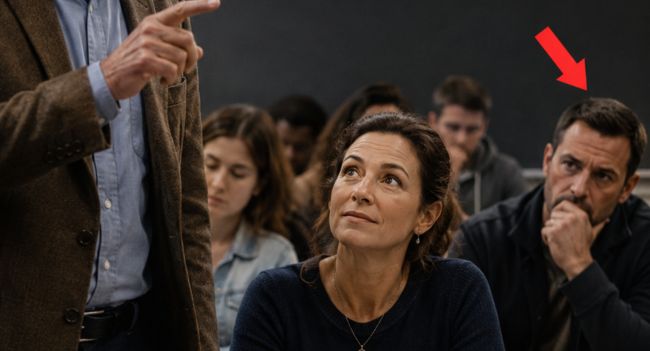
After Daniel discovered I was in school, I expected him to criticize the decision openly. Instead, he began asking quiet questions through Emma, while I built a routine that belonged entirely to me. Tuesdays and Thursdays were lecture nights, Saturday mornings were for reading, and the dining table slowly disappeared beneath textbooks, highlighters, and research articles. The chair I had always thought of as Daniel’s became simply another place to stack library books.
My grades kept rising. A 94 became a 96, then another paper came back even higher, and Professor Reynolds began pushing me to trust my ideas instead of apologizing for them. In class one evening, he asked why people resisted changing roles inside families. I raised my hand and said sometimes everyone benefits from a person remaining the caretaker, peacemaker, or dependable one—except the person trapped inside that role.
The room went quiet before Professor Reynolds said, “That’s exactly the tension.” Sitting there, I knew I was talking about myself. For years, Daniel had not needed to order me around because I had become extremely skilled at anticipating what would make life easier for him. I remembered birthdays, appointments, family obligations, bills, dinners, and emotional problems while treating my own desires as things that could always wait.
Meanwhile, Daniel seemed increasingly unsettled by the fact that I was doing well without him. When he stopped by the house for some winter clothes and saw my books spread across the dining table, he stared at them as if they belonged to someone else. “You really like this, don’t you?” he asked. When I said yes, I saw something in his face that looked less like disapproval and more like confusion.
Soon afterward he invited me to coffee. He apologized for the way he had spoken about school, insisting he had never meant to tell me I couldn’t do it; he had only thought he was being practical. I told him that was exactly the problem—his practicality had always been given more authority than my hope. For once, instead of arguing, Daniel sat quietly and listened.
Then he asked what grade I had in the class. When I told him I had a 97, he actually laughed in disbelief and said, “Claire, that’s incredible.” Years earlier, hearing pride in his voice would have made me glow for days. This time I simply said, “I worked for it.”
That answer changed the air between us. Daniel was impressed by what I had accomplished, but I realized I no longer needed his surprise to validate it. Before we left the coffee shop, he told me he would like to see the campus sometime. I brushed it off and joked that Riverside Community College was hardly Yale.
I thought the subject was finished until Emma called again. Daniel had been asking more questions—what building I studied in, which evenings I attended, even whether my papers were about our marriage. She told him to stop interrogating her, but Daniel had already learned enough. Two weeks later, on a rainy Thursday evening, the back door of Room H-214 opened while Professor Reynolds was speaking.
I barely looked up at first because students occasionally came in late. Then Jasmine, the nursing student beside me, leaned toward my desk and whispered, “Is that your husband?” My stomach tightened before I turned around. Daniel was standing in the last row, rain on his navy jacket, watching me.
For the first time all semester, I suddenly wondered whether I looked ridiculous sitting there among younger students. I wondered whether I had spoken too often, whether my reading glasses made me look old, whether Daniel would find some reason to believe the professor was being easy on me. His presence brought back every doubt I thought I had finally escaped. Then Professor Reynolds moved to the front of the room and began talking about what separated an average student from a truly strong one.
I had no idea that in a few seconds, he was going to say my name.