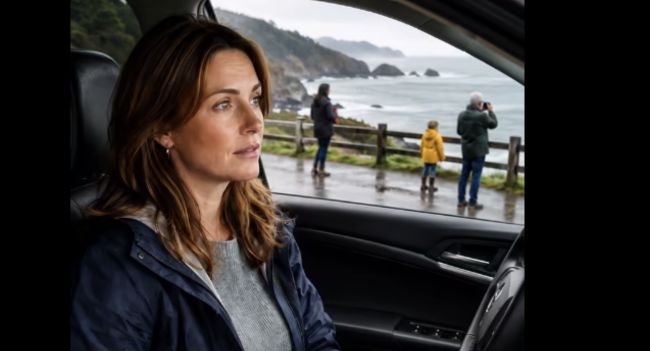
You could see the ocean from the highway,” my husband said.
“I know.”
“Then why did you stop?”
I looked through the windshield at the gray-blue Oregon coast stretching below me. Waves crashed against the black rocks, sending white spray into the air. My coffee had gone lukewarm between my hands, but I didn’t care.
“Because I wanted to.”
There was a pause on the phone.
David sounded almost confused.
“For an hour?”
I stared at the water.
“Yes. For an hour.”
That conversation probably wouldn’t have sounded important to anyone else.
But after twenty-seven years of marriage, it felt enormous.
Because for most of my adult life, I had never believed wanting something was a good enough reason to do it.
David had never told me that directly.
He had never said, “Rachel, you aren’t allowed to stop.”
He had simply spent twenty-seven years explaining why stopping didn’t make sense.
When we were younger, I actually loved that about him.
My father had been the kind of man who forgot appointments, misplaced bills, and occasionally discovered that the car was nearly empty only after we were already late.
David was the opposite.
He knew where everything was.
He planned routes before we left the house.
He checked the weather.
He calculated driving times.
He remembered reservations.
He kept jumper cables in the trunk and extra batteries in the kitchen drawer.
At twenty-four, that kind of certainty felt like safety.
I didn’t understand that certainty could slowly become something else.
On our tenth anniversary, we were driving toward a hiking trail when I noticed a roadside stand selling strawberries.
There were handwritten signs, little wooden baskets, and an older woman sitting beneath a faded umbrella.
“Can we stop?” I asked.
David glanced at the clock.
“We can get strawberries at the grocery store.”
“I know. These just look good.”
“We’re already going to be cutting it close if we want to finish the hike before dinner.”
He kept driving.
I watched the strawberry stand disappear in the side mirror.
I wasn’t angry.
Why would I be?
They were only strawberries.
That became the pattern of our marriage.
They were only strawberries.
It was only a coffee shop.
It was only a scenic road.
It was only an antique store.
It was only a little beach.
It was only twenty minutes.
It was only something I wanted.
David always had a practical reason to keep going.
Eventually, I learned to have practical reasons too.
If I wanted to go to a bookstore, I said I needed a birthday present.
If I wanted to take a walk, I said exercise was good for me.
If I wanted to visit our daughter Emma in Portland, I found something I needed to drop off.
If I wanted coffee somewhere other than our kitchen, I arranged to meet someone.
I became very good at defending my own desires before anyone had even challenged them.
What I almost never said was the simplest thing.
Because I want to.
Our children noticed.
I didn’t realize that until years later.
Emma and I were having lunch together when she started talking about family road trips.
She laughed about how her brother Luke used to fall asleep before we reached the freeway. Then her expression changed.
“You know what I remember most?”
“What?”
“All those places you wanted to stop.”
I smiled.
“What places?”
“Everything. Roadside stands. Antique stores. Beaches. Those weird tourist attractions with giant statues.”
She looked down at her plate.
“Mom always wanted to stop. Dad never did.”
I didn’t know what to say.
For years, I had told myself those moments were too small to matter.
Then my daughter described an entire childhood through them.
By then, Emma was living in Portland and Luke was in Eugene.
The house became quiet.
For years, David and I had organized ourselves around school schedules, soccer practices, homework, college applications, illnesses, holidays, and family obligations.
Once the children were gone, there was nowhere for our marriage to hide.
David talked about work.
He checked his phone.
He followed his routines.
And I began noticing how much of my own life was built around making his easier.
I worked at the library.
David had always described my schedule as flexible.
At first, I agreed.
So when the plumber needed someone home, I changed my hours.
When his mother needed help, I went.
When there was an appointment, I rearranged my day.
When one of the children needed something, I handled it.
David’s work had meetings and deadlines.
Mine was flexible.
His time was fixed.
Mine could move.
For years, I thought that was what partnership looked like.
Then one evening, I made dinner.
Salmon.
Roasted potatoes.
Asparagus.
David said he would be home, so I timed everything for seven.
At seven-fifteen, I covered the salmon.
At seven-thirty, I reheated the potatoes.
At seven-forty, he walked through the door.
He looked at the table.
“Oh,” he said. “I already ate.”
I stared at him.
“What?”
“I grabbed something with a coworker.”
“You could have texted me.”
David loosened his tie.
“Rachel, it’s dinner.”
“It’s not the food.”
“Then what is it?”
“I waited.”
He looked genuinely puzzled.
“I didn’t ask you to.”
I remember the silence after that sentence more clearly than anything else.
Because he was right.
He hadn’t asked.
He had never ordered me to arrange my life around him.
He had never demanded that I wait beside a cooling dinner.
He had never written down a rule saying his schedule mattered more than mine.
I had simply learned it.
And he had become comfortable with it.
I cried on the kitchen floor after he went upstairs.
The next morning, I woke up before him.
And I made his coffee.
That was the part I would think about later.
Not that I cried.
That I made the coffee.
A few months afterward, I finally asked him something I had been afraid to ask.
“Are you happy?”
We were in bed.
David was checking something on his phone.
“Yeah.”
“With me?”
He sighed.
Not angrily.
Almost tiredly.
“Rachel, I have an early meeting tomorrow. Can we not start one of these conversations at ten-thirty at night?”
One of these conversations.
I looked at him for several seconds.
Then I got out of bed.
I took my pillow into the guest room.
David assumed I needed space.
I let him believe that.
A week later, I suggested counseling.
“We’re too busy right now.”
A month later, I suggested it again.
“Therapists always need somebody to be the villain.”
The third time, he stared at me.
“Why do you keep acting like our marriage is broken?”
After that, I stopped asking.
But something else happened too.
I stopped waiting.
If David wasn’t home for dinner, I ate.
If he changed his plans, I didn’t automatically change mine.
I stopped saving television shows because we were supposedly going to watch them together.
I stopped reminding him to call Emma.
I stopped making excuses for why Luke hadn’t heard from him.
I stopped asking what time he would be home.
And slowly, almost invisibly, I started reclaiming small pieces of my life.
I joined a Saturday morning walking group.
I spent an afternoon in a bookstore without buying anything.
I ordered coffee even though there was perfectly good coffee at home.
Once, driving back from Portland, I took the scenic route.
No emergency happened.
Nobody suffered.
The world continued turning.
David noticed that I had changed.
But he misunderstood what the change meant.
One Saturday morning, I was sitting at the kitchen table reading when he walked in.
He poured himself coffee and smiled.
“You seem better lately.”
I lowered my book.
“Better?”
“Less upset.”
He leaned against the counter.
“I knew we just needed to stop overanalyzing everything.”
I stared at him.
He actually believed it.
He thought the absence of arguments meant the problem had disappeared.
He didn’t understand that I had stopped arguing because I was tired of trying to convince someone that my unhappiness deserved his attention.
I had stopped fighting for the marriage.
And because the house was quieter, David thought we were healing.
A few weeks later, I told him I wanted to separate.
He stared at me for so long that I wondered whether he had heard me.
“What?”
“I want to separate.”
“Rachel, come on.”
“I’m serious.”
“Because we’ve been having a rough patch?”
“No.”
“Then because of what?”
I could have given him twenty-seven years of examples.
The strawberries.
The dinners.
The missed conversations.
The counseling he refused.
The thousands of tiny moments when practicality had won and I had disappeared a little more.
Instead, I said something much simpler.
“I don’t want to live like this anymore.”
David began explaining immediately.
We had a good house.
Two healthy adult children.
Stable jobs.
Retirement savings.
No affairs.
No screaming matches.
No catastrophe.
He listed our marriage like assets on a spreadsheet.
Then he looked at me and asked the question that finally made everything clear.
“What exactly do you think is so terrible?”
I shook my head.
“That’s the problem, David. Nothing is terrible.”
He frowned.
“I’ve spent twenty-seven years waiting for something to be terrible enough to justify wanting something different.”
He had no answer for that.
We agreed to separate.
There were documents to organize, accounts to review, furniture to divide, and conversations with Emma and Luke that were both painful and strangely relieving.
Then came the drive.
I was traveling along the Oregon coast when I saw a turnout near Cape Lookout.
The view was beautiful.
For a few seconds, my old instincts took over.
Keep driving.
You’ll be late.
There’s no reason to stop.
You can see the ocean from the road.
Then I heard another voice.
My own.
I pulled over.
I bought coffee.
I sat facing the water.
Ten minutes passed.
Then twenty.
Then forty.
I did absolutely nothing productive.
And it felt extraordinary.
My phone rang after almost an hour.
David.
“Rachel, it’s a two-hour drive. You left almost three hours ago.”
I looked at the waves.
“I know.”
“Where are you?”
“Near Cape Lookout.”
“What happened?”
“Nothing.”
“Then why are you there?”
“I stopped to see the ocean.”
There was a pause.
“You could see the ocean from the highway.”
“I know.”
“You stopped for an hour?”
“Yes.”
“For what?”
I smiled.
For once, I didn’t search for an excuse.
I didn’t mention traffic.
I didn’t invent an errand.
I didn’t explain why stopping was healthy, necessary, efficient, or productive.
I simply looked at the water and told my husband the sentence I should have learned to say twenty-seven years earlier.
“Because I wanted to.”
David went quiet.
And this time, his silence didn’t frighten me.
I finished my coffee.
Then I stayed another ten minutes.