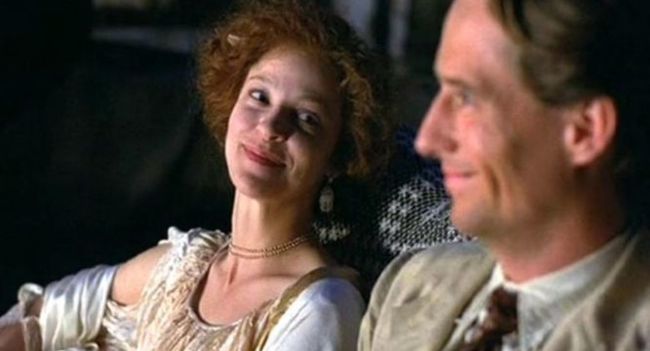
A young couple in love meets for the first time in the man’s small London flat. The beautiful, stylishly dressed woman, Kate Croy, played by Helena Bonham Carter, wanders into the man’s bedroom, her speculative gaze taking in the rather shabby surroundings.
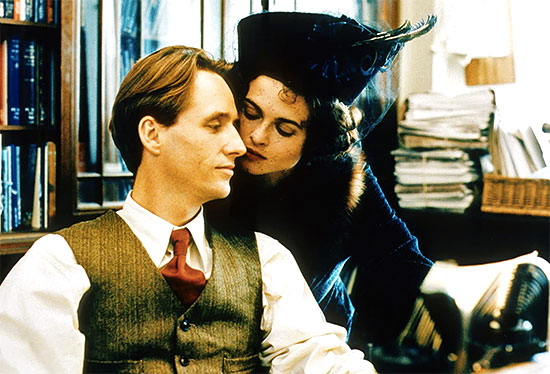
“What if I didn’t let you leave tonight? What would happen?” asks Merton Densher, the progressive journalist with attractively rumpled clothes played by Linus Roache.
Croy replies matter-of-factly, “I’d be penniless, cast out of society, and I’d be stuck with you.”
Love versus money. This is the dilemma as presented in the richly textured and emotionally anguished 1997 period drama “The Wings of the Dove,” based on the Henry James novel published in 1902 and considered one of James’ best late works.
Directed by British-born Iain Softley, the film was nominated for four Academy Awards, including Carter for Best Actress. The outstanding cast is rounded out by Alison Elliott (The Buccaneers), Elizabeth McGovern (Downton Abbey), Charlotte Rampling (Restless), Alex Jennings (Victoria), and Michael Gambon (Little Women).
American-British novelist Henry James wrote frequently about the intertwining of love and money, and more specifically about how a rich American heiress can unwittingly become a target in Europe, exploited by those who desire her fortune more than herself.
These New World/Old World cynical love stories also drive the plots of his works The Portrait of a Lady and The Golden Bowl, among others. And they are based on a certain 19th century reality, when “Dollar Princesses” such as Consuelo Vanderbilt went through with arranged marriages to English aristocrats who had little affection for them but desperately needed their American cash.

In The Wings of the Dove, the American heiress is Milly Theale, played by Elliott. She meets first Croy, then Densher in London and the triangle that forms is a tragic one because Theale doesn’t realize for quite a while that she is in a triangle, being used for her money. Or does she? That is one of the more tantalizing questions raised in the film.
The Modern Library has ranked The Wings of the Dove 26th on its list of the 100 Best English Language novels of the 20th century. It has, however, proved very difficult to adapt to stage, film, or television.
James wrote long novels filled with characters’ ruminating and planning, often in long passages describing their thoughts without much dialogue or action. Moreover, Kate Croy is planning something pretty despicable: She wants her secret fiancé, Densher, to marry Theale because she is certain that the American woman, described by an English aristocrat as “the world’s richest orphan, worth millions,” is dying.
Densher will inherit her fortune and only then can Croy have both things she wants: love and money.
James Thurber dubbed the novel The Wings of the Dove “a kind of femme fatale of literature” and analyzed its record of failed adaptations in a 1959 article published in The New Yorker. He blamed James’ “passion for indirection—an ambivalence that must present both challenge and handicap to the adapter, however ingenious, of his work.” He also quoted a theater critic who said Wings “can only succeed as something quite trashy or as something truly tremendous.”
The 1997 film, if not perhaps “truly tremendous,” is a definite success. And part of the reason is it embraces the “trashy” possibilities of the characters, such as Charlotte Rampling’s cold and calculating Aunt Maud and Alex Jennings’ debauched Lord Mark. Creating a high-end soap opera — such as Julian Fellowes’ Gosford Park and “Downton Abbey” — was not a feat as celebrated in 1959 as in the 21st century.
But another reason is the script, which softens the character of the mercenary Kate Croy. She’s now enormously complex and conflicted. This would not have been possible without the extraordinary acting of Helena Bonham Carter, who conveys depths of desire, pity, and contempt in her huge eyes.
The film begins with Croy and Densher sharing a subway car, staring at each other but barely speaking. They walk out together, still not speaking, and end up in an elevator, passionately kissing. But their love affair and wish to one day marry has to be kept secret because of Croy’s family. Her upper-class mother married a wastrel (Gambon) and died after suffering from her mistake.
Croy’s Aunt Maud will take her in and launch her in society if she has nothing to do with her father and breaks off her relationship with Densher. Should Croy defy her wishes, the aunt will not only cast her out but also cut off the subsidy she sends to Kate’s father, living in bars and opium dens.
After Croy tells Densher she can’t see him for a while, a few months pass. She meets the attractive, friendly, and naïve American heiress Millie Theale and a genuine friendship forms.
She’s startled when Theale tells her she spotted Densher at a party and he is Theale’s type of man—“He’s beautiful.” An idea takes shape in Croy’s mind, one that Densher is at first violently opposed to. All three travel to Venice, where the desires of each of them, and new possibilities of love, play out, ending in tragedy.
The director shifted the year the film takes place to 1910, which is in some ways makes the story less plausible. A young woman having to marry money or else suffer for her recklessness is an earlier idea, a cornerstone of Jane Austen. In pre-World War I England, women were throwing themselves into the fight for the vote. Marrying a successful reformer journalist like Merton Densher does not equal starvation. He is obviously no Leonard Bast from Howard’s End.
Perhaps the filmmakers wanted to take advantage of the fashions of 1910, which they do to great effect. Croy wears beautiful dresses and jackets, velvets and chiffon, set off with elbow-length black gloves and carefully tilted hats. The film’s costumes were nominated for an Oscar and many other awards.
But one of the most famous sequences in the film is when Helena Bonham Carter strips to a corset, revealing her ravishing pallor and stunning figure. It is her beauty, matched by Linus Roache’s hunger for her, that make “The Wings of the Dove” a remarkably sensual film, and that might be what is needed to bring Henry James’ psychological story fully to life.
Carter and Roache have gone on to great success in TV and films that showcase their skills as character actors, with Carter recently cast as Princess Margaret in “The Crown,” and Roache starring in “Summer of Rockets.” That’s one of the reasons it is well worth it to see this film, when their subtle, intelligent acting melds with their carnality, and produces a film that lingers in memory.
SOURCE: willowandthatch