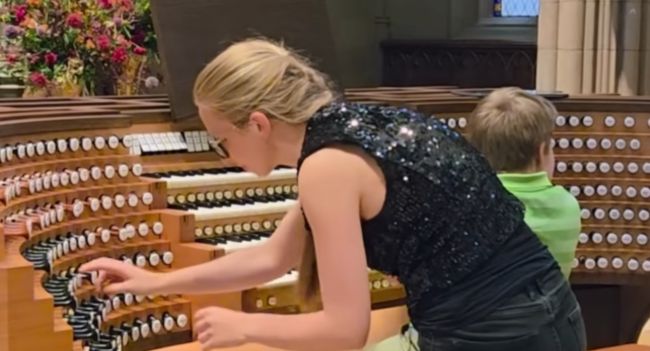
Ten-Year-Old “Peanut” Left New York in Awe With a Fearless Performance of Widor’s Legendary Toccata
Some performances are impressive because of the performer’s experience.
Others become unforgettable because they make you question what you thought was possible.
That was exactly the feeling inside Trinity Church in New York City when 10-year-old Nykoda, affectionately known as “Peanut,” sat down at the organ to perform Charles-Marie Widor’s Symphony No. 5 – Toccata.
For organists, the piece hardly needs an introduction.
Widor’s Toccata is one of the most celebrated works ever written for the instrument, famous for its dazzling speed, relentless precision, and enormous physical demands. Even highly accomplished professional organists approach it with enormous respect.
Which is why seeing a child perform it immediately captured everyone’s attention.
Yet the moment Peanut began to play, the focus shifted away from his age.
The audience simply listened.
From the opening bars, his confidence was remarkable. The rapid repeated figures that make the Toccata so challenging flowed with surprising control, while his hands moved confidently across the manuals. Just as impressive was his coordination on the pedalboard—an element of organ performance that often takes years to master.
Of course, nobody expects a ten-year-old to deliver the polished authority of a seasoned concert organist.
That wasn’t what made the performance extraordinary.
What made it unforgettable was the courage.
Peanut approached one of the organ repertoire’s greatest showpieces without hesitation, embracing its excitement rather than fearing its difficulty.
Every page reflected determination.
Every phrase showed preparation.
Every successful passage earned another smile from listeners who realized they were witnessing something genuinely special.
The setting added even more significance.
Trinity Church has welcomed generations of outstanding musicians, and its magnificent organ has echoed through countless historic performances. Watching a young musician bring that instrument to life created a beautiful sense of continuity—as though the next generation of organists was already beginning to write its own chapter.
There is also something deeply inspiring about seeing a child choose an instrument that many people mistakenly believe belongs only to another era.
In a world dominated by short videos and instant entertainment, Peanut demonstrated that dedication, patience, and classical music can still captivate an audience.
That may be the performance’s greatest achievement.
It reminds us that talent has no minimum age.
Great music has no expiration date.
And the future of the organ may already be sitting on the bench, feet just barely reaching the pedals.
As the final triumphant chords rang through Trinity Church, applause erupted with genuine enthusiasm.
It wasn’t applause driven by sympathy for a young performer.
It was applause earned through commitment, bravery, and a performance that exceeded every expectation.
Peanut may only be ten years old.
But for everyone fortunate enough to hear him play Widor’s Toccata, one thing became immediately clear.
This is a young musician with a future worth watching.