Congratulations!
You've earned 1 point
Lindsay Clancy’s Defense Seeks Mistrial After Second ‘Mortal Sin’ Reference Sparks Courtroom Clash
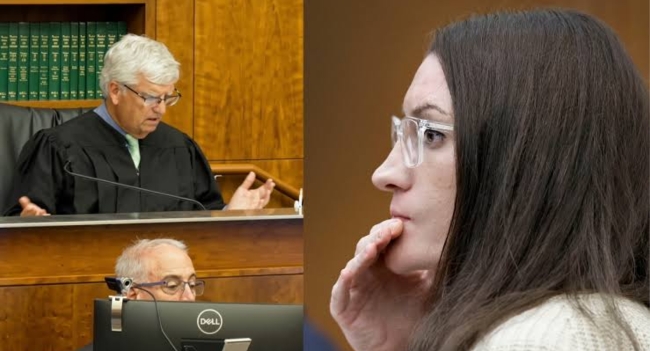
PLYMOUTH, Mass. — Lindsay Clancy’s murder trial was thrown into another legal dispute Monday when her defense attorney accused prosecutors of “intentional misconduct” and asked the judge to declare a mistrial after jurors heard a second reference to the Catholic concept of “mortal sin.”
Judge William Sullivan ultimately rejected the mistrial request. However, he agreed that testimony concerning Clancy’s religion and Catholic teachings was improper, ordering jurors to disregard it and warning that religious discussion had no place in the evidence they were considering.
Defense Challenges Second Religious Reference
Clancy, 36, is charged with murder in the deaths of her three children, Cora, 5, Dawson, 3, and Callan, 8 months.
She has not denied killing the children with exercise bands inside the family’s Duxbury, Massachusetts, home. The central dispute at trial is whether she was criminally responsible for her actions. Her defense maintains that she was suffering from postpartum psychosis at the time.
The latest confrontation unfolded during the prosecution’s rebuttal case, when psychologist Dr. Kirk Heilbrun testified about his evaluation of Clancy.
Heilbrun does not believe Clancy met the standard for insanity when she killed her children.
While discussing what Clancy had told him about the deaths, Heilbrun referred to her statements about expecting to be reunited with the children in Heaven. He then began discussing her Catholic upbringing and said he had questioned her about whether suicide was considered a “mortal sin.”
Defense attorney Kevin Reddington immediately objected.
Once the jury was removed from the courtroom, Reddington went further and requested a mistrial.
He argued that the episode could not be viewed in isolation because jurors had already encountered virtually the same religious concept earlier in the trial.
‘Mortal Sin’ Had Already Surfaced Once
One week earlier, Clancy’s former mother-in-law, Susan Clancy, had testified for the defense.
Susan described Lindsay as a loving and nurturing mother who had been struggling and seeking medical help. During cross-examination, prosecutor Shanan Buckingham asked whether Susan was an active Catholic before asking whether she knew murder was considered a “mortal sin.”
Judge Sullivan immediately stopped that line of questioning. The jury was instructed to disregard it.
Reddington did not request a mistrial after the first incident. He later explained that he believed the judge’s instruction had been sufficiently strong and made a tactical decision to continue.
The second reference changed his position.
Reddington argued that jurors had now twice been exposed to religious concepts involving murder, suicide, Heaven and Clancy’s Catholic background.
He characterized the repetition as “intentional misconduct” and argued that a mistrial was warranted.
Prosecutor Denies Deliberately Introducing Religion
Assistant District Attorney Jennifer Sprague rejected the defense’s accusation.
Sprague told the court that she had not attempted to elicit Heilbrun’s remarks about religion. According to the prosecutor, the psychologist was explaining his own reasoning when the disputed reference emerged.
She also argued that neither she nor Heilbrun had intentionally attempted to inflame the jury or create a problem in the case.
Judge Sullivan nevertheless questioned why portions of Heilbrun’s testimony concerning Catholic beliefs had been introduced at all.
Although some statements attributed to Clancy concerning God had previously entered evidence, Sullivan drew a distinction once the testimony moved into her Catholic upbringing and Heilbrun’s understanding of Catholic doctrine.
He refused to end the trial but made clear that the testimony had crossed into an improper area.
Judge Refuses to Declare Mistrial
When jurors returned, Sullivan delivered a direct instruction.
He told them that Clancy’s religious upbringing was an inappropriate subject and ordered that portion of the testimony stricken. He further instructed jurors that Heilbrun’s personal understanding of Catholic teachings was irrelevant and should not factor into their deliberations.
The ruling allowed the trial to continue, but the dispute added another contentious moment to proceedings already dominated by sharply conflicting expert testimony.
Trial Has Become a Battle Over Clancy’s Mental State
The central question before jurors is not whether Clancy caused her children’s deaths. Rather, the defense is attempting to establish that her mental condition left her legally not responsible.
Defense experts have testified that Clancy experienced psychosis. Psychiatrist Dr. Phillip Resnick, the defense’s final witness, testified that he believed she was psychotic, although he explained that this did not mean she had to appear psychotic continuously.
Prosecutors have countered with their own experts.
Dr. Avram Mack testified that although he believed Clancy suffered from depression, he did not find evidence supporting the conclusion that she was psychotic. Reddington subjected Mack to an aggressive cross-examination, challenging both his forensic experience and portions of his medical testimony.
Heilbrun was subsequently called as another prosecution rebuttal witness and likewise concluded that Clancy was not legally insane at the time of the killings.
That divide between the competing experts has increasingly become the defining issue of the trial.
Religious Evidence Becomes a New Flashpoint
The mistrial dispute introduces a separate question: whether references to religious doctrine could improperly influence how jurors evaluate Clancy’s state of mind and actions.
After the first “mortal sin” reference, Sullivan acted immediately and ordered jurors to disregard the prosecutor’s question. Following Monday’s second reference, the judge again intervened — this time explicitly striking testimony concerning Clancy’s Catholic upbringing and Heilbrun’s interpretation of Catholic teachings.
Reddington’s request to terminate the trial was denied, meaning the same jury will continue hearing the case.
The prosecution’s rebuttal case is scheduled to continue Tuesday as the trial moves closer to its conclusion — with Clancy’s mental state, the credibility of competing experts and the limits of what jurors may consider remaining at the center of the courtroom battle.