Beloved Central Park Bird Artist Lee Rogers Identified as Woman Killed in Gazebo, Suspect Turns Himself In

A homeless artist who spent years capturing the birds and wildlife of Central Park in intricate watercolor paintings has been identified as the 63-year-old woman killed near the park’s boathouse over the weekend.
Lee Rogers, also known as Elise Bainbridge Hill and Francis Lee Rogers, was found Sunday in a gazebo near East Drive and 74th Street. Law-enforcement sources said she had suffered fatal injuries during an altercation.
Jonathan Robles, 36, later turned himself in to authorities and was awaiting arraignment Monday on murder and criminal possession of a weapon charges.
Police sources said Rogers and Robles apparently became involved in an argument before the situation escalated, although exactly what sparked the confrontation remained unclear.
A Familiar Face Among Central Park’s Bird Lovers

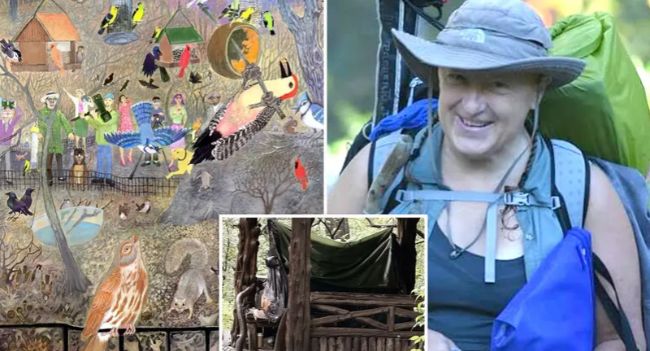
An undated painting by Lee Rogers, also known as Elise Bainbridge Hill, is titled “Central Park Bird Feeders.”Francis Lee Rogers
Long before her death became the subject of a police investigation, Rogers had established an unusual place within Central Park’s community.
For years, she lived on and off the streets while creating detailed paintings of the animals she observed around her. Cardinals, owls, raccoons, loons and Central Park’s famous red-tailed hawk Pale Male were among her subjects.
Nature-walk guide Robert DeCandido remembered her as the “Grandma Moses of Central Park,” saying birdwatchers became particularly fond of Rogers and regularly purchased her artwork.
Her connection to the park went far beyond painting from observation. Friends said she possessed an extensive knowledge of wildlife and animal behavior.
Joe Lopez first met Rogers in 2016 when he purchased one of her paintings of Pale Male. Years later, he still remembered her as “kind and sweet and soft.”
After learning of her death, Lopez returned to the gazebo where Rogers often slept, carrying one of her paintings with him.
“She was fun to talk to, she knew wildlife, she knew animal behavior,” he recalled. “It’s not like she just sat there and painted.”
Her Identity Revealed a Remarkable Past

Illustration of raccoons in a park at night, titled “Mother Racoon and young descending the cyclops tree 2016”.Francis Lee Rogers
Rogers had cultivated an air of mystery around herself.
When she was profiled in 2012, she declined to disclose her age or reveal much about her personal history. She used different names over the years, including Francis Lee Rogers and Elise Bainbridge Hill.
The latter identity connects her to the 2007 documentary “Begging Naked,” which chronicled her life over nearly a decade.
According to the documentary, Rogers ran away from home as a teenager and came to New York City. Her early years in the city included periods of drug addiction and prostitution before she later worked as a stripper while developing her artistic abilities.
Her experiences also became material for her paintings, which incorporated the vivid world surrounding her.
The documentary additionally explored Rogers’ struggles with her mental health. Eventually, she lost her home and began sleeping in and around Central Park.
On her own website, Rogers once described that period simply: “For many years I was homeless.”
She added that she worked on her paintings at the Central Park boathouse — the same area where she would eventually become a familiar presence to generations of parkgoers.
Friends Watched Her Life Change

Rogers, also known as Elise Bainbridge Hill, was the subject of a 2007 documentary, “Begging Naked,” detailing her past.Instagram/Francis Lee Rogers
Rogers sometimes stayed in shelters and, for a period, was able to leave the streets after another bird enthusiast offered her a place to live.
Eventually, however, she returned to Central Park.
DeCandido said Rogers appeared to change during the final four or five years of her life. She became more withdrawn and reclusive, and he noticed that her health appeared to decline.
The outspoken artist he remembered from years earlier was increasingly difficult to recognize.
Still, her artwork remained an enduring connection between Rogers and the people who had encountered her in the park.
Suspect Was Also Known Around the Park

Joe Lopez, an acquaintance of a 63-year-old homeless woman known as “Lee” who was found allegedly stabbed to death, stops by a Central Park gazebo with some of her artwork, where candles have been placed, Monday, Sept. 28, 2026.Matthew McDermott for NY Post
The investigation took another turn when Robles surrendered to police late Sunday.
Moje Ramirez, 51, who is also homeless, said he knew both Rogers and Robles from Central Park. According to Ramirez, the pair were familiar with one another but did not get along.
“They both knew each other well,” he said. “He lived here and she lived here. They didn’t get along but they were regulars.”
Ramirez also alleged that Robles could become unpredictable while under the influence.
Robles had not been convicted of the charges against him, and the precise circumstances leading to Rogers’ death remained under investigation.
For those who knew Rogers, however, the gazebo is now tied to a very different memory. Candles appeared there Monday as friends mourned a woman who spent years without a permanent home but nevertheless became part of Central Park itself — known to birdwatchers, fellow homeless New Yorkers and strangers who stopped long enough to discover the artist behind the paintings.