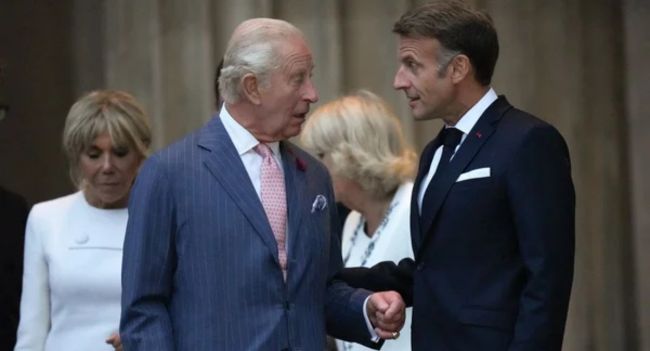
King Charles Makes Striking ‘Warriors Crossing the Channel’ Reference in Front of President Macron

King Charles made an eye-catching reference to warriors crossing the English Channel as he highlighted the changing relationship between Britain and France during a speech attended by French President Emmanuel Macron.
The King made the remark on Wednesday evening at the British Museum, where he and Queen Camilla joined President Macron and his wife, Brigitte Macron, to view the historic Bayeux Tapestry.
The nearly 70-metre-long embroidery tells the story of the events surrounding William the Conqueror’s invasion of England in 1066, including the Battle of Hastings.
From invasion to cultural exchange

Reflecting on the significance of the historic artwork, King Charles drew a direct contrast between its original story and the role it plays in relations between Britain and France today.
“It once depicted warriors crossing the Channel; yet today it forms part of a cultural exchange that will see some of the British Museum’s own precious artefacts travel to France in return, in a spirit of friendship,” the King said.
His reference was to the Norman warriors who crossed the Channel in 1066 as William the Conqueror invaded England.
It was not a reference to modern-day small boat migrants making the dangerous journey across the Channel. However, given the continuing political sensitivity surrounding Channel crossings, the wording carried an unmistakable modern irony with President Macron sitting opposite the King.
Migration remains an important issue for both Britain and France, with the two countries continuing to cooperate on tackling dangerous crossings.
Charles focuses on Britain and France’s shared history

Throughout his speech, the King emphasised the close historical and cultural connections between the two nations.
He described the Bayeux Tapestry as a symbol of their “shared history”, while stressing that its importance extends beyond the conflict and conquest depicted in its scenes.
Charles said the tapestry had become “a precious symbol of trust” at a time when trust was, he noted, “sadly” in short supply between nations.
The monarch also highlighted the reciprocal nature of the current exhibition arrangement.
The Bayeux Tapestry has been loaned to the British Museum, while a selection of treasures from the museum’s own collection will travel to France as part of the cultural exchange.
Those objects include the Sutton Hoo treasures, the Lewis Chessmen and a collection of Renaissance drawings.
The French Ministry of Culture has described the arrangement as an exceptional cultural exchange between Britain and France.
Charles said the objects reflected how the two countries had been “bound together for almost a millennium.”
A personal connection to William the Conqueror
The King also brought a touch of humour to his remarks by referring to his own Norman ancestry.
Charles joked that he was “undoubtedly the direct descendant of King William I”, although he suggested that the 13th-century Treaty of Paris could complicate his claim to being the current Duke of Normandy.
He later returned to the wider theme of shared heritage, arguing that Britain and France are so closely connected that neither country can “fully tell our own story without the other.”
The King concluded by looking beyond the historical events depicted in the tapestry and towards the future relationship between the two nations.
He described the cultural exchange as part of a continuing partnership that Britain and France should keep “woven” together.
Bayeux Tapestry returns to Britain
The exhibition marks the first time the Bayeux Tapestry has been displayed in Britain since it was created.
The historic embroidery will open to the public at the British Museum on September 10, giving visitors the opportunity to see the nearly 70-metre-long work depicting William’s invasion of England and the Battle of Hastings.
For King Charles, its arrival provided more than an opportunity to revisit a pivotal episode in British history. In the presence of President Macron, he used the tapestry to underline how a historic route once associated with invasion and warfare can now represent cultural exchange, cooperation and friendship between Britain and France.