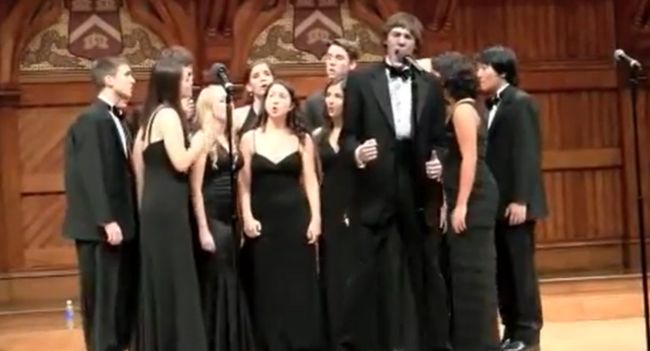
Harvard Veritones Turn Queen’s “Bohemian Rhapsody” Into an A Cappella Masterpiece That Still Amazes Listeners

Few songs in popular music are considered as untouchable as Queen’s legendary “Bohemian Rhapsody.” With its intricate harmonies, operatic middle section, soaring rock climax, and Brian May’s unmistakable guitar work, the six-minute epic has challenged musicians for decades. Yet the Harvard-Radcliffe Veritones managed to accomplish what many thought impossible—recreating the iconic masterpiece using nothing but their voices.
Originally performed in 2009, the Veritones’ arrangement has become one of the most celebrated collegiate a cappella performances ever recorded, earning widespread praise for its creativity, precision, and remarkable musicality.
From the very first note, the group establishes an atmosphere that echoes the grandeur of Queen’s original recording. The ensemble’s rich vocal blend creates a warm, layered wall of sound that mirrors the multi-tracked harmonies Freddie Mercury painstakingly crafted in the studio. Rather than simply covering the song, the Veritones faithfully capture its emotional depth while adding their own distinctive interpretation.

One of the arrangement’s most impressive moments arrives during the famous guitar solo. Instead of relying on instruments or backing tracks, arrangers Julia Rudolf and Dan Masterson designed an intricate sequence of vocal syllables and carefully chosen phonetic textures to imitate Brian May’s signature electric guitar tone. Using articulated “wah” and “zzh” sounds, the singers recreate the illusion of a distorted guitar with astonishing realism.
The performance reaches another level during the song’s legendary operatic section. Every rapid-fire “Galileo,” “Magnifico,” and harmonic exchange is executed entirely through live vocals. Crisp diction, seamless transitions between chest voice and falsetto, and flawless coordination among the singers allow the complex arrangement to unfold with remarkable clarity, despite its notorious difficulty.
As the song builds toward its explosive rock finale, the Veritones unleash an energetic vocal performance that rivals the intensity of a full rock band. Driving vocal percussion, powerful belt vocals, and dense harmonies combine to create a thrilling climax, proving just how dynamic a cappella music can be in the hands of exceptional performers.

The recording took place inside Sanders Theatre at Harvard University, a historic venue celebrated for its 19th-century architecture and exceptional natural acoustics. The hall’s warm resonance enhances every harmony, adding depth and richness to an already ambitious arrangement.
Following the overwhelming response to the live performance, the Veritones later recorded a studio version for one of the group’s albums, allowing the arrangement to reach an even wider audience through major streaming platforms.
The performance also received one of collegiate a cappella’s highest honors when it was selected for the prestigious Best of College A Cappella (BOCA) compilation, a recognition reserved for the finest student vocal performances each year. The inclusion cemented the Veritones’ interpretation as one of the most acclaimed a cappella renditions of a Queen classic.
More than a decade after its debut, the Harvard Veritones’ “Bohemian Rhapsody” continues to impress music lovers with its technical brilliance, fearless ambition, and extraordinary vocal craftsmanship. It remains a shining example of how a group of talented singers can transform one of rock’s greatest masterpieces into an unforgettable vocal experience—without using a single instrument.