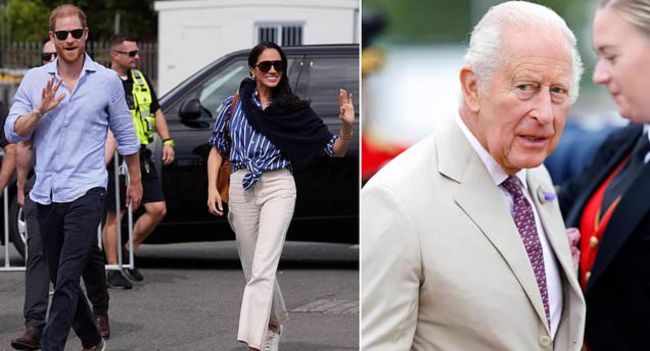
Prince Harry Unveils Busy UK-US Schedule as Sussexes Push Back Against King Charles’ “Private Citizens” Label
Prince Harry is stepping back into the public spotlight with a packed schedule of charity engagements in Britain and the United States — even as he and Meghan Markle continue to challenge King Charles’ decision to describe them as “private citizens.”
The Duke of Sussex is due to take part in a series of public appearances on both sides of the Atlantic this month, including several events in London before travelling to New York for the annual Clinton Global Initiative during United Nations General Assembly week.
The programme has been interpreted as a significant return to public life in Britain, coming just weeks after Harry and Meghan relocated to the UK while tensions with Buckingham Palace intensified.
At the heart of the dispute is the King’s recent letter of “guidance,” which confirmed that the Sussexes have not returned as working royals and that their HRH styles remain in abeyance.
But people close to the couple continue to argue that describing Harry and Meghan as private citizens does not reflect the reality of their lives or global profile.
Sussexes reject the “private citizens” description

Speaking to People, a source close to the couple said the idea that Harry and Meghan could simply live an ordinary private life was unrealistic because of their extraordinary level of public recognition.
“Members of the public know who they are,” the insider said, arguing that their fame makes a conventional private existence impossible.
The comments came after the Palace made its position unmistakably clear.
A letter issued by the Lord Chamberlain on the King’s instruction stated that, despite the couple’s return to Britain, their status remains that of private citizens with commercial and charitable interests.
The Sussexes’ spokesman subsequently said the couple were “surprised” by the statement and claimed they had not been given enough time to respond before it was circulated.
Their team has suggested that they received just over an hour’s notice before the letter was released and believed Harry should have been given more time to “clarify one or two points.”
The issue appears particularly sensitive because the letter explicitly stated that Harry and Meghan should not be treated as members of the working Royal Family.
Harry’s first UK engagements since the move

Against that backdrop, Harry’s September schedule has now been announced.
His programme begins with the inaugural Invictus Spirit Awards on September 17, followed by the launch of the Invictus education programme, INSPIRE.
The awards will honour individuals, organisations and communities described as embodying the resilience, service and unconquered spirit associated with the international Invictus Movement.
At the INSPIRE launch, Harry is expected to take part in an assembly and play pickleball with school pupils.
The education initiative was designed by teachers for learners ranging from early years through Key Stage 5. It draws on the Invictus Games and the experiences of its competitors to create curriculum-aligned resources covering subjects including maths, English, STEM, art, performing arts, sport and PSHE.
Harry will then attend the WellChild Awards in London on September 21.
The Duke has been patron of WellChild, a national charity supporting seriously ill children and their families, since 2007 and has regularly attended its annual awards.
This year’s appearance has been described as part of his continuing relationship with the organisation. Harry has attended the ceremony 15 times and is expected to meet the winners, their families, carers and healthcare professionals to hear about their experiences.
A return to the United States
Harry’s September programme will then take him back across the Atlantic.
On September 22 and 23, he will participate in the Clinton Global Initiative in New York alongside former president Bill Clinton, Hillary Clinton, Chrissy Teigen and LinkedIn co-founder Reid Hoffman.
The event takes place during the week of the United Nations General Assembly.
Taken together, the engagements give Harry a substantial public schedule in both Britain and America at a particularly sensitive moment for his relationship with the Palace.
Invictus caught in the wider dispute
The disagreement over Harry and Meghan’s status has also become entangled with the future of the Invictus Games.
Sources close to the Sussexes have claimed that Uganda’s decision to withdraw from the 2027 Invictus Games in Birmingham was a direct consequence of the Palace’s guidance describing Harry and Meghan as private citizens.
They told People that Ugandan officials had made clear that the decision was linked to the guidance from the Lord Chamberlain.
The source also argued that the withdrawal was an unintended consequence of the Palace letter and suggested this was one reason the Sussexes had wanted more time before its release.
However, Uganda’s General Muhoozi Kainerugaba said on Wednesday morning that his country would not participate in any event without approval from King Charles. He also said he was motivated to put an end to what he called “that Harry-Meghan nonsense.”
The development has added another layer to an already complicated dispute.
Just two months earlier, Uganda’s defence minister Kiryowa Kiwanuka had posed for photographs with a smiling Harry at an Invictus Games gathering in London.
Warning that the Sussexes’ public battle could hurt Invictus
PR expert Mark Borkowski has warned that the continuing public exchanges between Harry, Meghan and the Palace could ultimately damage the very organisation most closely associated with Harry.
Borkowski said Uganda’s withdrawal should be viewed as a warning for the Duke and Duchess.
He argued that the Sussexes’ repeated public briefings against the King and their portrayal of themselves as victims were not resonating with the public.
“Uganda is the warning,” Borkowski told the Daily Mail. He argued that the dispute surrounding the Sussexes was now beginning to overshadow Invictus, describing it as the “one unimpeachable thing Harry created.”
His broader criticism was that Harry and Meghan appeared to want the freedoms associated with private life while retaining some of the influence and authority associated with royal status.
Borkowski said the couple had repeatedly responded forcefully whenever that contradiction was highlighted.
Their children remain the priority

Despite the growing dispute with Buckingham Palace, people close to Harry and Meghan have insisted that their immediate priority remains their children.
Archie, seven, and Lilibet, five, are beginning a new school year after the family’s move back to Britain.
Sources told People that settling the children into their new surroundings “has been, and remains, their focus.”
The couple have reportedly been dealing with the practical demands of relocating their family halfway across the world, and insiders said they were “happy to be back.”
Harry and Meghan left Britain for the United States in 2020. They are understood to have moved into a non-royal home in the UK last month while retaining their residence in Montecito, California.
British public backs the King’s position

The Palace dispute is also unfolding against the backdrop of public opinion that appears to favour the King’s position.
A YouGov poll of 4,506 adults found that a majority of Britons did not want Harry and Meghan to return as working members of the Royal Family.
Asked whether the couple should become working royals again “at some point” now that they are back in Britain, 51 per cent said they would prefer them not to return to official duties.
Only 16 per cent said Harry and Meghan should become working royals again, while 33 per cent said they did not know.
The poll was conducted on Wednesday, one day after the Sussexes responded publicly to Buckingham Palace’s release of the letter confirming that they would not be returning to working royal duties.
For Harry and Meghan, the dispute therefore extends beyond the wording of one Palace letter. Their return to Britain has brought a renewed public presence, a growing schedule of charitable engagements and continued questions over where the boundaries lie between their private lives, their public influence and the Royal Family they left behind.
And while Harry’s latest programme shows that his public work is continuing on both sides of the Atlantic, King Charles’ position remains clear: the Sussexes have returned to Britain, but they have not returned as working royals.