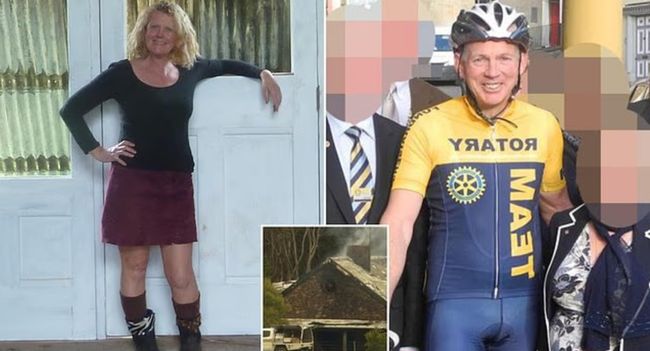
British man convicted of manslaughter after Airbnb host died in fire asks police a startling question about her dog
A British man convicted of killing his Australian Airbnb host showed little apparent concern for her in the immediate aftermath of the fatal incident — with police body-camera footage revealing that his first question was about her elderly dog.
Timothy Loosemore, 63, from Somerset, was found guilty of manslaughter but cleared of murder over the death of 60-year-old Maree Vermont at her rural home in Goldie, north of Melbourne.
Maree died after being violently attacked inside the property, which was then destroyed by fire. The blaze was so severe that forensic experts were unable to establish the precise cause of her death.
Loosemore is now awaiting sentence.
His first concern was Maree’s 14-year-old dog

In the hours after the fire, Loosemore was taken to Royal Melbourne Hospital, where police questioned him about what had happened.
Body-worn camera footage shown during the court proceedings captured his exchange with officers.
Rather than immediately asking about Maree, Loosemore’s first question concerned her 14-year-old dog, Maxie.
“Who’s looking after Maxie?” he asked.
An officer responded that they did not know and asked who normally cared for the dog.
Loosemore replied that Maree normally looked after him and explained that Maxie was 14 and suffered from dental problems.
Only afterwards did he ask about Maree herself.
“Is Maree all right? Is she?” he said.
The exchange later became an important part of the sentencing proceedings, with Justice Tinney questioning Loosemore’s apparent focus on his own belongings and the dog rather than Maree, who he knew had been inside the burning property.
Prosecutors said Maree rejected his advances

Loosemore had originally travelled to Australia on a cycling trip before staying at Maree’s property as an Airbnb guest.
The pair later became involved in what prosecutors described as a brief sexual relationship. The prosecution argued that Loosemore wanted the relationship to become more serious, but Maree repeatedly rejected his advances.
According to the prosecution case, he eventually “snapped” and attacked her inside the house.
Maree’s blood was subsequently found on Loosemore’s trousers and T-shirt, while evidence presented at trial indicated that she may have fought back. Loosemore also had injuries to his face.
Three kitchen knives were found in the living room, where Maree’s body was later discovered face down.
Prosecutor Mark Gibson, KC, argued that Loosemore had carried out a violent attack and then set fire to the property in an effort to conceal what had happened.
“He did something horrific to Maree Vermont,” Gibson told the court, arguing that the attack was carried out with murderous intent.
Fire destroyed the evidence
The blaze caused such extensive damage that Maree’s remains were burned beyond recognition.
That destruction ultimately became central to the murder charge.
Forensic experts could not determine exactly how Maree died, leaving the jury unable to conclude beyond reasonable doubt that Loosemore had committed murder. He was instead convicted of manslaughter.
Justice Michael Tinney later said that because Loosemore had never given a truthful account of what happened, the exact mechanism of Maree’s death would remain unknown.
“Because he has never told the truth about what occurred, the mechanism of death will remain unclear to anyone other than Mr Loosemore,” the judge said.
The judge also questioned Loosemore’s claim that he could not remember the events surrounding Maree’s death.
His barrister, Christopher Farrington, told the court that Loosemore had consistently maintained that he had no memory of what took place and therefore had not accepted responsibility or expressed remorse.
Loosemore gave different accounts of the fire
Loosemore has maintained that he cannot remember killing Maree.
But the court heard several different versions of what happened on the night of the fire.
He told neighbour Peter Greenham that he and Maree had a “small argument” before he went outside to collect wood. He said that when he returned, the property was already burning.
A similar account was given to another neighbour, Kynan Share.
On another occasion, however, Loosemore said he had been upstairs asleep before getting up to put wood on the fire, only to return and find the house engulfed in flames.
His defence argued that his account was consistent with someone who genuinely did not know what had happened.
The prosecution disputed that explanation.
Maree’s home was destroyed along with decades of memories

The fire did more than destroy the scene of Maree’s death. It wiped out the home that had been central to her family’s life for more than three decades.
Maree, a surveyor by profession, had moved to the property with her then-husband when she was in her 20s. Together, they raised their three sons there.
The family spent more than 30 years creating the stone house, using salvaged materials and working on it over decades.
Maree had reportedly completed the finishing touches to the property’s lead-light window trims only a week before her death.
Her son Darcy Vermont described the house as something his mother deeply loved.
“She adored the house and it was beautiful. She was really proud of her work,” he said.
The fire also destroyed family photographs and other irreplaceable memories.
Sons describe an unbearable loss
Maree’s sons have spoken openly about the devastating impact of losing their mother and seeing the family home destroyed.
Darcy said the court proceedings had been difficult but also offered some sense of closure.
“It’s a very hard day,” he said, adding that it helped to be able to stand in court and have the family’s voices heard.
He had previously described the manslaughter verdict as “upsetting and distressing”.
“It was an unlawful, violent assault that killed her, and then burning of the house meant there was not enough evidence to suffice intent of murder,” Darcy said. “We have to accept what we can get.”
His brother Harrison said the destruction of the family’s photographs made it even more important to remember their mother through her life and work.
“The loss is just devastating, especially to us kids,” he said. “She was just … she was our mum. She was beautiful.”
A man with no previous criminal record
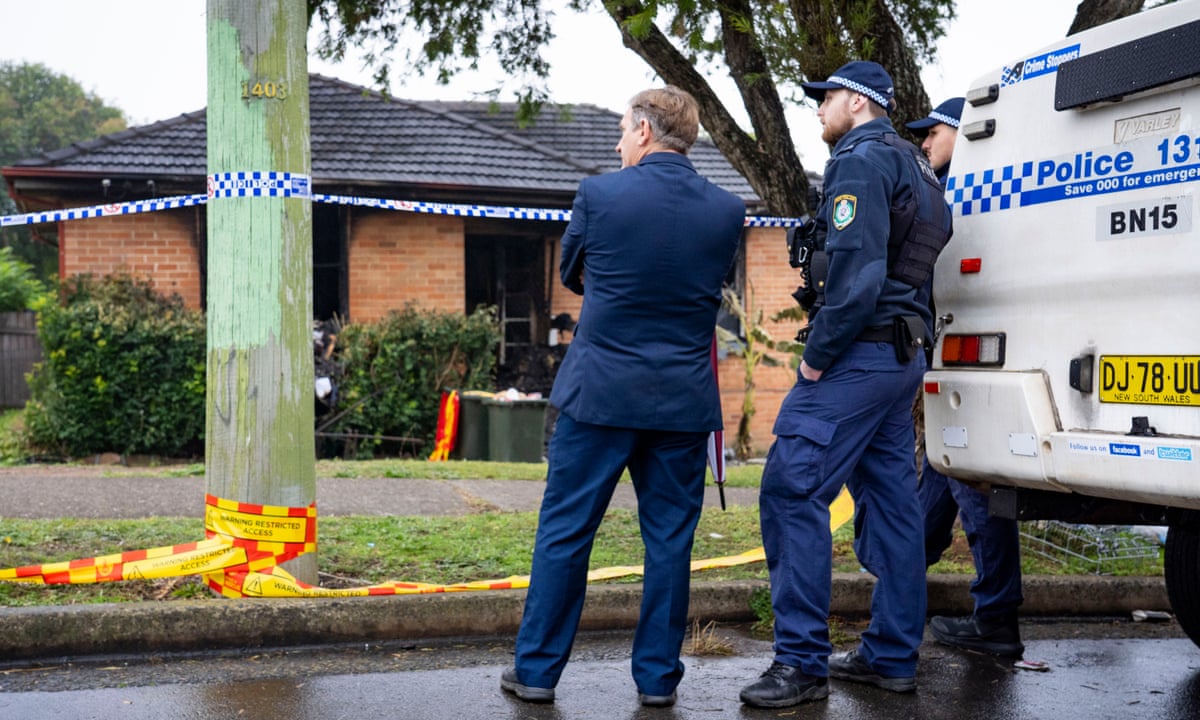
Before Maree’s death, Loosemore had no criminal history.
People who knew him, including some of Maree’s friends and relatives, described him as polite, calm and helpful.
He came from a rural community in Somerset and had previously operated a civil construction business in Britain.
His family had lived in Western Australia between 2004 and 2007 and became Australian citizens before eventually returning to the UK.
Loosemore returned to Australia with his son in September 2022 for a cycling trip. After his son left, he continued travelling alone, staying at properties where he worked in exchange for accommodation and food.
That was the arrangement under which he stayed at Maree’s property.
The relationship between the pair and what happened inside the house ultimately became the focus of a lengthy court case.
Loosemore was convicted of manslaughter after the jury rejected the prosecution’s murder charge, while the full circumstances of Maree’s death remain partly obscured by the fire that destroyed her home.
He remains in custody awaiting sentence.