Congratulations!
You've earned 1 point
Andrea Yates’ Lawyer Says Lindsay Clancy Mistrial Could Give Defense an Advantage if Case Is Tried Again

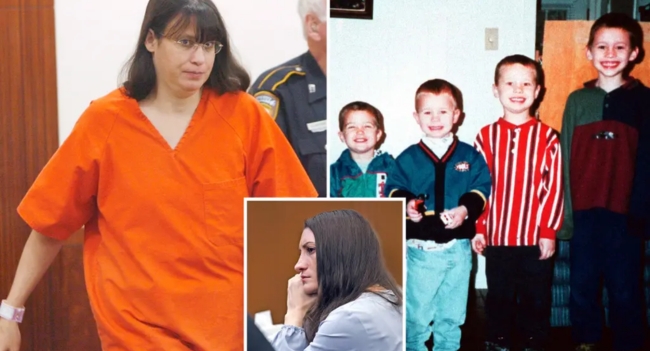
Andrea Yates was ultimately found not guilty by reason of insanity.AP
The mistrial in Lindsay Clancy’s closely watched murder case may feel like a painful non-result after weeks of testimony and days of deliberations. But George Parnham — the veteran Texas attorney who represented Andrea Yates in one of America’s most famous postpartum-psychosis cases — sees the outcome very differently.
Parnham, 85, believes the deadlocked jury could ultimately strengthen Clancy’s position if prosecutors decide to put her on trial again. His assessment comes after jurors were unable to reach a unanimous decision in the case involving the deaths of Clancy’s three children, Cora, 5, Dawson, 3, and Callan, 8 months.
“Give me a hung jury and a mistrial every day of the week,” Parnham told the New York Post.
The case ended in a mistrial on September 4 after a nearly six-week trial and seven days of deliberations. The jury ultimately remained divided, with Clancy’s attorney Kevin Reddington saying 11 jurors favored acquittal while one juror held out. Prosecutors have not yet announced whether they will seek another trial.
Why Parnham believes a mistrial could help Clancy

Lindsay Clancy’s case was declared a mistrial on Friday.USA TODAY Network via Reuters Connect
Reddington publicly expressed frustration with the outcome, describing it as a “real shame” after coming so close to an acquittal.
Parnham said he understood that reaction. A mistrial disrupts the legal process and leaves the defendant facing unresolved charges. At the same time, however, he argued that a second trial would give Clancy’s defense something it did not possess the first time: a detailed preview of the prosecution’s entire case.
The defense has now heard the government’s arguments, watched its witnesses testify and seen how prosecutors attempted to establish criminal responsibility.
If another trial takes place, Reddington would also have transcripts from the first proceeding that could be compared against new testimony. Parnham said inconsistencies or significant changes in a witness’s account could become important tools for the defense.
“Eleven to one, you’re surely hoping that you don’t get a mistrial with the holdout,” Parnham said. “But the other side is that if the case is retried, you have the advantage.”
For now, that possibility remains hypothetical. Plymouth County District Attorney Timothy Cruz’s office has said no decision has been made about whether Clancy will be retried. A status hearing is scheduled for September 29, when the legal path forward may become clearer.
Parnham predicts the case could end without another full trial

Yates drowned her children in the bathtub of their home. Pictured above, from left to right, are four of her children, Luke, Paul, John and Noah.Getty Images
Parnham went further, suggesting that prosecutors and the defense could ultimately reach an agreement rather than repeat the entire proceeding.
“I think in all probability, the resolution, if it happens, will not be a not guilty by reason of insanity acquittal,” he said.
His prediction is that Clancy could ultimately be convicted on lesser charges and spend what he described as “a short period of time” incarcerated. That is Parnham’s personal forecast, however, not an announced agreement or decision by prosecutors.
He also made clear that he personally believes Clancy should have been found not guilty by reason of insanity.
The prosecution has maintained a sharply different position. Prosecutors argued during the trial that Clancy understood what she was doing and could distinguish right from wrong. Her defense argued that severe mental illness, including postpartum psychosis, meant she lacked criminal responsibility when the children died.
Clancy remains charged, and the mistrial itself does not amount to either an acquittal or conviction. She remains in custody at Tewksbury Hospital.
The Andrea Yates case casts a long shadow

Clancy’s lawyer was disappointed with the mistrial.
Parnham’s perspective carries particular weight because of the case that defined much of his career.
Andrea Yates was 37 when she drowned her five children — Noah, 7; John, 5; Paul, 3; Luke, 2; and Mary, 6 months — at the family’s home outside Houston on June 20, 2001.
According to testimony, Yates waited until her husband, Rusty, left for work before drowning the children in the bathtub and later calling 911.
A jury initially convicted Yates of capital murder in 2002. That conviction was later overturned after it emerged that a prosecution forensic psychiatrist had provided false testimony.
A second trial produced a dramatically different result in 2006: Yates was found not guilty by reason of insanity. She remains at Kerrville State Hospital for psychiatric treatment.
The Yates case has inevitably resurfaced during the Clancy proceedings because both defenses centered on severe postpartum mental illness. Recent coverage has likewise noted that the two cases, separated by roughly a quarter-century, have forced courts and the public to confront similar questions about mental illness and criminal responsibility.
Parnham sees a crucial similarity between the two mothers

Parnham, pictured in court with Yates, said the mistrial could be used to the defenses’ advantage.AFP via Getty Images
Parnham argued that neither case presented an obvious conventional motive such as financial gain or revenge against a spouse.
“You eliminate all the possibilities of ulterior motives and you end up with the undeniable fact that mental illness is the reason these situations occurred,” he said.
Clancy’s defense maintained that she was experiencing postpartum psychosis. During the trial, a psychologist testified that Clancy told her husband she had heard a male voice instructing her to kill the children and herself.
Prosecutors disputed the defense’s interpretation of her mental condition, arguing instead that her actions were deliberate and that she remained capable of understanding right from wrong. Expert psychiatric testimony was contested throughout the proceedings.
Parnham praised Reddington’s handling of the psychiatric issues before the jury, particularly the challenge of explaining postpartum psychosis.
“I’ve worked on a lot of capital murder cases but when a mother and child are involved, it’s a totally different perspective,” Parnham said. “Jurors are perplexed and astonished really.”
Andrea Yates remains in treatment 25 years later
Parnham’s relationship with Yates has continued long after her trials ended.
He said he still visits her approximately every two months and believes she is likely aware of the Clancy case, although the two have not discussed it.
According to Parnham, Yates continues making progress in treatment. She reads and is occasionally given responsibilities helping other patients. He sometimes brings her food from Cracker Barrel when he visits.
One request from Yates has remained especially meaningful to him: she has asked Parnham to visit the graves of her children.
“I’ll go out and give flowers to the graves,” he said. “She’s so grateful that someone is doing that for her children.”
“I love her like a daughter,” Parnham added.
Lindsay Clancy’s legal future remains unresolved

Yates killed her children inside of her family’s home.Getty Images
Despite the comparisons with Yates, Clancy’s case remains its own legal proceeding with no final resolution.
The mistrial means prosecutors are legally able to pursue another trial. Other possibilities include negotiations between the two sides or further defense efforts seeking dismissal or a required finding of not guilty. Legal experts have noted that prosecutors will have to weigh the likelihood of obtaining a conviction against the financial and emotional costs of trying the lengthy case again.
For Parnham, however, the 11-1 split described by the defense is significant. Rather than viewing the mistrial purely as a setback, he believes the first trial may have provided Reddington with a roadmap for whatever comes next.
Whether prosecutors agree to a resolution or decide to take Clancy before another jury remains unanswered.
The next important date is September 29, when Clancy is scheduled to return to court.