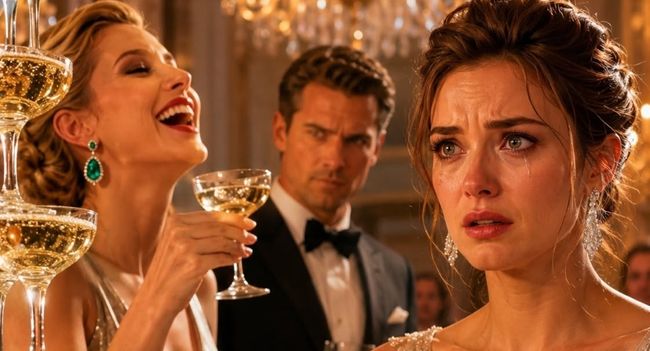
The Ring in the Champagne Tower
My husband’s mistress removed my twelve-carat wedding ring from her finger at midnight and dropped it into a seven-tier champagne tower while three hundred guests watched.
The diamond struck the rim of one crystal coupe, bounced into another and disappeared beneath the pale-gold champagne collecting in the basin below.
Vanessa Vale raised her empty hand as nervous laughter spread across the ballroom.
“To the things that finally belong to me,” she announced.
My husband, Grant Whitmore, stood beside her with one hand resting against the small of her back. He did not look embarrassed. He looked pleased.

“Claire,” he said when I remained silent, “please don’t ruin tonight with old grief.”
That was Grant’s gift. He could say something cruel in a calm voice and make everyone believe the cruelty belonged to the person receiving it.
Several guests laughed louder, relieved that he had given them permission.
I looked around the ballroom of Blackthorn Estate—the marble columns my grandfather had imported from Italy, the vaulted ceiling my mother had restored, the oak floor on which I had learned to dance with my father.
Grant had entered this house for the first time sixteen years earlier as an ambitious young consultant carrying a borrowed briefcase.
Now he stood beneath my family’s crest as though every stone belonged to him.
Vanessa watched me closely.
She wanted tears. A scene would have been even better.
Our divorce was not final, yet she had arrived at Blackthorn wearing my grandmother’s wedding ring and the emerald earrings Grant had given me on our tenth anniversary.
The humiliation had been planned down to the final detail. The champagne tower, the midnight toast and the carefully positioned guests with their phones already raised had all been arranged for one purpose.
They wanted the world to watch me break.
But neither Vanessa nor Grant knew that I had reported the ring stolen forty-eight hours earlier.
I turned toward Malcolm Bell, Blackthorn’s director of security.
“Mr. Bell, please stop the music and secure the ballroom.”
The string quartet fell silent in the middle of a note.
The doors closed.
Vanessa gave a short, disbelieving laugh. “You can’t be serious.”
“I’ve never been more serious.”
Grant stepped away from her. “Claire, whatever performance you’re planning, this is neither the time nor the place.”
I glanced at the champagne tower.
“You chose the time and place.”
For the first time that evening, uncertainty appeared in his eyes.
Blackthorn frequently hosted private exhibitions, charity auctions and collections worth millions. Valuable items brought onto the estate were documented by the security office, and my grandmother’s diamond had been registered years ago.
The stone also carried a microscopic identification mark connected to its certification number.
That number appeared in the police report I had filed two days before the gala.
Malcolm instructed two security officers to dismantle the lower section of the tower. They removed each glass carefully until the diamond appeared at the bottom of the central basin.
One officer rinsed it, examined the mark with a portable reader and compared the result with the information on a tablet.
“It matches,” she said.
Malcolm looked toward Grant before addressing the room.
“The ring is listed in an active theft report.”
The silence that followed was so complete that I could hear champagne dripping from one glass into another.
Vanessa folded her arms.
“So she registered her own jewelry. That doesn’t prove I stole it.”
“No,” I said. “Your own words will take care of that.”
Her eyes narrowed.
The ring had been transferred to me through my mother’s estate. It had been kept inside a private vault in the east wing—one accessible only to me, Grant and the estate’s head of security.
I looked directly at my husband.
“Did you remove my grandmother’s ring from that vault and give it to Vanessa?”
Grant’s expression hardened.
“We can discuss this privately.”
“Was the champagne tower private?”
Several guests lowered their phones, suddenly aware that they were no longer recording entertainment. They were recording evidence.
Vanessa turned toward Grant.
“You told me it was yours to give.”
Grant closed his eyes for half a second.
It was the first honest statement either of them had made all night, and it had been heard by three hundred witnesses.
Malcolm’s radio crackled.
“Greenwich police are at the south entrance.”
Vanessa’s face changed.
“Why are the police here?”
“Because Mr. Bell contacted them when the ring matched an active report,” I said.
She seized Grant’s arm.
“Fix this.”
For years, I had watched people use those same words with him.
Fix the contract.
Fix the story.
Fix the board.
Grant had always found someone he could pressure, reward or frighten into obedience.
But that night, with hundreds of cameras pointed toward him, he could not even fix the expression on his own face.
Detective Samuel Ortega entered with two uniformed officers. He approached Vanessa first.
“How did you obtain the ring?”
Grant stepped forward. “Detective, this is a marital dispute involving jointly held property.”
Ortega did not look at him.
“I asked Ms. Vale.”
Vanessa hesitated before answering.
“Grant gave it to me.”
“Did Mrs. Whitmore give either of you permission to remove it from her vault?”
Neither responded.
Ortega asked Malcolm to preserve the security footage and requested that the guests remain available to provide their contact information.
While officers recovered my grandmother’s ring, I took a fresh glass of champagne from a passing server.
Vanessa stared at me as though she were seeing me for the first time.
She had mistaken silence for helplessness.
Grant had made the same mistake for eleven years.
By sunrise, recordings from the gala were everywhere.
Millions of people watched Vanessa drop the ring into the tower. They replayed the moment security confirmed it had been reported stolen and slowed down the footage to capture the instant Grant’s confidence disappeared.
Online, people believed they had witnessed a cheating husband and his mistress accidentally humiliating themselves.
They understood only the smallest part of the story.
Six months earlier, I had found a hotel receipt in the pocket of Grant’s dinner jacket.
The room had been booked under his assistant’s name, but the minibar receipt listed Vanessa’s favorite champagne. I remembered because she had ordered the same label at a foundation luncheon and complained when it was served two degrees too warm.
I did not confront Grant.
Instead, I called Evelyn Cross, the attorney who had handled my father’s estate.
“Are you certain?” she asked.
“Yes.”
“Then behave as though you know nothing.”
That advice saved me.
Over the following months, Evelyn assembled a team that included forensic accountants, a private investigator and digital security specialists.
The affair was confirmed within a week.
What took longer to uncover was the reason Grant had become increasingly eager to portray me as unstable.
Anonymous stories had begun appearing online after my mother’s death. They described me as emotionally fragile, paranoid and unable to cope with grief.
Photographs showed me crying inside my car after leaving the hospital where my mother had died. Other images captured me outside my therapist’s office.
At first, I assumed gossip sites were feeding on the breakdown of a wealthy marriage.
Then Evelyn traced the payments behind the stories.
The money had moved through several intermediaries before reaching a public-relations company partly owned by Vanessa’s brother.
“That explains the campaign,” I said. “But why would Grant need strangers to believe I’m unstable?”
Evelyn opened a folder.
Inside was a draft petition seeking an emergency conservatorship over my financial affairs.
Grant’s attorneys had not filed it yet, but they had been preparing it for months.
The petition described my suspicions about Vanessa as “obsessive jealousy.” It used my therapy appointments and grief after my mother’s death as evidence that I could no longer make rational decisions.
It also referred to incidents that had not happened.
A public outburst at Blackthorn.
Threatening behavior toward Vanessa.
An attempt to destroy property during an emotional episode.
The gala had not simply been a celebration of Grant’s latest corporate acquisition.
It had been a trap.
Vanessa would wear my jewelry. Grant would dismiss me publicly. The midnight toast would push me beyond endurance, and three hundred guests would watch me scream, threaten Vanessa or tear down the champagne tower.
The ring was bait.
The guests were witnesses.
The cameras were evidence for a court filing that was already waiting to be completed.
Grant did not merely want to divorce me.
He wanted me declared incapable of controlling my own assets.
He believed that, as my husband, he could then petition to manage them for me.
The morning after the gala, Grant returned to Blackthorn with two attorneys.
He found me in my father’s library with Evelyn and Detective Ortega.
“You involved the police in a private family matter,” Grant said.
“You removed a registered heirloom from my vault.”
“It was a wedding ring I purchased.”
“My grandmother wore it for forty-three years before you were born.”
One of his lawyers whispered something to him, but Grant ignored it.
“Vanessa made a foolish gesture,” he said. “We can recover from this if you issue a statement explaining that the theft report resulted from a misunderstanding.”
“We?”
His expression tightened.
“You know what I mean.”
“I do. That’s why I won’t do it.”
Grant walked toward the desk and lowered his voice.
“You have no idea how exposed you are. The trust, the companies, this estate—none of it functions without me.”
Evelyn placed a document between us.
“Then you should read this.”
It was an amendment to the Ashford Legacy Trust, signed eighteen months before my father’s death.
Grant read the first page quickly. By the second, his confidence began to fade.
My father had placed the controlling shares of the Ashford companies into an irrevocable trust. I was its sole beneficiary, but Evelyn would remain the independent trustee until I formally assumed control.
Grant had no ownership rights over those shares.
More importantly, the amendment contained a protective provision. Any attempt by a spouse to gain control through incapacity or conservatorship proceedings would trigger an immediate independent review.
Until that review concluded, the spouse would be suspended from every management position connected to a trust-controlled company.
Grant looked at Evelyn.
“This cannot be enforceable.”
“It is,” she replied. “Your attorneys reviewed the original trust, but your access did not extend to this amendment.”
He looked at me next.
“You knew about this?”
“Not until yesterday.”
That was the only part he found reassuring.
Then Evelyn slid a second folder across the desk.
“But we’ve known about the draft conservatorship petition for three months.”
Grant stopped breathing for a moment.
The folder contained the false stories, payments to Vanessa’s company, photographs taken outside my therapist’s office and messages discussing how my public reaction at the gala could support the petition.
“You invaded my private communications,” he said.
“No,” Evelyn replied. “A former employee of Vanessa’s company provided records after discovering her firm was being used to manufacture false stories. Everything else came from legally obtained financial documents.”
Grant turned to me.
“I built those companies.”
“You expanded them,” I said. “With my father’s money.”
“You would have lost everything without me.”
“Then it’s fortunate we’re about to find out.”
Evelyn informed him that the trust’s board had convened an emergency meeting at nine that morning.
At nine fifteen, Grant was suspended as chief executive of Whitmore-Ashford Holdings pending an investigation.
By noon, three directors had resigned.
At two, the company announced an independent audit of transactions approved during Grant’s tenure.
The audit uncovered consulting payments to shell companies, unauthorized transfers and personal expenses disguised as corporate development costs.
Vanessa’s public-relations firm appeared repeatedly in the records.
She stopped returning Grant’s calls before the end of the week.
Her attorney eventually claimed that she had believed every item Grant gave her belonged to him and that she had known nothing about the conservatorship plan.
The messages recovered from her former employee told a different story.
One read: If she loses control at Blackthorn, we’ll finally have what we need.
Another said: Wear the ring. She won’t be able to resist.
Grant was not charged merely because he had been unfaithful or cruel. Those were not crimes.
But removing the ring, falsifying corporate expenses and coordinating a deceptive campaign to obtain control of protected assets created consequences his charm could not erase.
The divorce was finalized eight months later.
I retained Blackthorn, my family shares and every heirloom Vanessa had worn that night. Grant left with the assets that were genuinely his, reduced considerably by legal fees and the financial settlements arising from the audit.
The conservatorship petition was never filed.
It became evidence instead.
On the first anniversary of the gala, I hosted a charity auction at Blackthorn to support organizations providing legal assistance to women facing financial coercion.
Three hundred guests attended again, though the invitation list was very different.
Near midnight, Malcolm brought me a small velvet box.
Inside was my grandmother’s ring, fully restored after its journey through the champagne tower.
For months, I had kept it locked away because it reminded me of Grant.
That night, I understood that it had never truly represented him.
The diamond had belonged to my grandmother, then my mother and finally me. It had survived three marriages, two wars, a house fire and one spectacularly foolish attempt at public humiliation.
I slipped it onto my right hand.
Evelyn stood beside me as the clock reached midnight.
“Your father knew,” she said quietly.
“Knew what?”
“That Grant might eventually mistake access for ownership.”
I remembered the handwritten line my father had left beneath his signature on the trust amendment:
Protect Claire from anyone who mistakes her trust for weakness.
For years, Grant had believed my silence meant I was unaware of what happened around me.
Vanessa believed my dignity meant I was too frightened to fight back.
They were both wrong.
I had not remained silent because I was weak.
I had remained silent because they were still giving me evidence.
And by the time my wedding ring reached the bottom of that champagne tower, they had finally given me everything I needed.