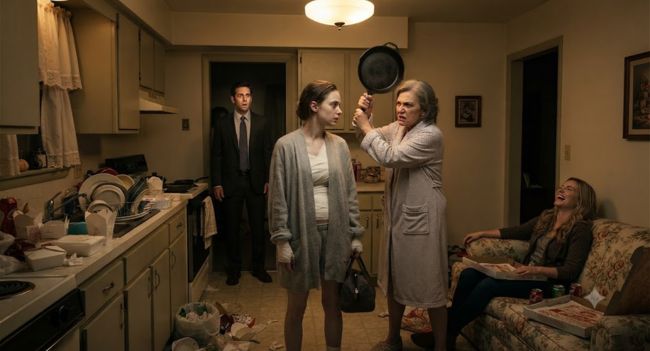
The pan never reached me.
A hand caught Agnes’s wrist before she could swing it.
“Put it down.”
Agnes froze.
So did Chloe.
I turned slowly.
Leo was standing behind me.
He looked nothing like the man I had spoken to on the phone from the hospital. His tie was gone, his shirt was wrinkled from travel, and there was a small suitcase beside the front door.
He had come home from Tokyo early.
“Leo?” Agnes whispered.
His eyes moved from the frying pan to me, then to the surgical dressing visible beneath my sweater.
“Put. It. Down.”
Agnes released the pan onto the counter.
Immediately, she started explaining.
“This isn’t what it looks like.”
Leo walked past her and came directly to me.
“Why are you standing?”
It was such a simple question that I nearly cried.
“I came back to pack.”
His face tightened.
“You left the hospital?”
“I didn’t have anywhere else to get my things.”
He looked at his mother.
“I was told she was being looked after.”
Agnes crossed her arms.
“She’s been poisoning you against us for years.”
Chloe finally put down her pizza.
“She’s dramatic, Leo. She disappeared for two days and then came back acting like—”
“She had emergency surgery.”
The room went silent.
Leo had apparently called the hospital after our conversation ended. He knew exactly what had happened.
Then he said something I hadn’t expected.
“The doctor told me what she survived.”
Agnes looked uncomfortable for the first time.
Leo turned toward me.
“Why didn’t you tell me it had gotten this bad?”
I almost laughed.
“I tried.”
He stopped.
And we both knew that was true.
I had told him Agnes criticized everything I did.
I had told him Chloe expected me to clean up after her.
I had told him I felt like a servant in my own home.
Every time, Leo had asked me to be patient.
“They’re family.”
“Mom doesn’t mean it.”
“Chloe will grow up.”
I had heard every version.
“I stopped telling you,” I said, “because you kept explaining them to me instead of listening.”
That hurt him.
It was supposed to.
Not because I wanted revenge, but because I was done protecting everyone from the truth.
Agnes suddenly pointed at me.
“See? She’s doing it right now. She’s turning you against your own mother.”
Leo looked around the room.
Dirty plates covered the counters.
Garbage overflowed near the kitchen.
Clothes had been dropped across chairs.
Two days.
That was all it had taken for the house to collapse without me.
Then his eyes landed on the pizza box beside Chloe.
He looked at his sister.
“You’ve been starving?”
Chloe said nothing.
Leo walked over and lifted the lid.
Three slices remained.
Then he opened the refrigerator.
It was full.
There were eggs, vegetables, cheese, leftovers, frozen meals.
Nobody had been starving.
They simply hadn’t wanted to cook.
Agnes’s face reddened.
“I shouldn’t have to cook at my age.”
Leo stared at her.
“She just lost a pregnancy.”
That sentence emptied the room of every excuse.
My hand moved instinctively toward my stomach.
Until then, I had been surviving the physical pain.
I hadn’t allowed myself to think about what I had lost.
Leo saw my face.
His anger disappeared for a moment.
He stepped toward me, but I moved back.
“No.”
He stopped immediately.
“I’m sorry.”
“I know.”
“I should have been here.”
“Yes.”
“I should have listened.”
“Yes.”
He looked devastated.
But an apology did not erase years of asking me to tolerate what should never have been tolerated.
“I meant what I said,” I told him. “I’m leaving.”
Agnes looked almost relieved.
“Fine. Let her go.”
Leo turned toward her.
“No, Mom. You’re leaving.”
Her mouth fell open.
“What?”
“You and Chloe.”
“This is your family home!”
“No. It’s mine and my wife’s home.”
Chloe stood.
“Where are we supposed to go?”
Leo looked at the pizza box.
“You’re both adults. Figure it out.”
Agnes started shouting.
She reminded him how much she had sacrificed raising him. She accused me of destroying the family. She said he would regret choosing a wife over his mother.
Leo listened.
Then he asked one question.
“When she collapsed on the kitchen floor, what did you do?”
Agnes stopped.
I looked at her.
So did Leo.
She tried to change the subject.
He asked again.
“What did you do?”
“I didn’t know how serious it was.”
“You stepped over her.”
Agnes’s face changed.
I had never told him that.
Then I realized how he knew.
There was a security camera in the kitchen.
Leo had installed it months earlier after packages repeatedly disappeared from the side entrance. I had forgotten about it.
He hadn’t.
After speaking with the hospital, Leo had checked the footage from the morning I collapsed.
He had watched everything.
He saw me fall.
He saw Agnes look down at me.
He saw her step around me.
He saw her make tea.
And he saw how long it took before anyone finally called for help.
Agnes sat down.
For the first time since I had known her, she had nothing to say.
Leo called a hotel and booked rooms for his mother and sister.
Then he told them they could return with movers for their belongings, but they were not staying another night.
I didn’t stay either.
Leo drove me back to the hospital.
The doctors were furious that I had left, but they readmitted me for observation.
Leo sat beside my bed.
For hours, neither of us spoke much.
Eventually, he said, “I want to fix this.”
I looked at him.
“You can fix your relationship with your family. You can fix your boundaries. You can fix the way you respond when someone tells you they’re being mistreated.”
I paused.
“But you don’t get to decide whether our marriage is fixed.”
He lowered his eyes.
“I understand.”
And for once, he did not argue.
Over the following weeks, I recovered somewhere else.
Leo respected that.
He stopped sending money to Chloe without conditions. Agnes moved into her own apartment. The endless expectation that I would cook, clean, organize, and absorb everyone’s anger ended overnight.
Leo began counseling on his own.
Months later, we started counseling together.
I did not forgive him because he dramatically appeared behind me and stopped his mother.
I began considering forgiveness because afterward, when there was nobody watching, he finally started doing the difficult work he should have done years earlier.
As for Agnes, she never apologized in a way that mattered.
Her first message said she was sorry “things became heated.”
I deleted it.
Her second said losing access to her son had taught her how painful family separation could be.
I deleted that too.
Eventually, I stopped waiting for an apology.
The most important change had already happened.
I no longer needed one to leave.
Nearly a year after that afternoon, I stood in the same kitchen where I had once collapsed.
The cast-iron pan was gone.
Leo had thrown it away months earlier.
I looked at the empty space where it used to sit and realized something.
For years, I thought keeping peace meant enduring whatever his family gave me.
It didn’t.
Peace began the afternoon I finally said I was packing my things.
Leo catching that pan may have stopped one terrible moment.
But walking away from the life that had made that moment possible?
That was the part that saved me.