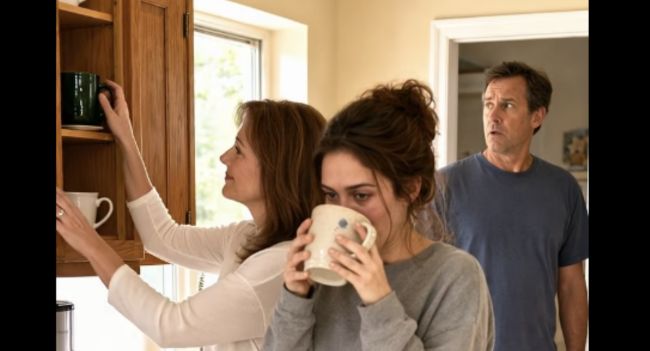
The coffee ritual had begun so innocently that I could not remember the first morning I did it. When Emma and her younger brother Daniel were small, I stayed home for several years while Mark worked, and making his coffee felt like tenderness. He would come downstairs adjusting his tie, find the mug waiting beside the newspaper, kiss the top of my head, and say, “You take such good care of me.” Back then, being needed felt almost identical to being loved.
But the children grew, I returned to work, and the arrangement never changed. I eventually became a branch operations manager at the public library, yet I still woke first, remembered appointments, packed what needed packing, replaced what was running low, arranged family plans, and somehow knew where everyone’s missing things were. Mark’s coffee remained first through all of it. The gesture stopped being something I gave and became something everyone assumed would simply happen.
I first noticed how deeply that expectation had settled into our marriage on my forty-sixth birthday. I came downstairs dressed for an early meeting and found Mark sitting at the table scrolling through his phone beside an empty coffeemaker. He looked at me and asked, “You didn’t make coffee?” When I told him no, he actually asked whether the machine was broken.
I laughed then because the alternative was admitting how much the question hurt. That afternoon, Mark sent flowers to the library with a card that said, “Happy birthday to the woman who keeps us all running.” My coworkers thought it was romantic, and part of me did too. But one word stayed with me long after the flowers died: running.
Not loved. Not seen. Running.
After the children left home, the imbalance became harder to ignore because there was nobody else creating noise around it. Mark still asked what we were doing Sunday, what was for dinner, whether I had called the plumber, where the batteries were, what Daniel had said about Thanksgiving, and when we were seeing Emma. None of those questions was terrible by itself. It was the thousands of tiny responsibilities behind them that exhausted me.
I did ask him for help over the years. Sometimes I asked gently, sometimes angrily, and twice I cried. Mark would improve for a while, make three dinners, do laundry, schedule something himself, then life slowly returned to normal. Eventually, I stopped fighting about it, and Mark mistook my silence for happiness.
Then Emma had Noah.
One night, three weeks after the baby was born, she called me close to midnight and started crying because he would not sleep. I drove to her house, stayed until after four in the morning, walked Noah through the living room, and let my exhausted daughter sleep. When I finally came home, Mark was still asleep.
At six, my alarm went off. I walked downstairs on less than two hours of rest and automatically poured coffee into Mark’s dark-green mug. Then I stood there staring at it.
Something inside me finally rebelled.
I had spent the night taking care of our daughter because she truly needed me. I was exhausted, had work ahead of me, and yet my body had still automatically decided that Mark should wake to a prepared cup of coffee. I poured his coffee back into the pot, washed the mug, and made tea for myself instead.
When Mark came downstairs, he asked about coffee. I told him it was in the pot. He stared at me as if I had spoken in another language.
That was the first time I saw fear behind his confusion.
Weeks later, after the Sunday when I handed Emma the first cup, Mark ordered my favorite takeout, poured wine, and lit a candle at dinner. He kept watching me as if kindness might make something familiar return to my face. Finally he asked, “Are you unhappy?”
I could have lied.
Instead, I said, “I was.”
His expression changed. “Was?”
I looked directly at the man I had spent almost thirty years loving and told him the one thing he was least prepared to hear.
“I don’t wake up every morning trying to figure out how to fix our marriage anymore.”
Part 3 is ready. If you’re still following this story, leave a  or a short “YES” so I know you want the next part.
or a short “YES” so I know you want the next part.