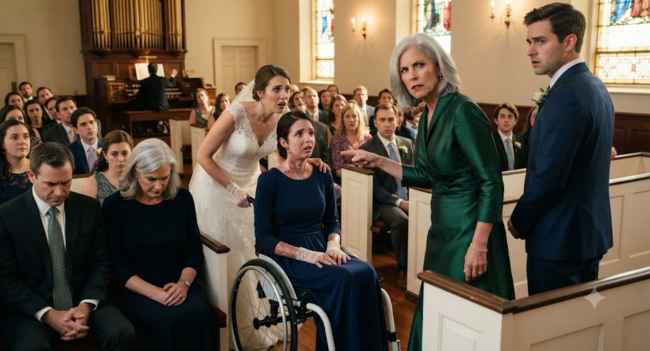
Margaret Callahan, the groom’s mother, stepped into the aisle before I could move my wheelchair.
She looked directly at Claire.
“She nearly died saving you.”
Five words.
The church went completely silent.
Claire’s face changed instantly.
Her fiancé, Daniel, turned toward her. “What does she mean?”
Claire forced a nervous smile. “She’s talking about the fire. It happened years ago.”
Margaret’s expression hardened.
“That woman went back into a burning house, wrapped her body around you, and carried you toward safety. Those scars you’re embarrassed to have in your wedding photographs are there because she protected you.”
Daniel stared at me.
Then at Claire.
“You told me your sister was injured in the fire. You never told me she was injured saving you.”
Claire looked toward our parents for help.
Mom finally stood. “This isn’t the time to discuss something that happened thirteen years ago.”
Margaret turned toward her.
“You heard what Claire just said to her, didn’t you?”
Mom said nothing.
Dad looked down.
That silence answered everything.
Claire’s eyes filled with tears. “I only asked her to move. I wanted the photographs to look a certain way. That doesn’t mean I don’t love her.”
I finally spoke.
“Then why do I need to be hidden?”
Claire froze.
I had spent years protecting her from guilt over the fire. Whenever relatives mentioned my scars, I changed the subject. Whenever Claire apologized, I told her she had been a child and none of it was her fault.
I never wanted her to feel indebted to me.
But I also never imagined she would grow up ashamed of the evidence that I had saved her.
“I would go into that house again,” I told her. “I would take every scar again if it meant getting you out.”
My voice broke.
“But I will not apologize because surviving it made me imperfect in your photographs.”
Daniel slowly stepped away from Claire.
She immediately noticed.
“Daniel?”
He looked devastated rather than angry.
“Why didn’t you tell me?”
“Because it was traumatic.”
“That isn’t what I’m asking.”
He pointed toward me.
“Why didn’t you tell me what she did for you?”
Claire had no answer.
Then Margaret revealed why she knew the story.
Her late husband, Thomas Callahan, had been one of the firefighters who responded to our house that night.
I stared at her.
Margaret explained that Thomas had spoken about the fire for years. By the time firefighters reached the second floor, I had already carried Claire through most of the burning house.
Thomas had helped pull us through a window.
He remembered the teenage girl who refused to let go of her little sister even after her own clothes had caught fire.
Margaret had recognized my name when she saw the wedding program.
“I didn’t realize you were that girl until today,” she said.
Then she reached into her handbag.
Inside was an old photograph.
It showed several firefighters standing outside our burned house the morning after the fire.
On the back, Thomas had written a short note about the two sisters they had rescued.
Margaret handed it to Daniel.
He read it.
Then he looked at Claire.
“I can’t marry you today.”
A gasp moved through the church.
Claire grabbed his arm.
“Daniel, please. You’re ending our wedding because I asked her to change seats?”
“No.”
He gently removed her hand.
“I’m stopping the wedding because I just watched you humiliate someone you should have been proud to have sitting in the front row.”
Claire began crying.
Mom rushed toward Daniel and accused Margaret of destroying the ceremony over one emotional mistake.
That was when Daniel said something I will never forget.
“Her scars didn’t ruin this wedding. Claire’s shame over them did.”
He walked away from the altar.
For several seconds, nobody moved.
Then Claire turned toward me.
I expected anger.
Instead, she collapsed onto the front pew.
“Hannah…”
I wheeled closer.
She looked at the scars along my hands.
For the first time that day, she seemed unable to look away.
“I’m sorry.”
I believed she meant it.
But an apology could not erase what had happened.
“I forgive the ten-year-old girl I carried out of that house,” I told her quietly. “But the woman standing here today has to decide who she wants to become.”
Then I left.
Margaret walked outside with me.
Six months passed before Claire contacted me again.
There was no wedding photograph attached to her message.
No excuse.
No request for me to convince Daniel to take her back.
Just an appointment confirmation.
She had started therapy.
Below it she had written:
“I spent years pretending the fire happened to me. I never understood that you were the one who kept living inside its consequences.”
That was the beginning.
Not of everything returning to normal.
It never did.
But of Claire finally taking responsibility without asking me to make her feel better about it.
Daniel did not immediately reconcile with her. He told her that changing because she wanted her wedding back was not enough.
Nearly a year later, Claire came to my apartment carrying a small box.
Inside was the photograph Margaret had shown us at the church.
Claire had restored it and placed it in a simple wooden frame.
On the back, beneath Thomas Callahan’s original handwriting, she had added one sentence of her own:
“My sister was never the scar in my perfect picture. She was the reason I was alive to stand in it.”
I cried when I read it.
Claire cried too.
And this time, neither of us tried to hide what the fire had left behind.