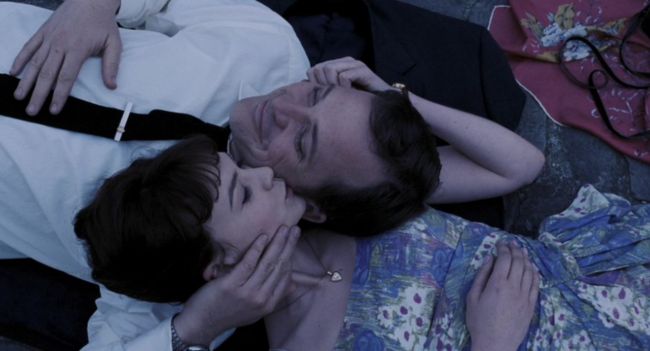

Carey Mulligan has had an astounding career. She shines in beloved films like Pride & Prejudice, Drive, and Inside Llewyn Davis, and has taken on the works of great playwrights like Chekov and Molière from the West End to Broadway. But she first held her own – and earned her first Oscar nomination – for An Education, a film based on the shocking memoir of journalist Lynn Barber. Mulligan stars as Jenny, a 16-year-old girl with a love of music and French in 1960s London. Jenny has all the markings of a teen of her time. She’s relatively sheltered and is becoming increasingly aware of it. She sneaks cigarettes with friends to feel rebellious, but for the most part, is bright and obedient. Her only struggles are Latin and pleasing her uptight and overly severe father, Jack (Alfred Molina).
She meets David (Peter Sarsgaard) when he offers her a ride to protect her beloved cello from a sudden downpour. David, very clearly in his 30s, immediately pursues a relationship with Jenny. The film doesn’t simply wring its hands about the nature of power imbalances and grooming. It shows the culture of restriction and emotional neglect that makes Jenny susceptible to it all. Almost entirely from Jenny’s point of view, An Education explores the hope and possibility of a teenager’s future when adults try desperately to shape it for themselves.
In ‘An Education,’ Carey Mulligan Is as Extraordinary as She Is Typical
An Education sets itself apart from other stories about teens groomed and seduced in that Jenny is as typical as she is extraordinary. Jenny’s home life isn’t gratuitously awful. Instead, it’s realistically mundane, peppered with a common kind of emotional neglect. Her father calculates every cent he spends on her education, music lessons, and a Latin tutor. He openly resents anything she does for pleasure and even wants to limit how many orchestra concerts she performs in – It doesn’t matter if she loves it.
He is obsessed with Jenny getting into Oxford as a point of status – a bridge to a good career, or, ideally, a good marriage. Jenny’s desire to go to Oxford is inspired by her genuine passion for languages and literature. Even where they agree, there is tension, and the kind of parenting that makes Jenny feel restricted, unheard, and unseen. And so David positions himself less as a suitor or even a friend. David presents himself as an opportunity. For Jenny, that opportunity is freedom, a slight rebellion, and, of course, the more sophisticated flirtation that an adult with grown-up tastes and grown-up money can provide. Wanting the best for their daughter, Jack and Jenny’s mother, Marjorie (Cara Seymour), easily buys into it. When he lies that he graduated from Oxford himself and has connections over a bottle of wine, Jenny’s parents are entirely taken in.
Alongside Jenny and her parents, the film allows you to be sucked into the charm of David and his friends, Danny (Dominic Cooper), a sharper, blunter business associate, and Helen (Mulligan’s Pride & Prejudice co-star Rosamund Pike), a beauty who ricochets between arrested development and a decidedly adult submission to her circumstances. Danny and Helen mirror the dynamic between Jenny’s parents. In her home life and her social life, Jenny is pressed between David and the domestic dynamics she’s desperate to escape. It only fuels Jenny’s feeling that it’s now or never to make her life meaningful, which causes her to cling tightly to David’s supposed sophistication.
‘An Education’ Deconstructs Romantic Tropes
Where leniency is denied to Jenny for normal teenage girl activities, such as taking an afternoon to listen to records or spending time with her friends, it’s given liberally to her by David. Her mother is permissive and blinded by not wanting her child to be trapped in the life she finds so restrictive. Her father wants to be liked and validated by David, whom he deems worldly and capable. A trip to Paris solidifies her parents’ feelings about it all – how can they question David if he can offer their daughter so much more? They too readily accept the lie that he has an elderly aunt who will act as Jenny’s chaperon.
Paris is the culmination of many things for Jenny. Throughout the film, David and his friends tease her that she’d fit right in there. Where her love for literature is very real, French feels loftier and more romantic than what her parents want for her. It’s the fantastical peak of her teenage dreams, whereas Oxford is, by contrast, an impressive but boring and grounded goal. In a montage cut between realism and fantasy, David takes photos of Jenny in a modern, form-fitting dress and a mature updo with his Pentax camera along the River Seine. Singer Juliette Gréco fills the scene non-diegetically at first, then fades diegetically through a scratchy, portable record player. Where Jenny is captured at the height of her youthful happiness, behind the camera, David is paranoid and resentful when passersby notice Jenny, men checking her out, couples smiling at her. The sequence skips sunset over the Seine and moves instead to the questionable couple lying in blue moonlight. In full dramatic irony, the audience can see that it’s falling apart, though Jenny thinks her life is finally beginning.
The only person who will face consequences for any of this is Jenny, the child in the situation. But without making Jenny a tragic example, director Lone Scherfig and the incomparable instincts in Mulligan’s performance show that there’s no such thing as a doomed woman, certainly no such thing as a doomed girl.
SOURCE: COLLIDER