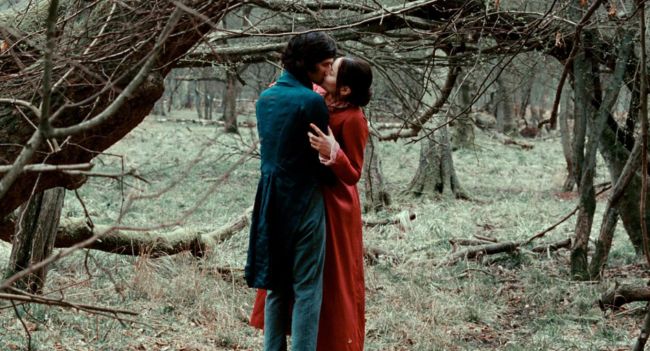

“The beginning of your poem has something very perfect,” says Keats’s lover, Fanny Brawne, of his Endymion – before complaining that the rest of it isn’t nearly as good. Tactfully, Jane Campion allows us to understand that this is not so much a criticism of Keats’s poetry but his life, in fact all our lives. They are finest at the beginning and careless youth is an Endymion moment, a blaze of perfection and rightness, destined to decay with adulthood’s compromises and responsibilities.
With this account of John Keats’s love affair with Fanny Brawne, played by Ben Whishaw and Abbie Cornish, Campion has made a fine and even ennobling film: defiantly, unfashionably about the vocation of romantic love. She has Whishaw and Cornish actually recite poetry – which, for most actors, is as difficult as walking on your hands or juggling with knives – and even proposes a kind of secular martyrdom for them in the movie’s final act. Their love is murdered by the false choice between love and art, and sacrificed to a petty tangle of money worries, social scruples and irrelevant male loyalties.
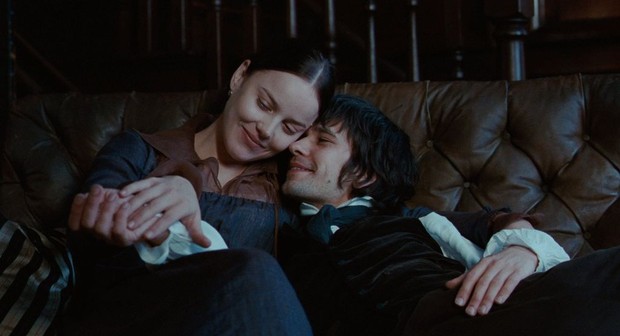
The movie is vulnerable to mockery or irony from pundits who might feel that Campion has neglected to acknowledge the primal force of sex, or from those who feel their appreciation of the poet exceeds that of the director. Nonetheless, I think it is a deeply felt and intelligent film, one of those that has grown in my mind on a second viewing; it is almost certainly the best of Campion’s career, exposing The Piano as overrated and overegged.
Very few films allow you to listen to the sounds of silence, or near-silence, between the lines of dialogue: the sounds of birdsong, or the rustle of clothing, or footfalls in a country lane – but that is what Campion’s does. Her film proceeds at a quiet, measured tempo and with a lucid calm. Another type of film would have supercharged its narrative moments with surging music and the engine-roar of dramatic acceleration, but Campion simply lets each scene unspool evenly. There is something coolly unobtrusive about her cinematic staging. Silently reading a letter in a picture-window is allowed no more ostensible weight than the flirtatious conversation at a ball, or even the final announcement of Keats’s death. And the action of the film proceeds largely within the summery pastures of 19th-century Hampstead, occasionally switching to the crowded squalor of Kentish Town. When Campion suddenly takes us to Keats’s silent funeral procession in Rome’s deserted Piazza di Spagna, it is the nearest thing to a flourish that she allows herself. But what a brilliant coup.
Cornish gives a wonderful performance as Fanny Brawne: the sensitive young woman who is intrigued and amused by the reputation of her neighbour, John Keats, but insistent on her own rival skills as a dressmaker and seamstress. Keats, as portrayed by Whishaw, has the self-possession of a middle-aged adult, the affected detachment of an artist and the eerie self-absorption of a child. Fanny’s “meet-cute” – to use the classic Hollywood term – is however not just with him; she also encounters Keats’s possessive and boorish best friend Charles Brown, played by the American actor Paul Schneider with a Scottish accent that British audiences may need to indulge a little. The same goes for his tartan waistcoat and trews.
Brown’s appearance in the story alerts us to the fact that this is a love triangle. Grumpy, cigar-smoking Brown is quite as in love with Keats as Fanny is. Desperate to maintain their fusty bachelor idyll together, idling, musing and writing, he is (justifiably) afraid that marriage will condemn his friend to poverty and exterminate his poetic gift. Brown even sends Fanny a valentine card for reasons that he can scarcely understand himself: a shabby attempt at both seducing and lowering her in Keats’s esteem? Is it an imitation of his revered friend – an attempt to get closer to Keats by behaving as he does? Or merely an admission of his own loneliness?
For a while, Fanny penetrates the mystery of Keats’s world and their affair proceeds: their single kiss is ecstatic in that lost metaphysical sense. It is also very physical. But how can things proceed when Keats cannot afford to marry and is already married to his work? He is moreover very ill, and his protective chorus of jealous critical admirers is never far away, fearing another English winter for their hero. They club together to buy a ticket for him to travel to the healthier climes of Italy, and the simple, abysmal fact of having spent all that money for him to go away crushes all hope for their love. Both his lover and his best friend see no choice but to concede the fiction that he may recover and that this arrangement is more seemly: an act of dishonesty that unites Brown and Fanny in shame. There’s no avoiding the dreadful sadness that descends on the film like a shroud, but even in the sadness there is a kind of euphoria, an ecstasy of loss.
SOURCE: THE GUARDIAN