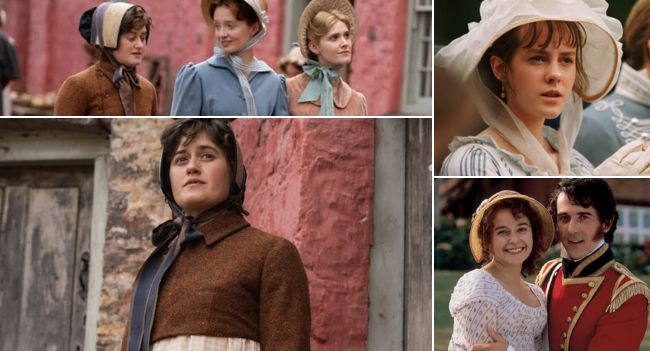
BEHIND LIZZIE & JANE’S SHADOW: THE TRAGEDY AND CORRUPTION OF THE OTHER BENNET SISTERS
In Jane Austen’s classic Pride and Prejudice, public attention is perpetually showered upon the sharp-witted Elizabeth and the pure-hearted Jane. However, the radiant spotlight on the two eldest sisters has completely blinded us to the dark reality of the younger Bennet sisters: Mary, Kitty, and Lydia.

Far from being mere comedic background noise, these three younger siblings serve as Austen’s most brutal societal critique—unmasking the horrifying consequences of a failed education and toxic, negligent parenting.
1. Mary Bennet: The Radicalization of a Attention-Starved “Pedant”
Mary is the only Bennet daughter cursed without beauty. Sandwiched between two older sisters praised for their grace and charm, and two younger sisters bursting with wild, flirtatious energy, Mary is utterly abandoned in her own home. To survive and crave a scrap of self-worth, she weaponizes the only avenue available: becoming an “Accomplished Woman.”

Yet, Mary’s tragedy is her complete lack of guidance. Her quest for wisdom devolves into empty, superficial pedantry. She memorizes moral clichés just to preach at people; she plays the piano mechanically and ostentatiously. Mary represents a tragic class of Regency women: exhausting themselves to meet societal standards, only to turn themselves into laughingstocks because they lack genuine emotional intelligence.
2. Kitty Bennet: The Identity-Less Follower and Peer Pressure Casualty
Catherine (Kitty) is often dismissed as the most faded character, but she reflects the absolute danger of peer pressure. Kitty isn’t inherently malicious; she is simply a flawed carbon copy of Lydia. Bound by age, Kitty completely surrenders her individual identity to mimic her younger sister’s toxic obsession with the militia officers.
Mr. Bennet’s cruel sarcasm (choosing to mock rather than mentor) and Mrs. Bennet’s blind indulgence turn Kitty into a jealous, hysterical, and dependent girl. It is highly telling that at the novel’s end, once separated from Lydia’s toxic influence and placed under the care of her eldest sisters, Kitty drastically improves. This exposes a ruthless truth: Kitty was a blank slate, corrupted entirely by a poisonous environment.
3. Lydia Bennet: The Spoiled Wild Child and the Collapse of Family Honor
Lydia is the terrifying climax of the Bennets’ parenting disaster. At just 15 years old, Lydia is the embodiment of unchecked flirtation, vanity, and reckless selfishness. She hurls herself at men, money, and status like a moth to a flame, culminating in her scandalous, ruinous elopement with the treacherous Wickham.
While readers love to hate Lydia, she is fundamentally a victim. Mrs. Bennet saw her own superficial youth in Lydia and actively funded her reckless behavior. Mr. Bennet simply checked out, lazily abandoning his daughter to a dangerous world just to keep his library quiet. Lydia’s eventual marriage to Wickham is no victory; it is a life sentence. A hollow-headed 15-year-old girl, legally chained to a manipulative gambler who does not love her, all because her parents refused to parent.
Conclusion
Through “the other sisters,” Jane Austen sounds a fierce alarm: neither physical beauty nor hollow moralizing can save a woman. Without a solid foundation of familial education, self-respect, and critical reasoning, women in the Regency era remain nothing more than cheap commodities, destined to destroy themselves in the ruthless gamble of marriage.