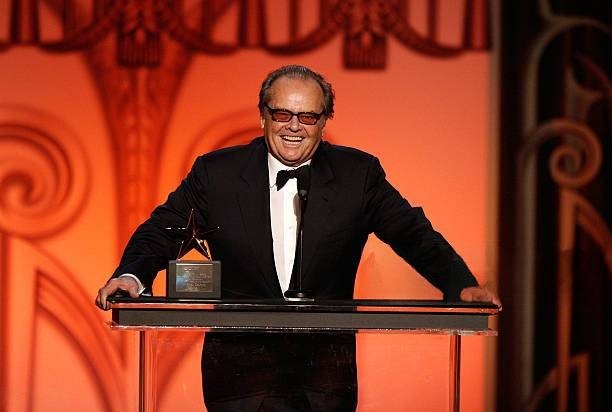
Jack Nicholson at the AFI Life Achievement Award 1994: The Night Hollywood Finally Paused to Say Thank You

By the time Jack Nicholson stepped onto the stage to accept the AFI Life Achievement Award in 1994, Hollywood already knew it was honoring more than a celebrated actor. It was honoring a man who had quietly — and sometimes chaotically — rewritten what it meant to be a leading man, a character actor, and a cultural icon, all at once.
The evening felt different from the start. This was not a typical awards ceremony driven by promotion or competition. There was no sense of anticipation about winners or box-office futures. Instead, the room carried something rarer: reflection. Gratitude. A collective understanding that a chapter of American cinema was being acknowledged in real time.
Nicholson, then in his mid-50s, had already lived several creative lives. He was the counterculture rebel of Easy Rider, the restless soul of Five Easy Pieces, the defiant Randle McMurphy in One Flew Over the Cuckoo’s Nest, the chilling presence of The Shining, and the tender, unexpected romantic lead in Terms of Endearment. Few actors had traveled so freely between danger and warmth — and fewer still had convinced audiences at every turn.

As tributes played on screen, laughter rippled through the audience, followed by moments of quiet recognition. Colleagues weren’t just watching famous scenes; they were remembering where they were when they first saw them. Directors, actors, and writers had grown up alongside Nicholson’s performances. His career wasn’t simply part of Hollywood history — it was Hollywood history.
What made the night especially moving was the tone of affection that surrounded him. This was not admiration from afar. It was personal. Many speakers referenced Nicholson not just as a performer, but as a collaborator who pushed boundaries, asked uncomfortable questions, and refused to settle for easy answers. He was known for taking risks long before they were fashionable — sometimes at the expense of his own image.
When Nicholson finally spoke, he didn’t present himself as a myth. He spoke like someone genuinely aware of how fragile success can be. His humor — dry, self-aware, unmistakably Nicholson — softened the room, but beneath it was sincerity. He thanked the people who believed in him when he was still an outsider, the filmmakers who allowed him to fail, and the actors who challenged him to listen rather than dominate0
 .
.
There was no attempt to polish the past. Nicholson acknowledged that his career was built as much on instinct and rebellion as on discipline. He spoke about timing, luck, and the strange freedom that came from never fully fitting into Hollywood’s expectations. In doing so, he reminded everyone why his work resonated so deeply: it was honest, even when it was uncomfortable.
Perhaps the most striking moment came not from his words, but from the reaction around him. The applause that followed was long and unhurried. People didn’t rush to return to their seats. Many stood still, absorbing the weight of the moment. This was recognition earned not through consistency alone, but through courage — the courage to choose difficult roles, flawed characters, and emotional risks again and again.
In the years since, the 1994 AFI Life Achievement Award ceremony has come to represent a turning point. It captured Jack Nicholson at the height of his legacy — still active, still relevant, yet already timeless. It was a reminder that true greatness in acting isn’t measured by awards or longevity alone, but by impact.
Jack Nicholson didn’t simply entertain audiences. He unsettled them. He challenged them. He invited them into characters who felt uncomfortably real. And on that night in 1994, Hollywood did something rare: it slowed down, looked one of its most complex figures in the face, and said thank you — not just for the performances, but for the honesty behind them.
Decades later, the applause still echoes. And so does the legacy.