When Young Voices Breathed New Life Into a Timeless Song: Inside Harvard Veritones’ Haunting “House of the Rising Sun”
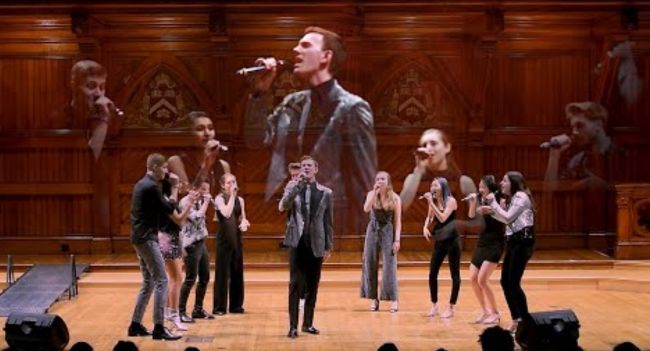
At first glance, it looks like a simple college performance — a group of young men standing together, no instruments in sight, no spectacle to hide behind. But within seconds of Harvard Veritones beginning House of the Rising Sun, it becomes clear this is something else entirely. What unfolds is not a cover, but a quiet reckoning between generations, carried only by human voices and shared breath.
The song itself is heavy with history. Long before it became synonymous with The Animals’ brooding 1960s recording, House of the Rising Sun existed as a traditional folk lament — a story of regret, fate, and roads that don’t lead back home. Choosing to reinterpret such a piece is a risk, especially for a collegiate a cappella group. The Veritones didn’t try to modernize it with flash. They chose restraint. And that decision changed everything.
From the opening line, the arrangement leans into atmosphere rather than volume. The lead voice emerges quietly, almost cautiously, as if stepping into a story already mid-sentence. Around him, the harmonies form slowly, deliberately, creating a sense of inevitability. There is no rush. Each note feels earned. Each pause feels intentional.

As the song builds, the group reveals its greatest strength: collective storytelling. No single singer dominates the narrative for long. Instead, voices rise and recede like passing thoughts — regret, longing, acceptance — weaving together into a single emotional arc. The bass grounds the performance, steady and ominous, while higher harmonies hover just above, adding tension without overwhelming the core melody.
What makes the performance particularly striking is the maturity behind it. These are students balancing classes, deadlines, and the uncertainty of early adulthood, yet they deliver a song steeped in consequence and reflection with remarkable emotional clarity. It’s not imitation. It’s interpretation. They don’t perform the song as observers — they inhabit it.
The staging reflects that same discipline. There are no exaggerated gestures, no theatrical distractions. The power comes from stillness. From eye contact. From breath control and timing. The audience doesn’t erupt or interrupt. Instead, the room seems to settle into a shared silence, the kind that only forms when listeners sense they’re witnessing something honest.

By the final verse, the weight of the arrangement is fully realized. The harmonies swell, not into chaos, but into resolve. The ending doesn’t explode — it closes inward, leaving a lingering echo that feels unresolved in the most human way. When the last note fades, it doesn’t feel like an ending. It feels like a door quietly closing.
What resonates most about Harvard Veritones’ House of the Rising Sun is not technical perfection, though it’s certainly there. It’s intention. It’s the understanding that some songs don’t need to be reinvented — they need to be respected, listened to, and carried forward.
In an era dominated by digital production and constant noise, this performance reminds us of something elemental: that voices alone can still hold history, emotion, and truth. That young artists can approach old stories not with irony, but with reverence. And that sometimes, the most powerful music happens when nothing is added — and nothing is rushed.
Long after the performance ends, the feeling remains. A quiet ache. A sense of having been invited into someone else’s story — and recognizing parts of your own within it.
That is the mark of a performance that lasts.