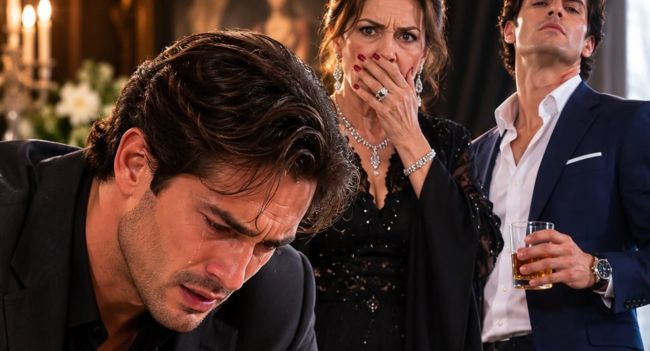
💔 “DON’T OPEN HER HAND,” MY MOTHER SHOUTED AS I STOOD BESIDE MY WIFE’S COFFIN.
My brother stepped closer and whispered, “Julián, you’re grieving. Don’t turn this into something ugly.”
But when I finally forced Camila’s clenched fingers apart and saw what she had died holding, I looked straight at him and said, “Then explain why your missing button is in my wife’s hand.”
Three weeks earlier, I had left our home in Valle de Guadalupe to travel to Monterrey for a business deal that could save my family’s vineyards.
Camila was eight months pregnant.
The morning I left, she stood barefoot in the kitchen wearing one of my old shirts, one hand resting on her stomach while she watched me pack.
“You’ll be back before he arrives, right?” she asked.
I laughed and kissed her forehead.
“I’ll be back before he even thinks about arriving.”
She smiled, but something in her expression stayed with me during the entire trip.
Before I walked out, she grabbed my wrist.
“Julián, if anything strange happens while you’re gone, don’t believe the first story they tell you.”
I thought she was talking about the business.
For months, Camila had suspected someone was stealing money from the vineyards. She had found duplicate invoices, unexplained transfers, and contracts containing signatures that did not look like mine.
My mother, Teresa, controlled most of the family finances.
My older brother Rodrigo handled negotiations with investors.
Whenever Camila questioned either of them, they dismissed her as an outsider who did not understand how our family worked.
I promised we would deal with everything when I returned.
I never imagined that warning would be the last real conversation we had.
When I came home three weeks later, I was carrying white lilies in one arm and a small wooden toy horse for our unborn son in the other.
The front door was unlocked.
Black curtains covered the windows.
Candles burned throughout the living room.
And directly beneath the chandelier stood a coffin.
My mother was waiting beside it in a perfectly tailored black dress.
She did not hug me.
She did not cry.
She simply said, “Your wife died during childbirth. The baby did not survive.”
The lilies slipped from my hand.
For several seconds, I could not understand the words.
I kept staring at my mother, waiting for her to admit it was some cruel misunderstanding.
Then I saw Camila.
She lay inside the coffin with her dark hair brushed around her shoulders. Her face looked peaceful, almost too peaceful, as if someone had carefully designed the scene.
I stepped toward her.
My mother immediately blocked my path.
“You should remember her as she was,” she said.
“She is my wife.”
“There is nothing you can do now.”
I moved around her and leaned over the coffin.
Camila looked beautiful, but something was wrong.
She had once told me that she never wanted to be displayed like a saint after death.
Yet her makeup was flawless.
Her dress had been pulled carefully over her stomach.
One hand rested neatly across her chest.
The other was clenched so tightly that the knuckles looked almost white.
I reached for it.
My mother’s voice rose behind me.
“Don’t open her hand.”
I froze.
Until that moment, everyone had spoken in controlled whispers.
Now her voice was sharp with panic.
Rodrigo appeared in the hallway holding a glass of whiskey.
He wore a navy-blue jacket and looked more irritated than devastated.
“Julián,” he said, “you’re grieving. Don’t turn this into something ugly.”
I looked from him to my mother.
Then I began opening Camila’s fingers.
They were stiff and cold.
I had to separate them one by one, apologizing under my breath as though she could still feel the pain.
The housemaids stood silently near the wall.
My mother grabbed my shoulder.
“Leave her alone!”
I pulled away and opened the final finger.
A navy-blue button fell into my palm.
A torn piece of fabric was still attached to it.
There was dried blood beneath Camila’s fingernails.
I recognized the button immediately.
Rodrigo had worn the same custom-made jacket to our father’s funeral two years earlier. Every button carried a tiny silver crest engraved with our family initials.
I looked up.
One button was missing from his jacket.
There was also a fresh scratch running down the side of his neck.
No one spoke.
Rodrigo slowly placed his whiskey on a table.
“That proves nothing,” he said.
I held up the button.
“Then explain why this was in my wife’s hand.”
My mother stepped between us.
“She must have grabbed it earlier. They argued sometimes.”
Camila and Rodrigo had argued, but never privately.
She did not trust him.
Two months earlier, she had accused him of pressuring my mother to sell the vineyards to a foreign investment company.
Rodrigo would receive a large private payment if the deal went through.
Camila had discovered the arrangement and threatened to show me the documents.
Now she was dead.
And the evidence she had managed to hold onto was literally in my hand.
Still, I did not accuse him.
Not yet.
I lowered my voice and said, “You’re right. I’m grieving.”
Rodrigo relaxed.
My mother exhaled.
They believed I had been broken badly enough to become obedient.
For the next several hours, I let them talk.
They said Camila’s death had been sudden.
They said the hospital had recommended an immediate burial.
They said there was no reason for an autopsy because childbirth complications were common.
Then my mother mentioned cremation.
“We should not prolong this,” she said. “Let her rest tomorrow.”
Tomorrow.
They wanted Camila’s body destroyed less than twenty-four hours after I returned.
That night, I pretended to drink until Rodrigo went upstairs.
Then I locked myself inside my father’s old office.
Behind his portrait was a safe only Camila and I knew how to open.
Inside were copies of the financial records she had collected.
There were payments from the vineyard accounts to shell companies.
Several were connected to Rodrigo.
Others had been approved using my mother’s authorization.
At the bottom was a legal agreement Camila had insisted we sign six months earlier.
If either of us died under suspicious circumstances, the surviving spouse would receive full authority over our shared assets and could request an independent investigation without interference from the family.
Camila had known she was in danger.
She had prepared for it.
I took out my phone and called Dr. Ana Lucía Méndez, Camila’s closest friend.
Ana Lucía was also the director of the private hospital where my mother claimed Camila had died.
She answered on the second ring.
“Julián?”
Her voice was shaking.
“I’ve been trying to reach you all day.”
I gripped the edge of the desk.
“Tell me what happened to my wife.”
There was a long silence.
Then she said, “Not over the phone.”
“My family says she died during childbirth.”
Another silence.
“That is not what happened.”
My entire body went cold.
“What do you mean?”
Ana Lucía lowered her voice.
“Camila was never admitted here alive.”
I stood so quickly that the chair fell behind me.
“She was brought through a private entrance without identification. Your mother demanded that no official file be created.”
“And the baby?”
Ana Lucía started crying.
I could hear her trying to control her breathing.
“Listen carefully,” she whispered. “Come to the hospital tomorrow at six in the morning. Use the emergency entrance. Do not bring anyone. Do not tell your mother where you’re going.”
“Is my son dead?”
She did not answer.
“Ana Lucía, is my son dead?”
Before she could speak, someone knocked hard on the office door.
“Julián?” Rodrigo called from the hallway. “Who are you talking to?”
Ana Lucía whispered one final sentence.
“There is something you need to see before they destroy the evidence.”
Then the call ended.
I stared at Camila’s documents scattered across the desk.
The button was still clenched in my fist.
Rodrigo knocked again, harder this time.
And that was when I noticed the small red light blinking beneath my father’s bookshelf.
A hidden camera.
Someone had been watching me the entire time.
Camila’s final clue changed everything.
I left the house before sunrise and drove to the hospital exactly as Ana Lucía had instructed. She led me through a restricted corridor into a small records room, where she locked the door behind us.
Then she handed me a sealed envelope.
Inside were photographs.
Not of a childbirth.
Not of an operating room.
They showed bruises on Camila’s wrists, scratches on her arms, and injuries that had nothing to do with labor. Ana Lucía explained that whoever brought Camila in had refused to answer basic questions, demanded that no official admission be created, and insisted on immediate cremation. She had secretly documented everything because something felt terribly wrong.
Then she opened another file.
“I lied about one thing,” she whispered. “I couldn’t tell you over the phone.”
My hands shook.
“The baby…”
“…was alive.”
For a moment I couldn’t breathe.
Ana Lucía explained that when Camila arrived, she was already beyond saving, but doctors managed to deliver the baby by emergency procedure. Before the paperwork could be completed, Rodrigo and my mother arrived with forged authorization claiming another hospital would continue the infant’s treatment. They took my son before anyone realized the documents were fake.
That was the beginning of the investigation.
Using the financial records Camila had hidden, the hospital photographs, the navy-blue button, and DNA recovered from beneath her fingernails, detectives uncovered a much larger conspiracy than anyone expected.
Camila had discovered that Rodrigo had been stealing millions from the family vineyards through shell companies. When she confronted him the night before I returned home, the argument turned violent. She fought back hard enough to rip the button from his jacket and scratch his neck before she collapsed from her injuries. Rather than calling for help immediately, Rodrigo phoned my mother. Together they staged the scene, fabricated the story of a tragic childbirth, and tried to rush the cremation before anyone could ask questions.
What neither of them knew was that Camila’s last act had been to hide the button in her clenched hand.
She knew I would find it.
Police located my son less than forty-eight hours later at a remote property owned by one of Rodrigo’s business associates. He was weak but healthy. The kidnappers admitted they had been promised a large payment to make sure the child disappeared forever, eliminating the only direct heir who could complicate Rodrigo’s plan to seize control of the vineyards.
At the trial, my mother insisted she had only been trying to protect her family.
The judge answered quietly:
“You stopped protecting your family the moment you chose your son over the truth.”
Rodrigo was convicted of murder, kidnapping, fraud, and conspiracy. My mother received a lengthy prison sentence for her role in covering up the crime and attempting to destroy evidence.
Months later, I finally visited Camila’s grave with our son in my arms.
He wrapped his tiny fingers around one of mine exactly the way she used to.
“I found what you left for me,” I whispered, placing the navy-blue button beside a bouquet of white lilies.
“You saved our son… and you made sure the truth was buried with no one.”
The wind moved softly through the vineyard she had fought so hard to protect.
For the first time since losing her, I wasn’t standing there as a broken husband seeking answers.
I was standing there as the father she had died to save, determined that our son would grow up knowing his mother’s courage—not the lies that almost erased her forever.