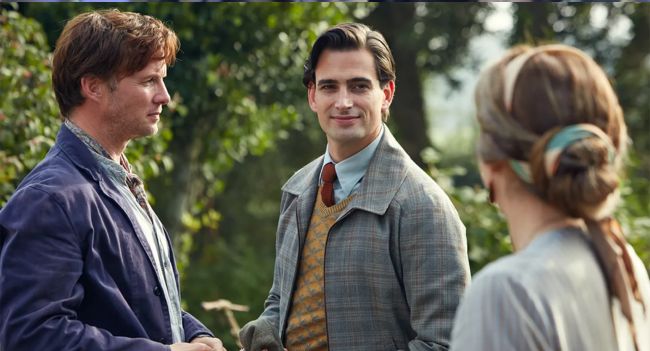
If only their passions had been as muted as their palettes – how different life could have been for the Bloomsbury set. By the end of the opening episode of Life in Squares (BBC2), the three-part dramatisation of the Stephen-Bell-Strachey-Keynes-Sackville-Woolf lot’s attempts to fit their life into their art, their art into their life and their genitals into anyone who was passing through WC1, we had had two deaths, at least four affairs (depending whose terms you use) and a handful of criminal assignations, all set against the most exquisitely tasteful interiors you could hope for. I don’t know how they found time to handpaint half the lampshades they did.
The drama took a certain effort of will to get into. You just have to accept that you are in a world where people convened salons, and probably did say things like “Childe Harold is a load of posturing nonsense! It can’t hold a candle to Don Juan, even if the alexandrines are forced to breaking point!” and let the pounding in your head pass.

Do try, because after that it’s very, very good. From Phoebe Fox and Lydia Leonard as the loving/warring sisters Vanessa, soon-to-be-Bell, and Virginia, slightly-later-to-be-Woolf, around whose increasingly strained relationship the story essentially revolves, to the doctor in a single scene realising his patient (the painter Duncan Grant) is “an invert”, the performances are uniformly wonderful (though Ed Birch as Lytton Strachey has so far the best part and the best time). And the script – once you take that linguistic leap of faith – is glorious. “That’s what they do,” muses Virginia as she and Vanessa ponder the proclivities of the men in their house and lives. “Exclude us. From clubs. Schools. Orifices.” Though on the last, Vanessa comes to disagree. She marries the uninverted Clive Bell and sends her sister a letter. “Copulation a tremendous success!” Attagirl.
It is also a success between Strachey and Grant (until he follows the lead of Strachey’s previous inamorata and hives off with Keynes, evidently preferring revolutionary theories of aggregate demand to Strachey’s increasingly distressing beard). And it’s a success between Bell and a Mrs Ravenhill after Vanessa has a baby. And almost between Bell and Virginia. And between Vita Sackville-West and Virginia. And I think that’s it. Personally, I’d bang any one of them for a half-share in Charleston and a set of those lampshades, but alas those days are gone. I recommend tuning in for the next two weeks, so that we may waft on through the 1920s and 30s with those absurd, amazing, beautiful characters, and fleet our time as carelessly as they in that ridiculously golden world.
If your ephemeral beauty needs were not quite sated by Life in Squares, you could turn with a happy sigh to the blooms in the first part of Carol Klein’s Plant Odysseys (BBC2), which this week traced the rise of the rose, from the wild dogwood scrambling through the hedgerows of Britain since time immemorial, via chance mutation and human intervention, to the great blowsy exuberance of the Princess Alexandra of Kent. They wound their way into art, literature, medicine, politics and religion along the way – the Marian idolisers of their virgin “rose without thorns” alone would keep you busy for 100-part series – stumbling only briefly when the upstart tulip (the subject of next week’s episode) came along. Klein took us on a wonderfully lively and attractive, if all too quick, tour of cabbages and kings. There are just three more episodes to go. More, please. A bouquet of Bourbons to whoever commissions them.
Less exotic but no less breathtaking were the delights on offer from The Pennine Way (BBC2). Polar explorer, mountain climber and ocean diver Paul Rose has taken what I imagine to be 10 minutes out of one action-packed Saturday to walk the 268 miles up the backbone of England, from Edale in Derbyshire to Kirk Yetholm in Scotland, to mark its 50th anniversary.
The right-to-roam movement began in the 1930s, but it wasn’t until 1965 that the campaign for a long-distance trail in the north reached fruition. There was wonderful contemporary footage of the landowners who opposed the Pennine Way’s creation, proclaiming they wouldn’t be sew werried ef the general stenderd of behayvyah among the British pebblic were heyeh. Ah, vowels. They don’t make ’em like they used to.
So far, Rose has seen Stoodley Pike, a crashed US wartime bomber, a place called Shining Clough, some weavers’ cottages and Barrie Rutter. All is well. All is well.
SOURCE: THE GUARDIAN