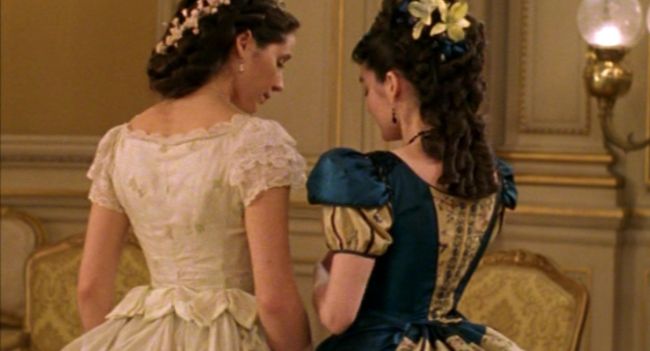

The costume drama’s enduring allure mostly lies in its escapism — the promise of being transported into a fantastical alternative past devoid of any stress greater than making sure the day’s afternoon tea arrives on time. While it’s difficult to argue with those winsome qualities, the best period pieces provide luxurious comfort but still contend with their timeframe’s less savory aspects. Those gorgeous ballgowns and starry-eyed romances are more satisfying when historical stratification, prejudices, and corruption both reflect and contrast against the characters’ aspirations.
The Way We Live Now, a BBC miniseries produced during the network’s costume production heyday that’s available for free on The Roku Channel, does just that. Written by BBC mainstay Andrew Davies (1995’s Pride and Prejudice, 2005’s Bleak House) and directed by David Yates (Fantastic Beasts), The Way We Live Now adapts Anthony Trollope‘s 1875 novel that’s both a dark satire and an incendiary critique of all-consuming greed. Defined by ambition, manipulation, betrayal, and strife, in some ways, The Way We Live Now is a milder, Victorian, yet still gnarly version of Succession.
What Is ‘The Way We Live Now’ About?

When the affluent European financier Augustus Melmotte (David Suchet) moves his family into the heart of London, gossip and curiosity abound. Any hostility surrounding his nouveau riche status, hisundisclosed ancestry, or his mystery-shrouded business deals fall by the wayside once society understands that this newcomer offers financial success beyond their wildest dreams. Suddenly, the country turns around Melmotte’s every move. Both the city’s peerage and its unfairly debt-riddled citizens flock to his style-without-substance mansion, plunging their stocks into his latest venture or hanging all their hopes upon his promises, respectively.
Melmotte’s monetary miracles demand a steeper sacrifice than anyone realizes. A cuttingly perceptive and self-made entrepreneur, he knows which cards to play and when to reveal his hand. He also knows he can defy certain social graces, because everyone, even the lords born with silver spoons in hand, will bow to his whims. His scams shamelessly prey upon his investors, rich and working-class alike, vowing to give them the moon in exchange for the funds he instead funnels into his own ambitions.
‘The Way We Live Now’ Boasts a Morally Complex Ensemble Cast of Characters


None of The Way We Live Now‘s characters fully escape Melmotte’s devious calculations. Their ramifications splinter off and strike even those he’s never met. Among the affected individuals are engineer Paul Montague (Cillian Murphy) and the Carbury family. Sir Felix Carbury (Matthew Macfadyen), the only son of widowed author Lady Carbury (Cheryl Campbell), has blithely gambled and drunk away his family’s entire fortune. Spying his golden ticket to endless luxury in Augustus’ daughter, Marie (Shirley Henderson), Felix sets out to seduce the naive, emotionally neglected heiress for her dowry.
Unlike her irresponsible yet doted-upon older sibling, Hetta Carbury (Paloma Baeza) endures her mother’s incessant guilt-tripping about Hetta’s marriage prospects; providing for their safety and security falls upon her shoulders. A modern-minded woman, her preferred aims include exploring the world and accomplishing things of merit. If she must marry, she’s determined to wed for love. After a chance introduction and several ballroom dances, Hetta and Paul fall in love at first sight. When he isn’t daydreaming about his lady, Paul’s quietly idealistic days are consumed by building a railway in America. He convinces Melmotte to fund the project and remains the only person on the railway’s board to question their financier’s suspicious methods — like where all their money has vanished.
Paul’s also the former ward and current friend of Roger Carbury (Douglas Hodge), Hetta’s and Felix’s cousin. That makes Paul and Hetta’s unspoken yearning rather messy, since Roger wants to marry Hetta — who doesn’t reciprocate his feelings — with a desperation bordering on irrational. Paul’s friendship with Roger, his exhausting schedule, his limited financial means, and a controversial figure from his past who entraps him through his gentlemanly honor all prevent him from proposing to his dream woman.
Greed, Selfishness, and Discrimination Go Hand-in-Hand in ‘The Way We Live Now’

Melmotte effortlessly exploits London’s industry because of the existing class-based structure. It’s a playground for the elite to maneuver stocks, trade, and liquidity to their liking, while the less fortunate desperately scramble for a saving grace to save them from impoverishment. But greed can destroy even the wealthiest, since those at the top always indulge their tireless need for more. No treachery is off-limits if it achieves their desires, and no price is too high — as long as someone else coughs up the cost. Appearances determine a great deal, but power and control rule supreme, and Melmotte knows that law like the back of his hand. Suchet, whose career is defined by his portrayal of Agatha Christie‘s quirky detective Hercule Poirot, phenomenally showcases his range as this ruthless figure.
Sexism and bigotry are also inseparable from The Way We Live‘s disproportionate hierarchy. Women must guarantee their future before their limited window of marriage eligibility closes, hence weddings being negotiated like passionless business arrangements. It’s a dire and familiar reality, one that Hetta defiantly rejects in favor of keeping what limited autonomy she possesses. Other women can’t enjoy that freedom without risking destitution. And for every decent man, there’s an answering scoundrel who flagrantly exploits the so-called fairer sex. Melmotte woos and intimidates his all-male inner circle, but he abuses both Marie and his permanently agitated second wife (Helen Schlesinger); Felix’s callous schemes shatter two different girls’ notions of love. That said, people of all genders flaunt their power, viewing love neither as something to cherish nor a social currency to exchange, but as a game they’ve rigged to benefit themselves.
As for bigotry, it’s important to note the possibility that Melmotte is a Jewish man and how his fiscal supremacy plays into the insidiously false stereotype that Jewish individuals control the world economy. The Way We Live Now mentions the rumors surrounding his potential ancestry one time, and doesn’t confirm or deny their validity. Although that ambiguity avoids a blatantly egregious error, it’s still discomfiting. The series does a better job on that front with the engagement between Mr. Brehgert (Jim Carter), a banker and a practicing Jew, and Georgiana Longestaffe (Anne-Marie Duff), a socialite repelled by his religion and shunned by her illustrious peers because of her upcoming nuptials.
‘The Way We Live Now’ Is a Twisty Period Drama That’s Definitely Worth the Binge
SOURCE: COLLIDER