THIS 60-YEAR-OLD MASTERPIECE HAS EVERYTHING MODERN MOVIES KEEP CHASING 🎬🔥❤️ Some films are remembered for their spectacle. Others for their romance. This rare classic somehow delivers both at the highest level. Set against the chaos of war and revolution, the story blends breathtaking cinematography, unforgettable music, grand-scale storytelling, and a love story so powerful that it still breaks hearts decades later. Every frame feels larger than life, yet the emotional journey remains deeply personal, following two people desperately trying to hold onto love as the world around them falls apart.
Congratulations!
You've earned 1 point
David Lean Followed Up ‘Lawrence of Arabia’ With This Other Epic Masterpiece That’s Just as Grand
Image via MGM
In addition to being a contributor for Collider, Rance Collins has also written for Variety, IndieWire, Los Angeles Magazine, Turner Classic Movies and The Huffington Post. His news coverage has earned him multiple honors from the California News Publishers Association, while his film and theater criticism made him a two-time Southern California Journalism Award winner. He also was recognized with 2024’s Excellence in Journalism Award by the California 51st Assembly District.
Before committing to journalism as a career, the Texas native lived many lives in Los Angeles – including as a Warner Bros. and Universal Studios tour guide, a political organizer, a marketing writer and producer, a leasing consultant, an occasional indie filmmaker, a Postmates driver and the personal assistant to TCM host Ben Mankiewicz. He holds a BFA in mass communications from Ouachita University and an MFA in screenwriting from Emerson College.
Other interests include ‘90s sitcoms, Hollywood backlots, true crime, record stores, Linda Ronstadt, two cats named Charlotte and Flynn, game nights, advocating for an expanded “Hacks” universe, his AMC A List entourage (aka Jorge), the daily NYT Connections, his Barbra Strikesand bowling team, and making his educator mom and author dad proud.
How do you follow up one of the greatest movies ever made? Well, if you’re David Lean, you just make another all-time great movie. In 1965, Lean was already considered to be among the best working directors of his day. He had, interestingly, started his career in England making relatively small, personal stories. He first directed the Noel Coward-penned In Which We Serve, which helped bolster the war effort in 1942. This Happy Breed followed, a relatively quaint drama.
He made two of his most celebrated early films in 1945, Blithe Spirit — an adaptation of the comic stage play — and Brief Encounter, a melodrama concerning a woman’s adulterous affair, which Time Out voted as the 12th greatest British movie ever made. He moved on to Charles Dickens with Great Expectations and Oliver Twist, both of which hinted toward the more epic scale Lean would become known for later on. His 1950s films included the location-shot Summertime, which starred Katharine Hepburn as a schoolteacher taking a once-in-a-lifetime vacation to Italy, where she falls in love with a married man.
David Lean Had a History With Great Epics
Image via Columbia Pictures
Lean came fully into his bombastic persona with The Bridge on the River Kwai, the World War II film shot on a mammoth scale, which starred Alec Guinness and William Holden. The movie, clocking in just 20 minutes shy of three hours, was a humongous box office success and won the Best Director Oscar for Lean, in addition to the movie itself winning Best Picture.
It took Lean five years to follow up that mammoth hit — and he did it with something bigger in every imaginable way: Lawrence of Arabia. It was even more celebrated, and it won Lean yet another Best Director Oscar, in addition to the movie itself winning Best Picture (again). The American Film Institute has twice ranked it as one of the ten best films ever made. Lawrence of Arabia is the longest movie to win Best Picture at the Academy Awards… it also has the interesting distinction of being one of (if not the) longest movies ever released to feature no female speaking roles.
✕Remove Ads
So now it was on David Lean to deliver again. And in 1965, he gave audiences everything they could possibly want with Doctor Zhivago.
The Production of ‘Doctor Zhivago’ Was Massive in Scale
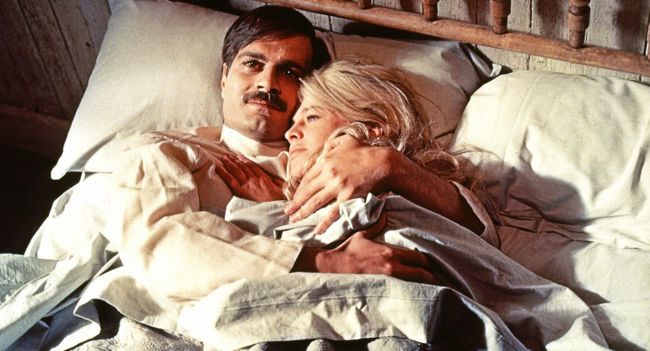
Doctor Zhivago is based on Boris Pasternak‘s 1957 novel about Russia during the simultaneous conflicts of World War I and the Russian Revolution. Starring Omar Sharif, the Oscar-nominated breakout star of Lawrence of Arabia, the book had been highly controversial and banned in the Soviet Union. As such, no scenes were actually shot in Russia — and the film was, of course, presented in English — but the epic story about doctor Yuri Zhicago and his two loves: his wife, played by Geraldine Chaplin, and his tortured obsession, Lara (Julie Christie), captured audiences in a way rivaled only in cinema history by Gone with the Wind. Had it not been for the release of The Sound of Music that same year, Lean might very well have walked away with another Academy Award and the biggest box office hit of all time.
✕Remove Ads
But no matter if the Von Trapps prevented a record-breaking success or not, Doctor Zhivago and its doomed romance entered pop culture in a way few films have ever managed.
Using approximate locations throughout Europe — and principally in Spain — Lean was able to accomplish striking realism in various sequences, including in scenes that required heavy snow, though, of course, movie magic was required for several scenes. One of the most awe-inspiring scenes involves a frozen palace in which Zhivago and Lara take refuge. These portions of the movie were shot during the summer. Cellophane and dripped wax covered the furniture in the house, and soap flakes and salicylic acid powder covered the floors. A massive field of daffodils was planted to showcase the majesty of spring for one section, but they bloomed early, were dug up, and later replanted when it came time to film the scene. Ultimately, 800 craftsmen from three different countries were utilized to bring the movie, budgeted at $14 million (roughly $144 million in 2025 dollars) to life.
✕Remove Ads
‘Doctor Zhivago’ Was a Pop Culture Phenomenon, Second Only to ‘The Sound of Music’
Steven Spielberg and David Lean Had a Falling Out Over This Unmade Epic
1:35
One of the most enduring elements of the movie was frequent Lean-collaborator Maurice Jarre’s score. Lara’s Theme became a cultural standard, and Jarre took home an Academy Award for his efforts. It also won a Grammy for Original Score, and the soundtrack album was nominated for Album of the Year. Topping the Billboard album charts, it sold well over a million copies in its first two years of release and is generally considered to be one of the best-selling film scores of all time.
The movie itself has also gone on to remain a standby in pop culture, recognized in the 1998 American Film Institute list as the 39th greatest movie ever made and in its “100 Passions” list as the seventh-best romance of all time. While Doctor Zhivago lost out for Best Picture at the Oscars to the behemoth that was The Sound of Music, it did sweep the Golden Globes, winning awards for Lean as Best Director, Jarre’s score, Robert Bolt’s screenplay, Sharif’s performance, and — of course — Best Motion Picture, Drama.
✕Remove Ads
And New York Magazine’s Vulture recognized it as one of the best films that lost Best Picture at the Academy Awards. That puts it in company that includes The Wizard of Oz and Citizen Kane, so it seems that the third major, smash-hit epic in a row for David Lean turned out pretty well.