For Eagles fans, Hotel California is not just a song. It is an anthem, a story, a world in itself. But for those who were there on a summer night in the late ’80s, it has also been a wound. During a major stadium concert, technical failure — and a sudden medical emergency backstage — forced Henley and the band to stop mid-song. The haunting outro never came. Fans left with unease, a memory half-finished, a story suspended in air.
Henley has rarely spoken of that night. “It wasn’t how we wanted it,” he once admitted in an interview. “It felt… incomplete.”

Time moved on. The band changed, splintered, reunited, lost Glenn Frey, found healing through music. But Hotel California, in its full, sprawling glory, seemed to carry a ghost of that interruption.
Until last night.

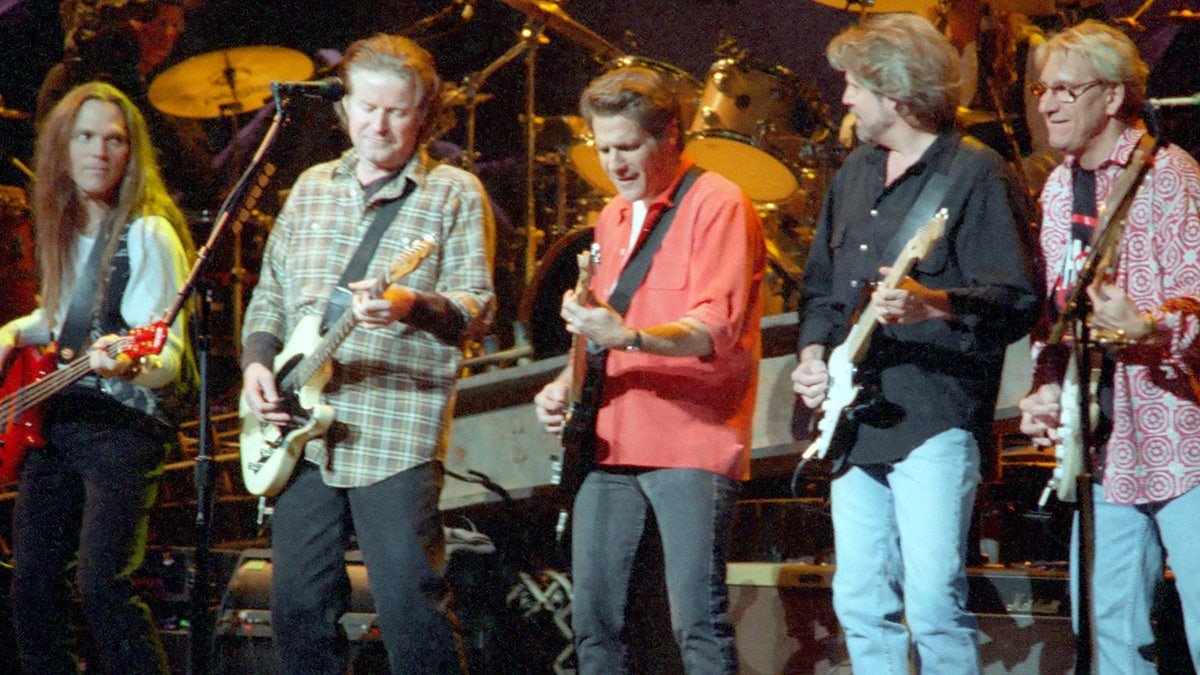
The stage was set at the Forum in Los Angeles — the same city that birthed the Eagles, the same ground where myths of rock ’n’ roll have lived and died. Don Henley, silver-haired but still sharp-eyed, walked slowly toward the microphone. Beside him, Joe Walsh gripped his guitar, already smiling knowingly. The crowd buzzed with rumors: Could it be? Would they finally do it?
Henley cleared his throat. “There’s something we never finished,” he said simply. The arena fell silent. Then Walsh struck the opening chords, and the unmistakable, eerie riff of Hotel California filled the night.
The performance began as always — Henley’s voice, weathered but resolute, painting the familiar tale of twisted paradise and hidden prisons. The audience sang every line, thousands of voices weaving into one. But as the song reached the point where it had once collapsed, an almost sacred hush descended. Everyone knew where they were. Everyone remembered.
Henley closed his eyes. The band played on. And then, with a slight nod to Walsh, the floodgates opened. The twin guitar solo soared into the rafters, ringing with defiance and redemption. This was the piece that had been stolen from them decades ago. Now it was whole.
Tears streamed down faces in the crowd. Fans who had been at the unfinished concert held hands, whispering to each other: “We’re finally hearing it.” Some stood frozen, phones forgotten, as if capturing it would diminish the weight of the moment.
When the final, lingering note faded into silence, Henley stepped forward again. His voice broke. “This is where we left you once… and this is where we close the circle tonight. For Glenn. For all of you. For the song that never ends.”
The arena erupted — not in wild cheers at first, but in a standing ovation that felt like reverence. People didn’t scream; they wept, they clapped, they embraced. It was less like a rock concert than a mass healing, a collective exhale after decades of holding breath.
Backstage, Henley told reporters, “That song belonged to the fans as much as it did to us. Leaving it unfinished that night — it haunted me. Tonight, I just wanted to give it back, complete.”
Joe Walsh, grinning through misty eyes, added, “It was like finishing a sentence we started thirty years ago. Only this time, we shouted the last word.”
Clips of the moment spread instantly across social media. Headlines read: “Hotel California Finally Completed” and “Eagles Close a 30-Year Loop.” Fans who weren’t there watched shaky footage with envy, while those in the arena described it as “a night no recording could capture.”
For many, it was more than music. It was about closure — about the way time can wound, but also heal. About a band that had given the world a myth and finally delivered its ending.
As the crowd filed out into the California night, one fan who had been at both concerts put it best: “Thirty years ago, we walked away unfinished. Tonight, we walked away whole.”
And somewhere in the echoes of that guitar solo, Hotel California stopped being an interrupted memory. It became, once again, eternal.