“STOP THE MUSIC. ARRÊTEZ TOUT!” — Céline Dion Breaks Every Rule Of Live Television, And In Doing So Creates A Moment The World Will Never Forget
The red light was on.
The orchestra was poised.
The countdown in the control room was already bleeding money by the second.
This was live television — the kind where nothing stops once it starts.
The script was clear: Céline Dion would step forward, lift her chin, and deliver the final, soaring note that generations have learned to brace themselves for. It was supposed to be flawless. Controlled. Timed to the second.

But from the center of the stage, Céline didn’t sing.
Instead, she raised her hand.
“Arrêtez tout.”
Stop everything.
The orchestra froze.
The conductor lowered his baton.
Producers began shouting into headsets, convinced something had gone terribly wrong.
But Céline wasn’t looking at them.
She was looking at a child.
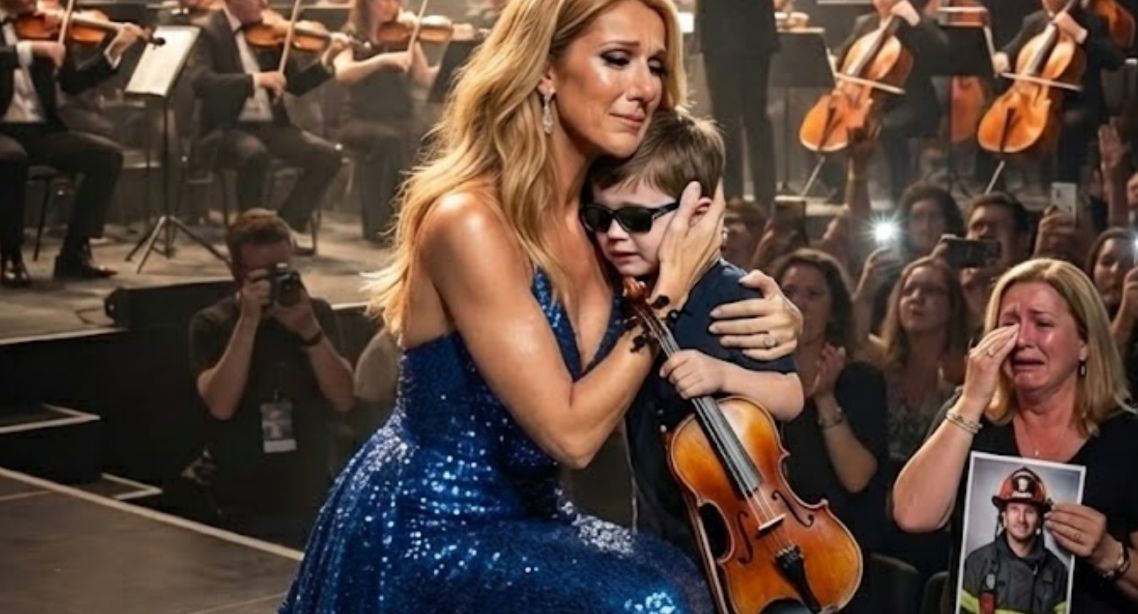
In the front row sat a small boy, no older than eight or nine, wearing a suit clearly chosen with care but slightly too big for his thin shoulders. In his hands, he clutched an old photo frame to his chest as if it were the only solid thing in the room. And as Céline sang, he sang too — every word — tears streaming down his face, his voice breaking in places where the pain was simply too much.
Céline saw him the way only someone who has lived through loss knows how to see.
And in that instant, the show stopped being a show.
Without waiting for approval, without glancing toward the wings, Céline walked to the edge of the stage. She didn’t wave the child over. She didn’t rush. She opened her arms and waited — patiently — until security lifted the trembling boy up to her.
When he reached her, she didn’t pose. She didn’t smile for the cameras.
She wrapped him in a hug that lasted long enough for him to stop shaking.
Then she did something no one expected.
Instead of sending him back to his seat, Céline took his hand and walked him straight into the center spotlight — the exact place she has commanded for decades, the place no one else ever stands beside her.
She knelt down slowly, carefully, meeting him at eye level.
“You sing it with me, mon amour,” she whispered.
She placed the microphone into his small hands.
The boy hesitated. The arena held its breath. And then, with a voice cracked by grief but carried by courage, he sang the final line — not perfectly, not powerfully, but truthfully.
:max_bytes(150000):strip_icc():focal(999x0:1001x2)/celine-dion-kids-eddy-nelson-1-391e1707f79643e88a54f8cf5899ca87.jpg)
In the front row, his mother collapsed into tears.
Only then did the story come out.
The boy’s father had been a firefighter, killed in the line of duty just months earlier. At home, during the quiet hours after the world had shattered, his father used to play “Because You Loved Me” every day — telling his son that no matter what happened, he was loved, protected, seen.
That song wasn’t just music to him.
It was his father’s voice.
In the control room, the panic stopped. No one was shouting anymore. Camera operators were crying. Musicians stared at the floor, overwhelmed by what they were witnessing.
Céline didn’t reclaim the spotlight when the song ended.
She let the boy finish it.
She kissed his forehead.
She handed the photo back to him with both hands.
She whispered something no microphone could catch.
When the applause finally came, it wasn’t thunderous. It was reverent.
Because in that moment, Céline Dion didn’t just break the rules of live television.
She reminded the world why music exists in the first place.
Not for perfection.
Not for timing.
Not for spectacle.
But for love — especially when it’s the only thing holding someone together.