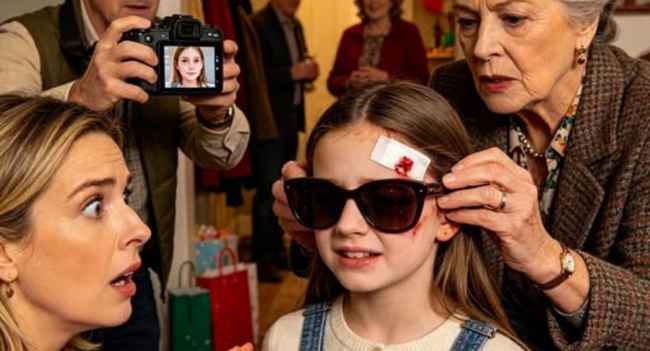
My mother-in-law put sunglasses on my nine-year-old daughter before a family party and said the child was “sensitive to light.” Underneath, one eye was swollen and a small gauze pad near her brow had b/lood showing through it. Grandma told me not to ruin the evening over “a little accident.” Then the family photographer quietly asked why he’d taken a picture of my daughter looking completely fine less than an hour before Grandma took her upstairs.
I looked at my daughter instead of answering Grandma.
People were laughing in the next room, serving dishes were moving across the table, and somebody had already started calling everyone together for pictures. My daughter stood beside me with her shoulders tucked inward, one hand pinching the hem of her shirt.
“Sweetheart, take the sunglasses off for me.”
Her fingers hesitated.
“Grandma said I have to leave them on until pictures are over.”
That changed the room for me.
My mother-in-law immediately stepped closer. “She bumped herself. I cleaned it up. She’s fine.”
“Bumped herself on what?”
She didn’t answer that question. Instead, she reached for my daughter’s sunglasses as though she could put them back and end the conversation.
I moved my daughter’s hand—and the glasses—out of her reach.
The photographer was still standing a few feet away with his camera hanging against his chest. He glanced toward the dining room, then back at me.
“I wasn’t trying to get involved,” he said quietly. “But I photographed her earlier.”
He brought up the image.
My daughter was near the bottom of the stairs, smiling at somebody outside the frame. No sunglasses. No gauze. Both eyes looked normal.
The timestamp put that photograph 43 minutes before the moment I found her.
I asked him when he’d last seen her downstairs.
He swallowed. “Right before your mother-in-law took her upstairs.”
My husband had finally noticed the cluster around us and walked over. His mother gave him the answer before he could ask the question.
“She had a little accident upstairs. Your wife is turning it into something ugly.”
My husband looked at our daughter’s face.
Then at the camera.
Then at his mother.
“What accident?”
Again, she couldn’t give us a straight answer.
First it was that our daughter had tripped. Then maybe she’d hit the edge of some furniture. Then my mother-in-law said she hadn’t actually seen the exact second it happened because she’d been getting something from another room.
Three versions. One minute.
My daughter stayed quiet.
I crouched until my face was level with hers. “You don’t have to explain anything here. We’re leaving, and I’m getting that eye checked.”
My mother-in-law’s expression hardened.
“Over this? With everyone already here?”
I didn’t argue about the party. I didn’t need to.
I picked up my daughter’s jacket and told my husband to get our things.
Behind us, his mother started telling relatives that I was upset and needed to calm down. Her voice became brighter each time somebody looked over, like volume could turn her version into the truth.
The photographer didn’t join her.
Instead, he called my name.
“There are more pictures.”
I turned back.
He explained that he’d been shooting candid photos around the house, not just posed family pictures. He had several frames from the stretch of time between the healthy photograph and when my daughter came back downstairs wearing sunglasses.
My mother-in-law stepped toward him.
“That’s enough.”
He didn’t lower the camera.
He showed me the earlier photograph again and enlarged my daughter’s face. There was no visible swelling around the eye. No gauze near her brow. Nothing that matched the explanation we’d been given.
That fact was no longer arguable.
My husband came closer to the screen.
His mother reached for his arm. “Don’t encourage this.”
He pulled his arm away.
The photographer glanced at my daughter, then at me. “I think you should see the next one.”
Then he advanced one frame and placed the camera in my hands.