My Family Tried To Force Me To Sign Away $9.8 Million To My Sister—Then Grandma’s Original Trust Documents Revealed Who Actually Controlled Everything
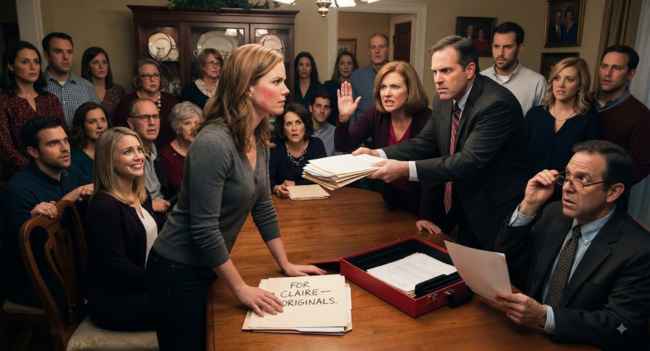
Mr. Caldwell took the first document from the red case.
Nobody spoke.
My mother was still standing beside me after slapping me.
Karen sat frozen.
My father stared at Grandma’s handwriting as though he’d just seen someone walk back from the dead.
Mr. Caldwell read the first page.
Then the second.
Then he stopped.
“Richard…”
Dad immediately interrupted.
“Those documents are outdated.”
Mr. Caldwell looked up.
“No.”
“They’re originals.”
My father stood.
“I’ve managed those assets for twenty years.”
“Management isn’t ownership.”
That was the same thing I’d told him minutes earlier.
Only now…
It was coming from his own attorney.
Mr. Caldwell turned another page.
Then he looked at me.
“Claire, did your grandmother give these directly to you?”
“Six months before she died.”
My father’s face changed again.
Because he hadn’t known.
Grandma had called me unexpectedly one Saturday morning.
She asked me to drive down alone.
When I arrived, she didn’t invite anyone else into the room.
She simply placed the red case in my hands.
“If they ever tell you family means doing what you’re told,” she said, “open this before you agree to anything.”
At the time, I thought she was being overly cautious.
Now I understood.
Grandma had known exactly what would happen after she died.
Mr. Caldwell returned to the trust.
The $9.8 million was divided among investments, commercial properties, land, and several income-producing accounts.
But Grandma hadn’t given Dad the power to distribute them however he wanted.
She had created an irrevocable trust.
Dad had served as administrative manager while she was alive.
After her death…
His authority changed.
He could oversee ordinary maintenance.
He could approve routine expenses.
He could not sell the core properties.
He could not transfer the investments.
And he absolutely could not consolidate everything into Karen and Daniel’s company.
Not without approval from the successor trustee.
Karen leaned forward.
“Who is the successor trustee?”
Mr. Caldwell didn’t answer immediately.
He turned to the final page.
Then looked directly at me.
“Claire.”
Nobody breathed.
My mother actually laughed.
“No.”
Mr. Caldwell slid the document across the table.
There it was.
SUCCESSOR TRUSTEE:
CLAIRE ELEANOR BENNETT.
My name.
My signature.
Grandma’s signature.
Two witnesses.
A notarization.
And an amendment recorded years earlier.
Karen stood so quickly her chair scraped backward.
“Grandma would never do that.”
I looked at her.
“She already did.”
Dad reached for the papers.
Mr. Caldwell pulled them away.
“Don’t touch the originals.”
That sentence changed the room.
Until then, Dad had behaved as though Mr. Caldwell worked for him.
Now the attorney was protecting the documents from him.
My father pointed toward me.
“She manipulated Mother.”
I almost laughed.
I’d spent years being accused of abandoning Grandma because I lived two states away.
Now apparently I’d secretly controlled her.
Dad couldn’t make both stories true.
Mr. Caldwell kept reading.
Then his expression became even more serious.
“There is an additional restriction.”
Karen sank back into her chair.
Grandma had anticipated pressure between beneficiaries.
The trust contained a coercion clause.
Any beneficiary who attempted to force, threaten, intimidate, or improperly influence the trustee into making an unauthorized transfer could have distributions suspended pending independent review.
Everyone slowly looked toward my mother.
My cheek was still red.
Mom’s mouth opened.
“That slap had nothing to do with the trust.”
Mr. Caldwell looked at her.
“You struck the trustee immediately after she refused to authorize a transfer.”
Silence.
Mom sat down.
But Dad still wasn’t finished.
“This entire thing is absurd.”
He pointed toward Karen.
“She has been managing those properties for years.”
That caught Mr. Caldwell’s attention.
“What do you mean by managing?”
Dad hesitated.
Daniel suddenly looked at the floor again.
There it was.
The same reaction I’d noticed before dinner.
I turned toward him.
“What have you already done?”
Karen answered too quickly.
“Nothing.”
I looked at Daniel.
“What have you already done?”
He still wouldn’t meet my eyes.
Then Mr. Caldwell asked Dad for the most recent trust accounting.
Dad said it wasn’t available.
The attorney asked when the beneficiaries had last received one.
Nobody answered.
That was when I opened the second folder from Grandma’s case.
Across the tab she’d written:
CHECK THE RENT.
Grandma owned three commercial buildings through the trust.
For years, Dad had told everyone they barely produced enough income to cover taxes, repairs, and insurance.
But Grandma had kept copies of old leases.
I had compared them with the annual summaries Dad sent before her death.
The numbers didn’t match.
Not even close.
One building alone generated nearly $310,000 more annually than Dad had reported.
Another had tenants I couldn’t find anywhere in the trust statements.
Then there were payments to a management company I’d never heard of.
Caldwell Property Solutions.
Mr. Caldwell frowned.
“That’s not my firm.”
“I know.”
I turned toward Daniel.
“Who owns it?”
Daniel finally looked at me.
Karen started crying again.
Dad said nothing.
I pulled out the corporate registration.
Caldwell Property Solutions wasn’t connected to the attorney.
It was controlled by Daniel.
The room exploded.
Relatives who’d spent the evening calling me selfish suddenly wanted explanations.
Dad insisted the arrangement was legitimate.
Karen said Daniel’s company had merely provided property-management services.
I asked why Grandma’s trust had been paying it hundreds of thousands of dollars without those payments appearing clearly in the beneficiary reports.
Nobody answered.
Then I produced bank summaries.
For nearly four years, money had moved from trust properties into Daniel’s management company.
From there, portions had been transferred into accounts connected to Karen.
I didn’t accuse anyone of stealing.
I didn’t need to.
I simply looked at Mr. Caldwell.
“Is that something a successor trustee should investigate?”
“Immediately.”
Dad slammed his fist against the table.
“This is exactly why you should never have been given control.”
And there it was.
Not denial.
Anger that I could now look.
The transfer meeting ended right there.
Nobody signed anything.
Mr. Caldwell instructed that no extraordinary trust transaction should proceed until the original documents and financial records were independently reviewed.
The next morning, I retained separate trust counsel and a forensic accountant.
What they found took months to untangle.
Some payments were legitimate.
Many weren’t adequately documented.
Management fees had been inflated.
Expenses attributed to trust properties included costs connected to Karen and Daniel.
There were transfers Dad described as advances.
Loans without proper paperwork.
Renovations billed to properties that had never received them.
And the proposed $9.8 million consolidation would have moved the remaining assets into an entity where the trust’s protections would have been dramatically weakened.
Grandma’s clause had stopped it.
Karen called me three weeks later.
Not to apologize.
To ask whether I could release enough money for her and Daniel to cover their legal expenses.
I almost admired the audacity.
“You told twenty relatives I didn’t deserve responsibility for the trust.”
“Claire, please.”
“You watched Mom hit me because I wouldn’t give you $9.8 million.”
“That wasn’t my fault.”
“You stayed seated.”
She went silent.
Then she said something I’d heard my entire life.
“But we’re sisters.”
I closed my eyes.
For years, that sentence had meant I should give something up.
My time.
My plans.
My money.
My dignity.
This time I answered differently.
“Then you should’ve treated me like one.”
I ended the call.
My relationship with my parents never recovered.
Maybe there had been nothing healthy left to recover.
Dad continued insisting Grandma had made a terrible mistake.
Mom eventually apologized for slapping me, but her apology included the words “you have to understand how emotional I was.”
I didn’t have to understand it.
I simply had to stop accepting it.
Karen and Daniel faced the financial consequences of whatever the independent review determined they were responsible for, and trust management was moved to professional administrators.
I remained successor trustee long enough to stabilize everything.
Then I appointed an independent corporate trustee.
That surprised everyone.
Dad had told the family I wanted control.
Karen had told them I wanted the money.
Neither understood that Grandma had never chosen me because she thought I’d cling to power.
She chose me because she believed I’d protect the trust even if protecting it meant giving up control myself.
Months later, Mr. Caldwell returned Grandma’s original documents.
Inside the red case was one envelope I hadn’t noticed before.
It was stuck beneath the lining.
My name was written across it.
Inside was a single page.
Grandma had written:
“Claire,
Karen needs to be loved without being rescued.
Your father needs to learn that managing something does not mean owning it.
And you need to learn that saying no does not make you cruel.
If they put a pen in your hand and tell you that keeping the family together requires your signature, remember this:
A family worth keeping will never require you to erase yourself to remain part of it.”
I read that last sentence three times.
Then I understood why Grandma had left the originals with me.
She hadn’t left me $9.8 million.
She’d left me responsibility.
And the first thing that responsibility required…
Was refusing to sign it away.