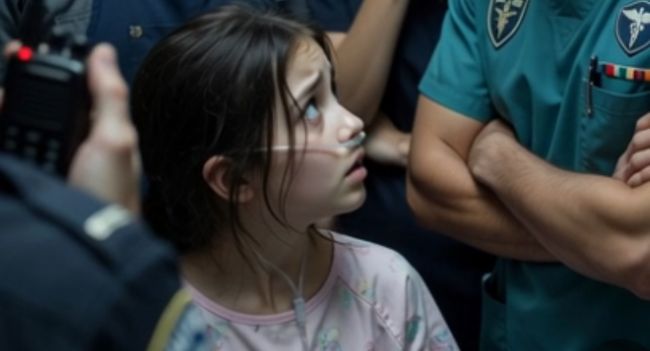
The hospital hallway fell silent.
One officer slowly lowered his radio.
Another looked from Lily’s mother to her father, then back again.
The dispatcher replayed the final moments of the 911 call through a speaker.
First came the frightened breathing of an eight-year-old girl struggling to stay conscious.
Then a woman’s quiet whisper.
“Tell them the food came from Dad.”
A pause.
Then Lily’s tiny voice.
“Mom… did I say it right?”
No one said a word.
Not even Lily’s mother.
The officer who had arrested Lily’s father quietly reached for the handcuffs.
“I’m sorry.”
He removed them.
Lily’s father rubbed his wrists but didn’t look angry.
He only asked the same question he had been asking all morning.
“Can I see my daughter now?”
The surgeon nodded.
“Just for a minute.”
Lily was still sleeping in the pediatric intensive care unit.
Machines quietly monitored every heartbeat.
Her father gently held her hand.
“I’m here, sweetheart.”
“You don’t have to be scared anymore.”
Tears rolled down his face.
Outside the room, detectives began asking Lily’s mother new questions.
This time…
The answers kept changing.
She insisted she had only wanted Lily to explain where dinner came from.
Then she claimed the little girl misunderstood.
Then she said she couldn’t remember exactly what she’d said.
But the recording never changed.
Neither did the timeline.
Security cameras from the apartment complex showed Lily’s father arriving with grocery bags.
He stayed less than five minutes.
He hugged his daughter.
Then drove directly to work.
Store surveillance confirmed he never left again until police arrested him.
The timeline made poisoning impossible.
Doctors continued reviewing Lily’s medical records.
The Army surgeon found something that troubled him.
For nearly a year, Lily had visited urgent care several times with unexplained stomach pain.
Each visit ended the same way.
Pain medication.
Hydration.
Home.
No specialist.
No imaging.
No follow-up.
The surgeon quietly said,
“She wasn’t poisoned.”
“She was repeatedly showing signs of a congenital intestinal condition.”
“It was missed until today.”
He looked toward Lily’s mother’s chair.
“Someone kept treating symptoms instead of finding the cause.”
Child Protective Services opened an investigation before Lily even left intensive care.
Investigators searched the family home.
They found printed custody paperwork.
Highlighted passages about child support.
Notes discussing supervised visitation.
One handwritten sentence caught everyone’s attention.
“If he loses custody forever, everything becomes easier.”
Detectives exchanged glances.
The investigation had become much bigger than a medical emergency.
Three days later, Lily was finally awake.
The surgeon sat beside her bed.
“You were very brave.”
She looked around the room.
“Is Daddy mad at me?”
“No.”
“He loves you very much.”
Lily’s eyes filled with tears.
“Mom told me…”
“…if I didn’t say Daddy made me sick…”
“…he’d never be allowed to take me to the beach again.”
The room became completely silent.
A social worker quietly reached for a tissue.
Months later, prosecutors played the full 911 recording in court.
Jurors listened to every second.
Then they watched surveillance footage from the grocery store.
Hospital records.
Medical testimony.
The surgeon carefully explained how Lily’s intestine had twisted around a congenital abnormality, cutting off its blood supply.
The condition had nothing to do with food.
Nothing to do with poison.
And everything to do with a medical emergency that required immediate surgery.
The 911 recording had nearly sent an innocent father to prison while his daughter fought for her life.
Lily’s mother was convicted on charges related to filing a false report, interfering with a criminal investigation, and child endangerment after investigators concluded she coached her daughter during the emergency instead of helping paramedics understand what was really happening.
The judge spoke directly to her before sentencing.
“A frightened child should never have to choose between telling the truth and pleasing a parent.”
One year later, Lily returned to the hospital carrying a handmade card.
She had fully recovered.
She walked straight to the surgeon who had saved her life and wrapped her arms around him.
On the front of the card she had written,
“Thank you for believing my dad when nobody else did.”
The surgeon smiled.
“I believed the evidence.”
Then he looked toward Lily’s father, who was waiting nearby.
“And I believed a little girl deserved the chance to grow up with the parent who never stopped fighting for her.”
Sometimes the most important words in a courtroom aren’t spoken by lawyers.
Sometimes they’re whispered by a child who finally feels safe enough to tell the truth.