THE LAST FLIGHT HOME
A thin curtain of rain covered the windows of the twelfth-floor apartment in London. From the living room, Claire could see the red lights on the rooftops blinking through the mist like hearts desperately sending signals into the darkness.
Two plates sat on the dining table.
One had gone cold hours ago.
The other had never been touched.
Claire looked at the clock.
11:47 p.m.
Her phone vibrated.
Daniel: I’m sorry. The meeting ran late. Don’t wait up for me.
One brief message.
No congratulations. No explanation. Nothing to suggest that Daniel remembered it was their eighth wedding anniversary.
Claire placed the phone on the table, slipped the wedding ring from her finger, and set it beside her untouched glass of wine.
She did not cry.
Some pain had lived inside her for so long that even tears had become unnecessary.
Claire had met Daniel ten years earlier in a small coffee shop in Brooklyn.
At the time, she was a young British architect spending six months in New York as an intern. Daniel was a photojournalist for a local newspaper, usually appearing with messy hair, an old camera, and a notebook stuffed with loose pieces of paper.
The first time they spoke, Daniel accidentally spilled coffee over Claire’s architectural drawings.
“Oh, God!” he exclaimed, grabbing a handful of napkins. “Did I just destroy an entire building?”
Claire studied the brown stain spreading across the blueprint, then looked at him.
“No. You’ve simply added a lake in the middle of the lobby.”
Daniel laughed.
Three months later, he proposed to her on the Brooklyn Bridge at sunrise. A year after that, they moved to London when Claire accepted a position at a prestigious architectural firm.
The early years of their marriage were filled with lazy mornings, weekend train journeys, and dinners prepared with more sincerity than skill.
Then life began demanding more than love.
Daniel left photojournalism to become the creative director of a media company. He frequently came home late and was constantly flying to New York, Paris, or Berlin.
Claire’s career advanced just as quickly. She became the lead architect of a major redevelopment project in East London.
They lived in the same apartment, but gradually became more like two courteous tenants than husband and wife.
Four years earlier, Claire had become pregnant.
For three months, they called the baby “Little Star.” Daniel bought a new camera and promised to capture every moment of their child’s life.
But on a cold November morning, that tiny heart stopped beating.
After leaving the hospital, Claire sat motionless in the car. Daniel held her hand, but neither of them knew what to say.
Claire needed him beside her.
Daniel chose to bury himself in work.
He believed that if he stayed busy enough, grief would never catch up with him.
Claire believed his silence meant he did not feel the loss as deeply as she did.
A crack formed between them. At first, it was as thin as a strand of hair. With each passing year, it widened into a canyon.
Daniel returned home at nearly two in the morning following their anniversary.
He stepped into the living room and saw the wedding ring on the table.
“Claire?”
She stood beside the window, still wearing the dark blue dress she had put on for dinner.
“You haven’t slept?”
“Do you remember what yesterday was?”
Daniel said nothing.
His hesitation lasted only a second, but it was long enough.
“You really forgot.”
“I’m sorry.”
“You’re always sorry.”
Daniel placed his briefcase on the floor.
“I’m handling a major project. If it succeeds, I could—”
“You could do what? Earn more money? Get a more impressive title? Spend even more time flying to New York?”
“I’m doing all of this for us.”
Claire laughed bitterly, although her eyes were red.
“No, Daniel. You do it because you’re afraid to come home.”
The words stopped him.
“What did you say?”
“You’re afraid to look at me. You’re afraid to see the empty room we once planned for our baby. You’re afraid to talk about what happened.”
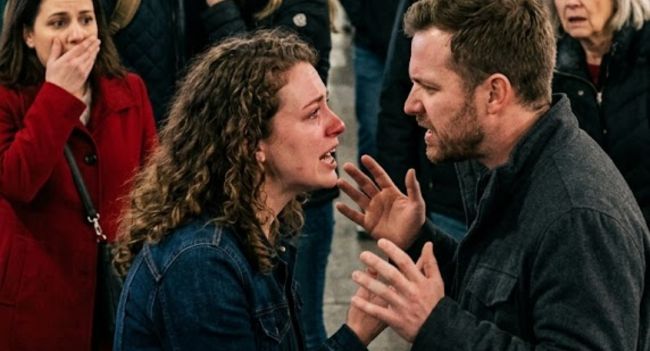
“And what about you?” Daniel raised his voice. “Did you ever ask me how I felt?”
“I waited for you to tell me!”
“I didn’t know how!”
Silence flooded the room after his shout.
Daniel turned away, clenching his fists.
When he spoke again, his voice was broken.
“I thought it was my fault.”
Claire stared at him.
“Why would you think that?”
“The night before you went to the hospital, we argued. I accused you of working too hard. I walked out and ignored my phone for three hours.” He swallowed painfully. “I know the doctors said no one was responsible. But part of me kept thinking that if I had stayed home, if I hadn’t upset you…”
“Daniel…”
“I couldn’t look at that room. I couldn’t look at you without remembering that I had failed to protect both of you.”
For the first time in four years, Claire saw her husband cry.
But a truth revealed too late could not instantly heal everything.
She slipped the ring back onto her finger—not because she had forgiven him, but because she was not yet ready to throw it away.
“I need time,” she said. “I’m going to stay with my sister for a while.”
Daniel did not try to stop her.
Perhaps he understood that sometimes loving someone meant allowing them to walk out the door.
Three weeks later, Claire received an anonymous email.
Attached was a photograph of Daniel embracing a woman outside a hotel in Manhattan. The woman was Sophia Cole, the managing director of his company’s New York office.
The subject line contained only four words:
You deserve to know.
Claire stared at the photograph for a long time.
Daniel had mentioned Sophia before. She was young, intelligent, unmarried, and seemed to accompany him on nearly every business trip.
Claire called him.
Daniel answered after the third ring.
“Claire, I was about to call you.”
“What is Sophia to you?”
There was silence on the other end.
That silence destroyed the fragile hope that had begun to grow inside her.
“It isn’t what you think.”
“Then explain it.”
“I can’t discuss this over the phone.”
“That is always your answer. You can’t talk. You don’t know how to talk. You’ll explain later.”
“Claire, please trust me.”
“I trusted you for ten years.”
She ended the call.
That evening, Claire contacted a divorce lawyer.
A week later, Daniel returned to London.
He found Claire at her construction site, surrounded by drilling machines and unfinished steel frames. The cold air cut through their clothes. Wearing a hard hat and holding a roll of blueprints, she directed the engineers as though her marriage had not just collapsed.
Daniel waited until everyone had left.
“Why are you here?” Claire asked.
“To tell you the truth.”
“You have five minutes.”
Daniel handed her a folder.
Sophia was not his lover.
She was overseeing the acquisition of another company. The embrace in the photograph had taken place moments after Sophia revealed that she had been diagnosed with cancer. Daniel had been helping her contact a specialist in London.
“The email was sent by a colleague who wanted to sabotage the acquisition,” Daniel explained. “The company investigated and identified him.”
Claire examined the documents. Everything appeared to support his explanation.
But she felt no relief.
“You could have told me about Sophia.”
“I signed a confidentiality agreement.”
“Not about the acquisition. You could have told me that you were helping a sick friend. You could have told me something about your life.”
Daniel lowered his head.
“I know.”
“The photograph isn’t the real problem.” Claire handed the folder back to him. “The problem is that I was able to believe you were betraying me.”
Those words hurt him more than any accusation could have.
Daniel stood alone in the freezing construction site and watched the woman he loved walk away.
This time, he did not chase her.
He finally understood that he could not save their marriage merely by proving his innocence. He had to prove that he was still capable of being present in her life.
Over the following months, Daniel began therapy.
He did not do it to persuade Claire to return. He did it to confront the grief he had spent four years trying to escape.
He resigned from the media company. Then he picked up his old camera and began working on a community photography project about families who had lost children.
Once a week, he wrote Claire a letter.
He did not beg.
He did not make grand promises.
He simply told her the truth.
Today I met a father who has kept his son’s bedroom unchanged for twelve years.
I realized that I turned my grief into a wall, then blamed you for being unable to cross it.
I still love you. But I understand now that love means nothing if the person you love always feels alone.
Claire read every letter but did not reply.
She focused on her career. Her housing development project won a national architecture award. She appeared in magazines, spoke at conferences, and received an offer to work in New York for a year.
On the day she accepted the offer, Claire stood in front of a map of the city for a long time.
Brooklyn was where their story had begun.
Perhaps it could also be where she began again—alone.
In early December, Claire flew to New York to sign her new contract.
An unexpected snowstorm caused dozens of flights to be canceled. She became stranded at a subway station in Brooklyn when parts of the transportation system temporarily shut down.
Her phone had only three percent battery remaining.
As she searched for a taxi number, Claire noticed a large poster hanging on the station wall.
It showed an elderly couple sitting in an empty child’s bedroom. Beneath the photograph were the words:
“Some losses do not separate us. Silence does.”
The photographer’s name appeared in the lower corner:
Daniel Carter.
Claire stood motionless among the hurried commuters, unable to look away.
Her phone vibrated.
It was a message from her sister.
Daniel is in New York. His exhibition is tonight.
Claire looked outside. The snow was falling so heavily that the streets had nearly disappeared.
She did not know why she started running.
Perhaps she wanted to see what Daniel had created from their grief.
Or perhaps, after everything, her heart still remembered the way home.
By the time Claire reached the gallery, the opening reception had ended.
Daniel was standing alone among the photographs. He turned when he heard the door open.
They looked at each other across the white room.
“Claire?”
She removed her scarf, still struggling to catch her breath.
“I saw your photograph at the station.”
Daniel stepped toward her but stopped several feet away.
“I didn’t know you were in New York.”
“I’m here for work.”
“Congratulations on the award.”
“You heard about it?”
“I still read every article about you.”
Claire looked around the gallery. Every photograph told a story of loss, guilt, and the ways people learned to continue living.
At the far end of the room hung a photograph that had never been published.
It showed the white crib beside the window in their London apartment. Sunlight fell across a small stuffed rabbit.
The photograph was titled:
Little Star.
Claire covered her mouth with one hand.
“You went into that room?”
“Yes.”
“When?”
“Three months ago.” Daniel looked at the photograph. “For the first time in four years.”
“How did it feel?”
“I cried for an entire day.” A sad smile appeared on his face. “But the next morning, I opened the window. I thought the room needed light.”
Claire felt something inside her begin to melt.
Not all the pain.
Only the ice that had covered it for so long.
“I was going to divorce you,” she said.
“I know.”
“I’m still not sure we can go back to the way we were.”
Daniel shook his head.
“I don’t want to go back. The people we used to be loved each other, but they also hurt each other because they didn’t know how to face their grief.”
“Then what do you want?”
“I want us to begin again. Slowly. Honestly. Without making perfect promises.”
Outside the gallery windows, snow continued to fall over the streets of Brooklyn.
Claire studied the man standing before her. He was no longer the young photographer who had proposed on a bridge at sunrise. She was no longer the woman who believed love could protect people from every kind of suffering.
Perhaps growing older did not mean keeping love unbroken.
Perhaps it meant having the courage to gather the broken pieces and build something new together.
Claire stepped closer.
“I’ll be living in New York for a year.”
“I could move here.”
“No.” She shook her head gently. “You can’t abandon your life again just to follow me.”
Daniel was silent.
“But,” Claire continued, “you may invite me for coffee tomorrow morning.”
A smile slowly appeared on his face.
“I know a place in Brooklyn.”
“Do you still spill coffee on strangers’ blueprints?”
“Only when I want an excuse to talk to them.”
Claire laughed.
It was the first laughter they had shared in years.
Daniel did not immediately embrace her. He simply held out his hand and waited.
Claire looked at it, then placed her hand in his.
One year later, they returned to London.
They did not return because every problem had disappeared. They returned because they had learned to talk about their problems before they became walls.
Daniel continued his photography work. Claire established her own architectural studio, specializing in spaces designed to support the mental health of grieving families.
They still argued.
They still had demanding days and quiet nights.
But neither of them walked away without admitting when they were hurting.
One spring morning, Claire placed a small box in front of Daniel.
Inside was a pair of tiny yellow socks.
Daniel looked at her, barely daring to breathe.
“The doctor says everything is going well,” Claire whispered. “But I’m terrified.”
Daniel knelt beside her.
“So am I.”
“Aren’t you going to tell me everything will be perfect?”
“No.” He took her hand. “I’ll only promise that this time, whatever happens, you will not go through it alone.”
Nine months later, their daughter was born on a morning of gentle rain.
They named her Stella.
Their star.
In the room that had remained closed for so many years, Daniel hung the first photograph of their daughter on the wall. Claire stood beside him and rested her head against his shoulder.
Outside the window, London remained noisy, hurried, and forever changing.
Their lives were changing too.
No flight could ever carry them back into the past.
But sometimes, after enduring countless storms, love could still discover a new way home.