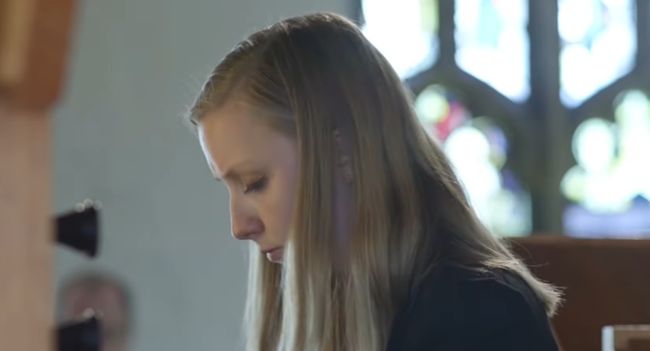
Anna Lapwood’s Bach Trio Sonata No. 2 in C Minor Was a Masterclass in Clarity, Elegance, and Joy

There are pieces that allow an organist to impress with sheer power.
Johann Sebastian Bach’s Trio Sonata No. 2 in C Minor is not one of them.
Instead, it demands something far more difficult: absolute control, complete independence between the hands and feet, and the ability to make three separate musical voices sound as though they are having one perfectly balanced conversation.
When Anna Lapwood performed the work, she demonstrated exactly why Bach continues to sit at the heart of every great organist’s repertoire.
From the opening movement, there was a remarkable sense of transparency.
Every melodic line emerged with crystal-clear definition. Rather than allowing the grandeur of the instrument to dominate the music, Anna treated the organ almost like a chamber ensemble, giving each individual voice its own personality while ensuring none ever overshadowed the others.
That balance is extraordinarily difficult to achieve.
The Trio Sonatas are often described as the organist’s equivalent of a pianist’s concert études. Each hand performs an independent melodic line while the feet carry a third equally important voice. It requires astonishing coordination, concentration, and musical awareness.
Watching Anna perform, however, none of those technical challenges were visible.
Her movements remained relaxed and graceful, allowing the audience to focus entirely on the music rather than the mechanics behind it.
That effortless appearance is, of course, the result of years of discipline.
But it also reflects Anna’s unique philosophy as a performer.
She never approaches Bach as an academic exercise.
She approaches him as a storyteller.
Throughout the sonata, every phrase felt alive. The elegant counterpoint unfolded naturally, with each voice answering another like old friends engaged in thoughtful conversation. The rhythmic vitality of the faster passages sparkled with energy, while quieter moments offered space for reflection without ever losing momentum.
One of the most striking aspects of Anna’s interpretation was her sense of pacing.
Rather than rushing through the intricate passages to display virtuosity, she allowed the music to breathe. That patience revealed details that can easily disappear in less thoughtful performances. Listeners were invited to hear not just the brilliance of Bach’s writing, but also its warmth, humour, and humanity.
It is performances like this that explain why Anna Lapwood has become such an important ambassador for the organ.
Many people first discover her through film music or social media clips, but once they encounter her Bach, they quickly realise that her artistry runs far deeper.
She has an extraordinary ability to make centuries-old music feel completely immediate.
The final movement brought the performance to a joyful conclusion.
Its lively energy never became hurried, its technical brilliance never became self-conscious. Instead, the music danced effortlessly toward the final cadence, leaving the audience smiling rather than simply admiring.
When the last note faded, the applause arrived almost instantly.
Not because the audience had witnessed impossible technical feats—although they certainly had.
But because Anna Lapwood had done something even more remarkable.
She had taken one of Bach’s most intricate masterpieces and made it feel welcoming, vibrant, and profoundly human.
That is perhaps her greatest gift.
She doesn’t simply perform Bach.
She helps people fall in love with him all over again.