Nearly a decade after it first premiered, Stranger Things has finally come to an end, and the finale has proven to be as emotional as it is controversial. While the last season delivers catharsis for longtime viewers, many feel that the season as a whole is uneven, possibly ranking as the weakest in the series. A recurring complaint centers on the sheer amount of exposition: in each of the eight feature-length episodes, characters frequently explain their plans and strategies in painstaking detail, making already long episodes feel drawn out.
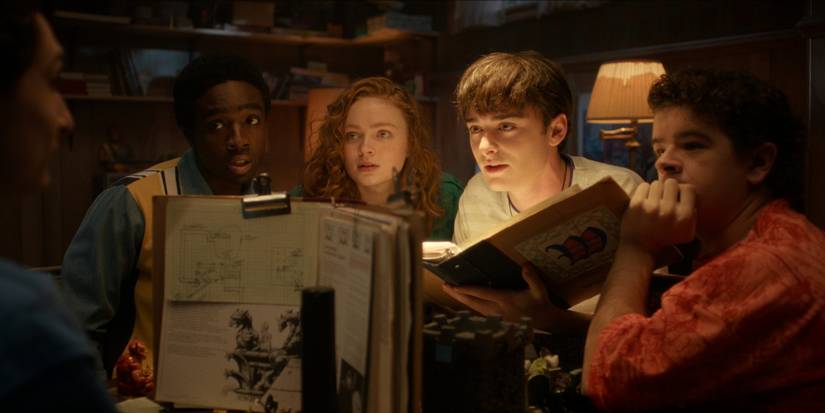
This reliance on exposition isn’t new to television—since the early days, shows needed ways to bring audiences up to speed mid-episode—but in Stranger Things 5, it dominates the storytelling. The series’ reliance on Dungeons & Dragons as a narrative framework exacerbates the problem, turning what once felt charming and immersive into a predictable pattern.
Dungeons & Dragons Shapes the Storytelling

From Season 1, the D&D framework helped young characters like Lucas, Max, Will, and Dustin navigate the strange events of Hawkins. Naming monsters, planning strategies, and role-playing their actions made sense for a group of kids immersed in the game. However, by Season 5, even characters who had never played D&D—Robin, Steve, and Joyce among them—are acting and reasoning as if in a tabletop campaign. Fans have jokingly wondered if the entire series is secretly one long D&D game, a theory the Duffer Brothers have denied, though the influence remains undeniable. Even seemingly non-D&D references, like Dustin talking about a “shield generator,” still follow the logic of the game.
The Limitations of Thinking Like a Dungeon Master

A D&D campaign relies on structure: players react to challenges, the dungeon master guides events, and everyone moves through the story step by step. In the earlier seasons, this approach worked because episodes were shorter, faster-paced, and more dynamic. In Season 5, with longer episodes and a sprawling ensemble, the pattern becomes repetitive: something goes wrong, the characters come up with a plan, execute it, fail, regroup, and then succeed. It’s a narrative loop that often feels mechanical and leaves little room for organic character growth.
This focus on giving every character something to do sometimes undermines the story. While D&D logic works for gameplay, it doesn’t translate seamlessly to screen storytelling. Characters end up performing actions dictated by campaign mechanics rather than genuine narrative motivation, stretching scenes unnecessarily and slowing momentum.
D&D Analogies Overwhelm Original Storytelling

The problem extends beyond storytelling structure. Stranger Things 5 continually relies on D&D analogies for worldbuilding, often replacing deeper exploration of the show’s supernatural elements. Vecna, the Mind Flayer, and the Abyss are all defined by their D&D counterparts rather than through independent development, limiting their threat and intrigue.
This also affects character development. Holly, central to the final arc, largely functions according to her assigned “D&D persona”—Holly the Heroic. While she drives the plot, her actions are determined more by her archetype than by her individual growth, leaving her as a plot device rather than a fully realized character.
A Double-Edged Sword
:max_bytes(150000):strip_icc():focal(749x0:751x2)/stranger-things-season-4-1-85494fc512184a6ba951bb2bdfa35ca8.jpg)
The D&D framework is part of what made Stranger Things culturally significant, and fans who play the game will appreciate its presence. But by letting D&D dominate the narrative, the show sacrifices originality and richer storytelling opportunities. Occasional references can enhance the series, but making them the foundation of every plot point limits both character and story development.
Stranger Things is now available to stream on Netflix.