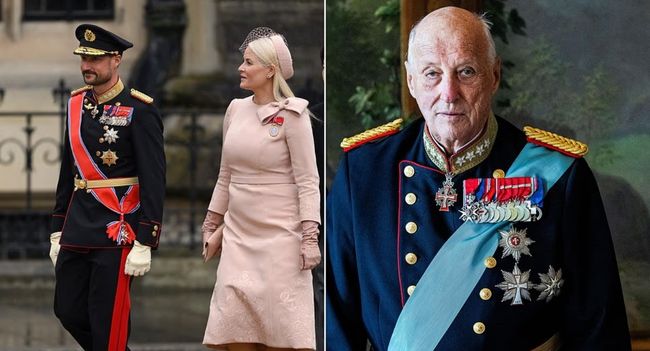
King Haakon VIII takes Norway’s throne as nation mourns Harald V — while royal family faces fresh scrutiny over Epstein links


Norway has entered a new royal era under King Haakon VIII, following the death of his father, King Harald V, at the age of 89 on Friday, August 28.
Harald died peacefully at Oslo University Hospital, Rikshospitalet, at 6.35am, after being treated for haemolytic anaemia and a subsequent bacterial infection. His death ended a 35-year reign during which he became one of Norway’s most respected and popular public figures.
Within hours, the former Crown Prince Haakon, 53, became Norway’s new monarch. He had already been carrying out some of his father’s duties while Harald was receiving treatment in hospital.
The succession comes at a deeply emotional moment for Norway, with mourners gathering outside the Royal Palace in Oslo to leave flowers and light candles in memory of the late king.
But alongside the grief, the new reign begins with renewed scrutiny of the royal family — particularly Haakon’s wife, Mette-Marit, whose past association with convicted sex offender Jeffrey Epstein has become one of the biggest controversies facing the monarchy.
Haakon becomes King as Norway mourns


Haakon’s accession follows the automatic succession of the Norwegian throne after Harald’s death.
The new king has inherited a largely ceremonial role within Norway’s constitutional monarchy, but his arrival comes at a particularly difficult time for the royal household.
His wife, now Queen Mette-Marit, has faced intense criticism over documents released in connection with the Epstein investigation. The material showed that she had corresponded with Epstein between 2011 and 2014, long after he had been convicted of soliciting sex from underage girls.
Mette-Marit has expressed deep regret over the relationship and said she had been manipulated and deceived by Epstein. Reuters reported that the controversy has contributed to a decline in public support for the Norwegian monarchy.
The issue has therefore followed the royal family directly into the beginning of Haakon’s reign.
Princess Ingrid Alexandra now becomes heir


Haakon and Mette-Marit have two children together: Princess Ingrid Alexandra, 22, and Prince Sverre Magnus, 20.
Ingrid Alexandra is now the heir apparent and has become Crown Princess following her father’s accession.
Her future could mark another historic chapter for Norway. If she eventually takes the throne, she would become the country’s first reigning queen since Queen Margaret I, who died in 1412.
Haakon also has a step-son, Marius Borg Høiby, Mette-Marit’s son from a previous relationship. His own legal troubles have added another layer of controversy around the family.
In June, Høiby was sentenced to four years in prison after being convicted of two counts of rape and numerous other offences, including violence and drug-related charges. He has appealed the conviction.
The case has attracted enormous attention because Høiby grew up alongside members of the Norwegian Royal Family after his mother married Haakon in 2001.
Although he has never held a royal title or carried out official royal duties, his close association with the family has meant that the case has inevitably affected the wider monarchy.
A final farewell to King Harald


As the news of Harald’s death spread through Norway on Friday, crowds began gathering outside the Royal Palace.
Flowers and candles were placed in Palace Square, while mourners stood quietly to pay tribute to a monarch who had spent more than three decades representing the country.
The Royal Court announced Harald’s death in a statement, saying:
“It is with deep sadness that we announce that His Majesty King Harald has passed away.”
The palace said he died peacefully at Rikshospitalet at 6.35am on August 28.
Among those mourning was King Charles III, who described Harald as his “dear cousin”.
Charles said he and Queen Camilla were deeply saddened by the death and praised Harald’s decades of service, warmth, humility and sense of duty.
The British and Norwegian royal families have maintained particularly close historical ties, strengthened during the Second World War and through generations of family connections.
Harald and Charles were related through King Edward VII and Queen Alexandra of Denmark, making the two monarchs second cousins once removed.
Harald’s extraordinary wartime childhood

Harald’s life began during a turbulent period in European history.
Born on February 21, 1937, he was the only son of King Olav V and Princess Märtha of Sweden.
When Nazi Germany invaded Norway in April 1940, Harald was only three years old.
He and his two older sisters, Ragnhild and Astrid, were taken to Sweden with their mother. Later, the family travelled to the United States, where they remained for much of the war.
Meanwhile, Harald’s father and grandfather, King Haakon VII, eventually travelled to London with the Norwegian government-in-exile.
Harald returned to Norway with his family in June 1945, after Germany’s defeat.
The experience of exile and occupation became an important part of the young prince’s early life and remained closely connected to the history of the Norwegian monarchy.
From young prince to popular king
Harald suffered another devastating loss as a teenager when his mother died of cancer in 1954. He was only 17.
His grandfather, King Haakon VII, died three years later, leaving Harald as heir to the Norwegian throne.
The young prince studied at the University of Oslo and attended the Norwegian Military Academy, graduating in 1959.
He later continued his education in Britain, studying history, economics and politics at Balliol College, Oxford, from 1960 to 1962.
Sport was another defining part of his life.
Harald became an accomplished sailor and represented Norway at the Olympic Games in Tokyo in 1964, Mexico City in 1968 and Munich in 1972.
It was also during this period that his relationship with Sonja Haraldsen developed.
Sonja was a commoner, and their relationship initially faced resistance from the royal establishment. Harald ultimately made clear that he would remain unmarried rather than give up the woman he loved.
The couple married at Oslo Cathedral in 1968.
Their first child, Princess Märtha Louise, was born in 1971, followed by their son Haakon in 1973.
Harald’s 35 years on the throne
Harald became king in January 1991, following the death of his father, King Olav V.
Over the next 35 years, he became known for his comparatively informal and modern approach to monarchy.
He was widely respected for his ability to connect with ordinary Norwegians and for his public response during periods of national tragedy.
His support for tolerance and diversity was particularly visible in speeches following the 2011 terrorist attacks, when he spoke emotionally about the pain experienced by Norwegian families.
He also became an outspoken supporter of equality and LGBT rights, reflecting the increasingly modern character of the Norwegian monarchy.
Harald also maintained close relationships with members of the British Royal Family.
He was close to the late Queen Elizabeth II, and the two shared family connections through Edward VII.
His relationship with King Charles continued for decades, including visits and royal gatherings in Britain.
Health problems in Harald’s final years
Harald’s final years were increasingly affected by health problems.
He underwent treatment for cancer in 2003 and had a pacemaker fitted in 2024.
In February 2026, he was hospitalised in Tenerife while on a private trip with Queen Sonja after developing an infection and dehydration.
He was admitted to hospital again on August 17, this time after complications connected to haemolytic anaemia, a condition in which red blood cells are destroyed more rapidly than normal.
The palace later said he had developed a bacterial infection and that his condition had deteriorated.
Despite his health difficulties, Harald repeatedly rejected the idea of abdication.
He had previously said that he had sworn an oath to the Norwegian Parliament and regarded that commitment as lifelong.
Mette-Marit’s Epstein controversy
The new reign begins against the backdrop of a controversy that has placed enormous pressure on Haakon’s immediate family.
Documents released in 2026 revealed that Mette-Marit had maintained contact with Epstein after his conviction.
The correspondence has prompted questions about the nature and extent of their relationship.
Mette-Marit has acknowledged that she should have investigated Epstein’s background more carefully and has publicly expressed regret over the relationship, saying she felt manipulated and deceived.
The controversy has been particularly damaging because it comes at a moment of transition for the monarchy.
Haakon must now establish himself as king while his family faces scrutiny that could test public confidence in the institution.
Another major challenge for the new royal family
The Epstein controversy is not the only issue confronting the new king.
Mette-Marit’s son, Marius Borg Høiby, was sentenced in June after a trial involving allegations of rape, violence, drug use and other offences.
He was convicted of two rapes and 32 other charges and sentenced to four years in prison, according to the Guardian. He has appealed.
The case has been particularly sensitive because Høiby was raised in the public eye after Mette-Marit’s marriage to Haakon.
Although he is not a working royal, his family connection has ensured intense media attention.
Together, the Epstein controversy and Høiby’s conviction have created an unusually difficult backdrop for Haakon’s first days as monarch.
A new chapter begins
For Norway, however, the immediate focus remains on the loss of King Harald.
His death closes a 35-year chapter defined by duty, modernisation and a close relationship with the Norwegian public.
He was a monarch shaped by war, exile, family tragedy and decades of public service. His marriage to Sonja, a commoner, helped symbolise a less traditional Norwegian monarchy, while his approach to national crises strengthened his reputation as a unifying figure.
Now his son faces the challenge of carrying that legacy forward.
King Haakon VIII begins his reign at a moment of profound national mourning — but also at a time when the Norwegian Royal Family is facing some of its most serious controversies in years.
With Queen Mette-Marit under scrutiny over her past links to Epstein, Høiby’s conviction still fresh in public memory and Princess Ingrid Alexandra now preparing for her future role as heir, Norway’s new royal era is beginning under an unusually intense spotlight.
The flowers gathering outside Oslo’s Royal Palace mark the end of Harald’s reign.
For Haakon, they also mark the beginning of a very different chapter.