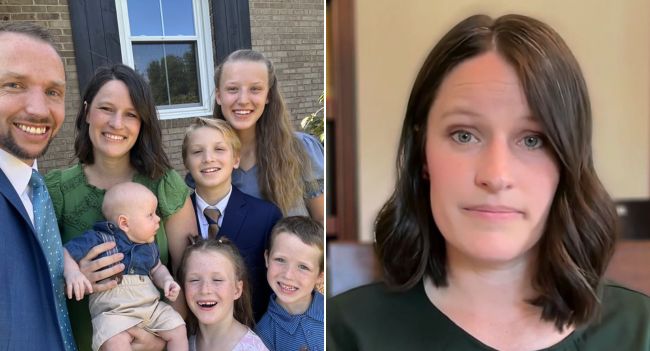
A Virginia mother says she did nothing wrong when she allowed her 5-year-old son to walk alone to a nearby pond — but a court has convicted her of contributing to the delinquency of a minor.
Karyann Parkinson received a suspended jail sentence following the misdemeanor conviction stemming from the June incident, according to Virginia court records.
Now, Parkinson says she plans to appeal the conviction, arguing that she was allowing her son, Samuel, to develop independence while remaining in a familiar and gated community.
The case has sparked a heated debate over where the line should be drawn between age-appropriate independence and parental neglect.
:max_bytes(150000):strip_icc():focal(999x0:1001x2):format(webp)/karyann-parkinson-tout-b258f781f2c946cd9d14d49093a776c4.jpg)
Karyann Parkinson.Credit :
CBS
‘Go There. Come Right Back.’
Parkinson told CBS News that she gave Samuel permission to walk roughly half a mile from their home to a local pond to collect goose feathers.
“I told him, ‘Go there. Come right back,’” she said, according to the outlet.
She said she had recently walked the route with her son and believed he understood where he was going and how to return home.
The pond was located within their gated community, Parkinson said, and she did not believe allowing her son to make the short trip alone violated the community’s rules.
But the situation changed after a security guard reportedly spotted the boy.
According to Parkinson, the guard confronted her at her home and told her that he was going to contact police.
Her Son Refused a Ride From a Stranger
Parkinson also told CNN that the security guard offered Samuel a ride back to the house.
The boy allegedly refused because he did not know the man.
Instead, according to his mother, Samuel walked home by himself.
Parkinson viewed that reaction as evidence that her son understood one of the most basic safety lessons she had taught him: not to get into a vehicle with a stranger.
But what Parkinson saw as a sign of independence and good judgment became part of a much larger legal dispute.
Two weeks after the incident, she was charged.

‘We Expected This to Go Away’
Parkinson said she initially believed the case would be dismissed once prosecutors and a judge reviewed the circumstances.
“We just expected that as soon as this gets in front of a prosecutor actually looking at it and a judge, this is all gonna go away,” she told CBS.
It did not.
Instead, Parkinson was convicted of contributing to the delinquency of a minor.
She was given a suspended jail sentence and, according to CBS, was also placed on Virginia’s child abuse and neglect registry for seven years.
The consequences could extend well beyond the conviction itself.
At the time of the incident, Parkinson was pregnant and studying for the bar exam. The registry listing could also affect her ability to participate as a volunteer at her son’s school, according to the report.
The Question at the Center of the Case
The controversy has divided public opinion.
Supporters of Parkinson argue that a 5-year-old can learn responsibility through carefully supervised independence and that the punishment is disproportionate to what happened.
They point out that Samuel knew the route, remained within a gated community and reportedly refused to leave with an unfamiliar adult.
Critics see the situation very differently.
A half-mile journey may not sound far, but a 5-year-old walking alone toward a body of water presents risks that a young child may not be able to anticipate.
A pond can introduce dangers that have little to do with whether a child knows the route home. A fall, sudden injury, encounter with an unfamiliar person or another unexpected situation could quickly leave a young child unable to respond appropriately.
That is why the debate has become bigger than one mother and one afternoon.
It is about how much independence is appropriate for a young child — and when parental judgment crosses a legal line.
A Debate Over ‘Free-Range’ Parenting
The case has also revived the long-running debate over so-called “free-range” parenting.
For some parents, allowing children to walk short distances alone is an important part of teaching independence.
Others believe a 5-year-old is simply too young to be left alone, particularly near water.
The distinction is important.
A child being capable of following a familiar route does not necessarily mean that child is capable of handling an emergency.
And a parent’s confidence in a child’s judgment does not eliminate the possibility of something unexpected happening.
At the same time, critics of the conviction argue that a poor parenting decision should not automatically become a criminal matter.
Parkinson Plans to Fight the Conviction
Parkinson has made clear that she does not believe she should have been convicted.
She has said she intends to appeal the decision, keeping the legal dispute alive.
The case now raises questions not only about what happened that day, but also about how Virginia’s child-protection laws should be applied when parents make decisions involving childhood independence.
For Parkinson, the issue is deeply personal.
She believed she was giving her son a simple opportunity to walk a familiar route, collect goose feathers and return home.
For prosecutors and those who believe the conviction was justified, the central issue is different: whether a 5-year-old should ever have been expected to make that journey alone.
The appeal could ultimately determine whether Parkinson’s decision was merely a parenting mistake — or conduct serious enough to warrant a criminal conviction.