Lindsay Clancy Jury Deadlocked as Judge Orders More Deliberations in High-Profile Massachusetts Trial

Lindsay Clancy is pictured with her family in photos shown during her trial.
PLYMOUTH, Mass. — Jurors deciding Lindsay Clancy’s fate have told the court they cannot reach a unanimous verdict, creating a dramatic impasse after days of deliberations in one of Massachusetts’ most closely watched criminal trials.
But Judge William Sullivan was not prepared to end the case there.
On Tuesday, September 1, the Plymouth Superior Court judge instructed the 12-member jury to return to the deliberation room and continue trying to reach an agreement. The panel, made up of nine women and three men, had deliberated for roughly 17½ hours over three days before reporting the deadlock on the fourth day.
The development raises the possibility of a mistrial if the jurors ultimately conclude they cannot agree. For now, however, deliberations are continuing.
Judge responds after jury says it cannot agree

Clancy, 32, strangled her daughter Cora, 5, and sons Dawson, 3, and Callan, 8 months.lind.say.969/Facebook
The jury resumed discussions Tuesday morning and returned to the courtroom roughly an hour later with a note informing Sullivan that, despite spending many hours considering the case, the panel had been unable to reach a unanimous decision.
Sullivan acknowledged both the length and complexity of the trial, reminding jurors that they had heard testimony from more than 80 witnesses and considered more than 300 exhibits.
He then asked them to return to their discussions while keeping his previous legal instructions in mind.
The judge’s decision means the jury has not formally been declared hopelessly deadlocked. A mistrial therefore has not been declared, and Clancy’s case remains in the hands of the same 12 jurors.
The central question jurors must resolve

The jury continues deliberations during Day 25 of the Clancy trial.AP
Clancy, 36, a former labor and delivery nurse, is charged in connection with the January 24, 2023 deaths of her three children — Cora, 5, Dawson, 3, and Callan, 8 months — at the family’s home in Duxbury, Massachusetts.
The central dispute at trial has not been over whether Clancy caused the children’s deaths. Instead, jurors have been asked to determine whether she was legally criminally responsible for her actions at the time.
Her defense maintains that Clancy was suffering from severe postpartum psychosis and was experiencing a profound psychiatric crisis.
Her attorneys have argued that her condition prevented her from appreciating the wrongfulness of what she was doing. They have also focused heavily on her psychiatric treatment and the medications prescribed to her in the months leading up to January 2023.
Prosecutors have presented a sharply different interpretation.
They acknowledge that Clancy experienced mental-health difficulties but argue that the evidence shows she understood her actions and deliberately created an opportunity to be alone with the children.
Among the evidence highlighted at trial was cellphone information concerning the restaurant Clancy asked her husband, Patrick, to visit and data related to his route away from their home. Prosecutors presented those details as evidence of planning, while the defense disputed the conclusions prosecutors drew from them.
Postpartum psychosis at the center of the trial

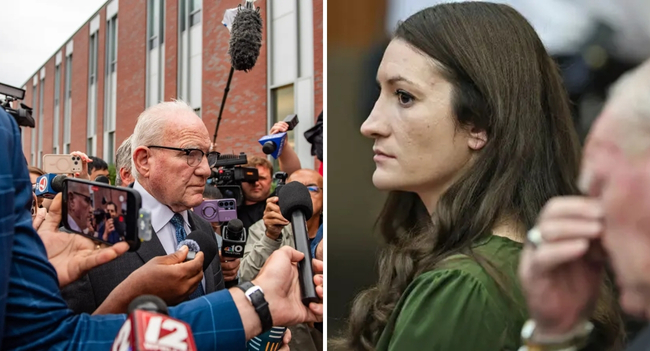
Clancy’s defense attorney Kevin Reddington is surrounded by press as he arrives during her murder trial at the Plymouth County Superior Court in Plymouth, Massachusetts, on Tuesday, Sept. 1, 2026.AFP via Getty Images
Much of the lengthy trial focused on Clancy’s psychiatric condition before the deaths.
The defense’s position is that postpartum psychosis distorted Clancy’s perception of reality severely enough that she lacked criminal responsibility. Prosecutors, meanwhile, have argued that mental illness alone does not establish that she was legally incapable of understanding the wrongfulness of her conduct.
That distinction has become crucial.
Jurors have heard competing interpretations of Clancy’s behavior, medical history and actions before and after the deaths, leaving them to determine not simply whether she was mentally ill, but whether her condition met Massachusetts’ legal standard for lack of criminal responsibility.
The length of deliberations underscores the difficulty of that decision, although the jury’s numerical split — whether one juror is holding out or the panel is divided more evenly — has not been disclosed.
Evidence jurors revisited
The jury has demonstrated that it is closely examining evidence introduced during the trial.
Among the physical items jurors previously asked to review were prescription medication bottles and a knife connected to Clancy’s suicide attempt following the children’s deaths.
Those requests were significant because medication and Clancy’s psychiatric treatment formed an important part of the defense case.
The prosecution, however, relied on other evidence — including phone data and Clancy’s communications with her husband — to argue that her actions showed planning and awareness rather than an inability to distinguish right from wrong.
Jurors must weigh those competing interpretations alongside weeks of testimony from medical professionals, investigators, relatives and other witnesses.
What happens if the jury remains deadlocked?

Post-partum mental health advocate Amanda Aikulola, of Johnston, Rhode Island, stands outside Plymouth Superior Court during jury deliberations in Clancy’s trial on Tuesday, Sept. 1, 2026.Josh Reynolds for The New York Post
Tuesday’s announcement does not automatically mean the case will end in a mistrial.
Sullivan has instructed jurors to keep deliberating, giving them additional time to reconsider the evidence and determine whether they can unanimously agree on a verdict.
If they ultimately remain unable to agree, the judge could eventually declare a mistrial because of a hung jury.
That would not amount to an acquittal.
A mistrial caused by a genuinely deadlocked jury generally allows prosecutors to try the defendant again because jeopardy does not terminate in the same way it would following an acquittal. The prosecution could therefore pursue another trial before a new jury.
For now, that remains only a possibility.
A verdict still hangs in the balance

Protesters gather outside Plymouth Superior Court on Wednesday, Aug. 26, 2026, during Clancy’s trial.USA TODAY Network via Reuters Connect
The jury’s deadlock marks another pivotal moment in a case that has generated intense attention far beyond Massachusetts, in large part because it sits at the intersection of criminal responsibility and severe postpartum mental illness.
After hearing from more than 80 witnesses and examining more than 300 exhibits, 12 jurors now face the task of reaching one unanimous conclusion about Clancy’s mental state at the critical moment.
Their first message to the court indicates they have not been able to do so.
Judge Sullivan has nevertheless told them to continue.
Until they return with another message or a verdict, the central question that has dominated the trial remains unresolved: whether Lindsay Clancy was criminally responsible for her actions on January 24, 2023.