Congratulations!
You've earned 1 point
Stream It or Skip It: ‘Desert Warrior’ on Hulu, Anthony Mackie’s $150 Million Historical Epic

The turbulent production history behind Desert Warrior may ultimately be more compelling than the film itself.
Now streaming on Hulu, the Saudi Arabian production was conceived as a major showcase for the country’s developing film industry. It assembled an impressive international team led by Marvel star Anthony Mackie, with Aiysha Hart, Sharlto Copley and Ben Kingsley also joining the cast.
Rise of the Planet of the Apes director Rupert Wyatt was hired to oversee the project, which began filming in 2021. Post-production stretched on for years, while Wyatt reportedly left the film before later returning.
Despite an estimated $150 million budget, Desert Warrior earned just $733,000 at the box office—a striking result for a project designed to become a new cornerstone of Saudi cinema.
The story
Set in Arabia approximately 1,500 years ago, the film begins after Emperor Kisra, played by Kingsley, has overthrown the existing rulers and ordered their daughters to be taken as his concubines.
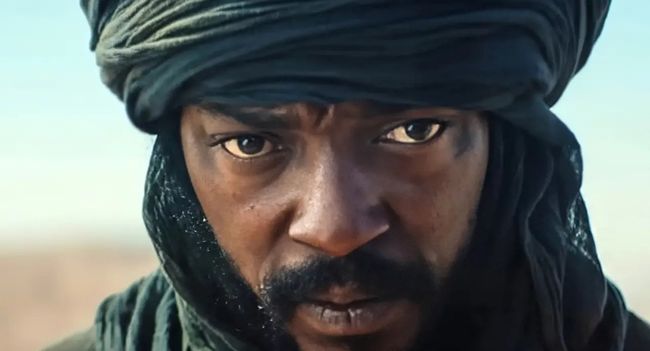
Anthony Mackie plays a mysterious outlaw known simply as Bandit. Travelling through the desert with little more than two camels, he encounters Princess Hind, played by Hart, and her father, King Numan, portrayed by Ghassan Massoud.
The pair are fleeing Kisra’s forces, led by the ruthless warrior Jalabzeen, played by Copley.
Hani, the leader of a local tribe, offers the fugitives protection despite the danger posed by the emperor. His decision is based on honour, but that protection does not initially extend to Bandit, whose reputation as an outlaw leads to his banishment.
Predictably, however, Bandit is not quite as simple as he first appears.
A rebellion begins to take shape

After failing to capture Hind, Jalabzeen returns to Kisra. The emperor promptly sends him back into the desert with orders to complete the mission.
Meanwhile, Hind eventually reunites with Bandit. Together with Hani, they begin approaching neighbouring tribes and attempting to persuade their leaders to put aside old disagreements.
Their objective is to create a united rebel army capable of confronting Kisra’s much larger force.
Much of the film’s middle section is devoted to negotiations, political arguments and efforts to secure alliances. Although these scenes are intended to establish the scale of the rebellion, they slow the story considerably.
The long-awaited battle finally arrives during the last half-hour, when the newly assembled tribal force confronts the emperor’s army.
Familiar influences
Desert Warrior clearly draws inspiration from several established historical and action epics.
Its desert landscapes and sweeping visual ambition invite comparisons with Lawrence of Arabia, even if the storytelling never reaches the same standard. The large-scale battles and political conflict also recall Gladiator.
Emperor Kisra, meanwhile, occasionally resembles the kind of grotesque authoritarian ruler represented by Immortan Joe in Mad Max: Fury Road.
These influences are easy to recognise, but the film struggles to transform them into a distinctive identity of its own.
The standout performance
Sharlto Copley delivers the film’s most memorable performance as Jalabzeen.
The character is disappointingly one-dimensional, functioning primarily as the relentless warrior pursuing Hind and her allies. Even with those limitations, Copley brings more energy and menace to the screen than most of the surrounding cast.
Mackie and Kingsley appear far less engaged. Both performances feel functional rather than inspired, while the inconsistent accents across the ensemble become another distraction.
Does the $150 million budget appear onscreen?
Visually, Desert Warrior is often impressive.
The production makes extensive use of real locations, horses, camels and large groups of performers against the Arabian desert. Its climactic sequences recreate a version of the historical Battle of Dhi Qar with a scale rarely seen in contemporary streaming releases.
Wyatt and the film’s producers appear determined to capture the feeling of a traditional Hollywood epic. Practical filmmaking is prioritised wherever possible, with soundstages and computer-generated imagery used more sparingly than in many modern blockbusters.
The film also introduces some contemporary techniques, particularly through its rapid editing during the action sequences.
There is no denying the effort involved. The money is visible in the landscapes, costumes and enormous battle scenes. Unfortunately, impressive production values cannot compensate for weaknesses in the screenplay.
An ambitious story undermined by its writing
The film’s greatest problem is its complicated and frequently confusing narrative.
Four credited screenwriters attempt to balance political diplomacy, tribal conflict, historical spectacle, personal redemption and a rebellion against tyranny. Instead of forming one coherent story, those elements often compete for attention.
Desert Warrior never fully decides whether it wants to be a sprawling historical epic or a more focused account of ordinary people resisting an oppressive ruler.
The story also introduces potentially powerful feminist themes through Hind, a future queen building an army against a despot who enslaves women. Yet those ideas are never developed with sufficient depth and eventually disappear beneath the film’s broader ambitions.
Lengthy conversations and repetitive negotiations weaken the momentum before the final battle. By the time the spectacle arrives, the characters have not generated enough emotional investment to give it the desired impact.
Final verdict
Desert Warrior contains the ingredients of an absorbing historical epic: an enormous budget, striking desert scenery, practical battle sequences, an experienced director and several internationally recognised actors.
What it lacks is a screenplay capable of holding those elements together.
The film looks expensive and occasionally delivers the grandeur promised by its premise, but its muddled storytelling, flat dialogue and underwhelming performances make the journey feel much longer than necessary.
The story of its delayed production, extraordinary cost and disastrous box-office return may be fascinating. The finished film is considerably less so.
SKIP IT.