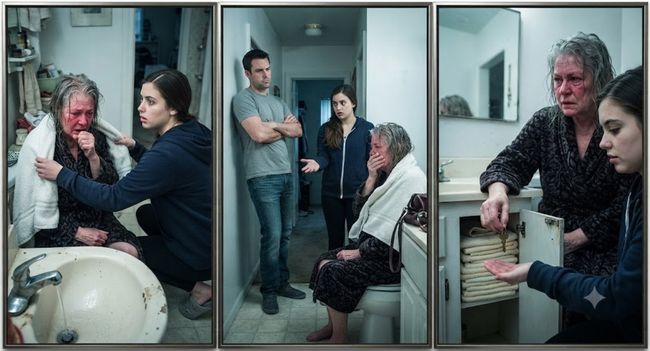
Here’s the full continuation, keeping it complete without making it unnecessarily long.
The brass key was so small I almost dropped it.
“What does this open?”
Mom looked toward the hallway before answering.
“The lockbox in the garage.”
My brother, Ryan, heard her.
His entire expression changed.
“What lockbox?”
Mom didn’t answer him.
That frightened me more than if she had.
I helped her toward the front door, but Ryan stepped in front of us.
“You’re not going through my garage.”
Mom’s hand tightened around my arm.
“Move,” I said.
“It’s my house too.”
Mom finally looked at him.
“No, Ryan. It isn’t.”
Silence.
For almost two years, Ryan had been living with Mom after losing his apartment. He told everyone he had moved in because she needed help after Dad died.
Apparently, somewhere along the way, he had started believing helping her meant controlling her.
Mom reached into her coat and pulled out her phone.
“I want to leave now.”
That was enough for me.
I called the police.
Ryan immediately backed away.
Suddenly he was calm.
Suddenly this was all a misunderstanding.
He told Mom he loved her. He said she had become forgetful. He said I was upsetting her and turning her against him.
But Mom didn’t respond.
She just sat beside me on the porch until officers arrived.
When they asked what happened, Ryan tried to answer first.
One officer stopped him.
“I asked her.”
Mom stared at her hands.
Then she told them.
Not everything.
Not yet.
But enough.
She told them about the bathroom.
The missing car keys.
The arguments.
And how frightened she had become inside her own home.
An officer photographed the redness around her face and helped arrange medical evaluation.
Ryan was told to stay away from her while the immediate situation was addressed.
Before we left, Mom looked at me.
“The box.”
So with an officer nearby, we went into the garage.
Behind Dad’s old workbench sat a gray metal lockbox.
The brass key fit.
Inside were folders.
Bank statements.
Copies of checks.
Property documents.
A notebook.
And an old phone.
I looked at Mom.
“What is all this?”
Her eyes filled.
“Proof that I’m not confused.”
I felt something cold move through me.
Ryan had been telling relatives for months that Mom was becoming forgetful.
I had heard it myself.
She lost things.
She repeated herself.
She couldn’t manage money anymore.
That was his version.
Mom opened the notebook.
Dates filled page after page.
Every time money disappeared.
Every time Ryan took her debit card.
Every time he borrowed her car and refused to return the keys.
Every time he pressured her to sign something.
Every time he told someone she was confused after she objected.
Then Mom handed me several bank statements.
There were withdrawals she said she had never authorized.
Transfers she didn’t recognize.
Payments connected to accounts she didn’t understand.
“I started keeping copies because things kept disappearing,” she said.
“Why didn’t you tell me?”
“I was ashamed.”
“Of what?”
She looked toward the house.
“That my own son scared me.”
That answer broke something inside me.
But Mom wasn’t finished.
She picked up the old phone.
“I bought this six months ago.”
Ryan didn’t know about it.
She had used it to photograph documents whenever she feared the originals might disappear.
She had also recorded several conversations.
I didn’t listen to them there.
I put everything back inside the box and took it with us.
That night, Mom stayed at my house.
She slept almost twelve hours.
The following morning, she woke up and immediately apologized for being a burden.
I stopped her.
“You’re not going back until you decide you want to.”
She started crying.
Then we began making calls.
An attorney reviewed the financial documents.
Mom contacted her bank.
We secured her accounts, changed passwords and began determining which transactions she had actually authorized.
We didn’t assume every questionable transaction was theft simply because Ryan’s name appeared somewhere.
We let the professionals sort through it.
But one thing became clear quickly.
Mom had not imagined the financial pressure.
And she had been documenting it for months because she was afraid nobody would believe her.
Ryan called constantly.
At first he apologized.
Then he blamed me.
Then he blamed Mom.
Then he returned to the same argument he had used in the bathroom.
She had caused everything.
The shoes.
The money.
The police.
The family embarrassment.
There was always another excuse.
Eventually, Mom stopped answering.
A few weeks later, Ryan came to my house.
He stood outside and demanded to speak with her.
Mom was behind me.
I expected her to hide.
Instead, she stepped forward.
Ryan softened his voice immediately.
“Mom, come home. We can fix this.”
She looked at him for a long time.
Then she said, “It is my home.”
Ryan frowned.
“And you won’t be living there anymore.”
For once, he had nothing ready to say.
Mom had already spoken with her attorney about the property and the steps necessary to regain control of her home.
The process wasn’t instantaneous.
Neither was everything involving the financial records.
Real consequences rarely arrive as neatly as they do in stories.
But Mom never moved back in with Ryan.
Eventually, she returned to her house after arrangements had been made for her to feel safe there.
The first thing she did was change the locks.
The second was move Dad’s old workbench.
Behind it, we found another pair of Ryan’s shoes.
Mom stared at them.
Then she started laughing.
I hadn’t heard that laugh in months.
“What?” I asked.
She wiped her eyes.
“All this started over shoes.”
I shook my head.
“No.”
She looked at me.
I held up the tiny brass key she had told me to keep.
“The shoes were just that day’s excuse.”
Mom became quiet.
Then she nodded.
That was the lesson neither of us forgot.
There had always been an explanation for Ryan’s behavior.
Mom said the wrong thing.
She moved something.
She embarrassed him.
She questioned money.
She left his shoes outside.
Every excuse was different.
The purpose was always the same: make her believe his behavior was something she had caused.
Months later, Mom asked for the brass key back.
I placed it in her palm.
She looked at it for a moment and smiled.
“I don’t need to hide it anymore.”
And that tiny sentence meant more to me than everything we found inside the lockbox.
Because the most important thing Mom recovered wasn’t the documents, the accounts, the car keys, or even the house.
It was the right to live in her own home without being afraid of what she might accidentally do wrong next.