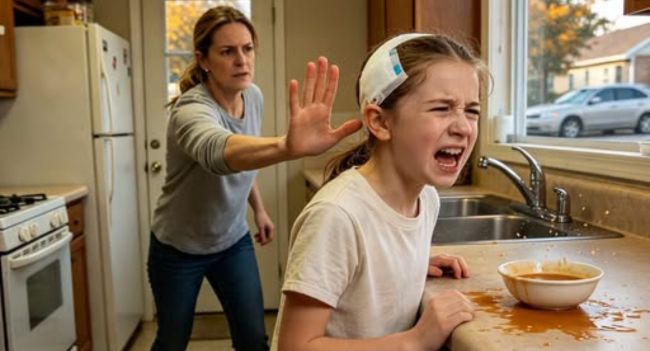
My ten-year-old daughter had just come home after brain surgery when her stepmother slapped the side of her face nearest the surgical dressing because she spilled soup. My daughter couldn’t run. She could barely stand without support. By the time I got home, my wife had already told everyone the swelling came from treatment. Then my daughter pointed at the kitchen camera and whispered, “Daddy, she forgot that one still works.”
I didn’t ask my wife for an explanation. I crouched beside my daughter first. The kitchen still smelled like broth, and a streak of soup had dried down the cabinet beneath her chair. Her discharge papers were open on the counter. When I moved my hand near the swollen side of her face, she flinched before I even touched her.
That was enough.
I called the after-hours number from her discharge paperwork and put the phone on speaker while I opened the camera app. My wife stood at the other end of the kitchen with her arms folded, telling me I was scaring my daughter by “turning this into something bigger.”
The recording loaded.
My daughter was sitting exactly where she was sitting now, one hand braced against the table because standing was still difficult. She reached for her bowl. Her fingers slipped. Soup spilled across the table and down the cabinet.
My wife turned toward her.
She didn’t reach for a towel.
She stepped forward and struck my daughter across the side of her face nearest the dressing.
The sound on the recording was small and flat. My daughter folded toward the table, covering the side of her head with both hands. My wife immediately looked toward the kitchen doorway, then toward the camera she apparently believed was inactive.
I watched the next part without speaking.
My wife cleaned the soup. My daughter stayed in the chair. Then my wife leaned close enough that the camera caught her voice telling my daughter that if anyone asked about her face, the swelling was from treatment.
Behind me, my wife said, “I panicked.”
I turned around. “You told everyone it was treatment.”
“I didn’t want people making assumptions.”
“You gave them an explanation before anybody asked.”
Her arms dropped. “She’s fine.”
My daughter’s fingers tightened around the edge of my sleeve.
The person on the medical line had heard enough of our conversation to understand there had been a blow near the surgical area. I was told to bring my daughter back to be evaluated. I thanked them, ended the call, and saved the camera clip before doing anything else.
My wife watched my thumb move across the screen. “Why are you saving that?”
“Because she told me what happened.”
“She’s ten. She’s emotional. She just had surgery.”
That sentence landed harder than the excuses before it. She wasn’t only denying what I had watched. She was already building a reason my daughter shouldn’t be believed.
I looked down at my child. “Did anybody tell you not to tell me?”
She nodded once.
My wife cut in immediately. “Don’t question her like that.”
I didn’t argue with her. I asked my daughter whether she wanted to leave with me and get her head checked. She whispered yes before I finished the question.
So I helped her stand.
Her knees shook when she put weight on them. I kept one arm around her without touching the side of her head, picked up her discharge papers with my free hand, and started toward the front door.
My wife followed us out of the kitchen.
I could hear her changing explanations as she walked—first it had been treatment, then panic, then an accident, then me supposedly upsetting everyone by refusing to calm down. I didn’t answer any of them. The camera had already answered the only question that mattered.
At the entryway, my daughter stopped because my wife suddenly moved sideways and planted herself between us and the front door.