Josh Tarling opens up after racing Vuelta a España just days after brother Finlay’s death

Josh Tarling delivered a remarkable performance in the opening stage of the Vuelta a España — but the result meant very little to the Welsh cyclist just eight days after the death of his younger brother, Finlay.
The 22-year-old Netcompany Ineos rider chose to compete in the three-week Grand Tour despite the devastating loss, saying that returning to racing gave him something else to focus on while he grieved.
His decision had the full backing of his family and team.
And on Saturday, August 22, Tarling produced an extraordinary ride on the opening stage, briefly moving into the lead before Ethan Hayter and eventual winner Tadej Pogačar edged ahead.
Tarling ultimately finished just four seconds behind Pogačar.
Yet when asked what the performance meant to him, his answer revealed just how difficult the past week had been.
“Not a lot”
Speaking to Eurosport after the stage, Tarling admitted that the result itself was not particularly important to him.
“Not a lot. No, I’m happy with it. And I’m happy I could try and get my head busy with other stuff.”
He thanked his team for allowing him to make the decision to race and for giving him the opportunity to return to competition.
“So yeah, obviously I’m happy and I’m thankful for the team and everything, to let me come and let me give it a good crack.”
The result was nevertheless an impressive one.
Tarling fought his way into contention during the opening stage before being overtaken first by Hayter and then by Pogačar, the reigning Tour de France winner.
He finished four seconds behind Pogačar and was also recognised as the best young rider after the stage.
For Tarling, however, the significance was not the result. It was simply having a chance to occupy his mind.
A return to racing after an unimaginable loss

Finlay Tarling, 19, died on August 14 during the eighth stage of the Volta a Portugal.
The younger Tarling was riding for the NSN Development Team when he was involved in a serious collision during the stage between Melgaço and Fafe.
According to reports from Portuguese authorities, Finlay was struck in a head-on collision by a vehicle that was not part of the race and was travelling in the opposite direction on the course. The crash occurred in the Arcozelo area of Ponte de Lima.
Finlay received medical attention but died from his injuries.
The eighth stage was subsequently neutralised with around 20 kilometres remaining, and the scheduled podium ceremony was cancelled as a mark of respect.
The 19-year-old was a highly regarded young cyclist and a promising time-trial specialist. He had finished third in the under-23 time trial at the British National Championships earlier this summer.
His death devastated his family, teammates and the wider cycling community.
Just eight days later, his older brother was back on the start line in Spain.
Geraint Thomas: “I couldn’t be prouder”
Geraint Thomas, the legendary Welsh cyclist and racing director for Netcompany Ineos, said the team had fully supported Tarling’s decision to race.
Thomas explained that Josh had wanted to return to what he knew and find some sense of normality by being around his teammates.
“For a start, it’s just great to have him here,” Thomas told TNT Sport.
He said Tarling had been keen to ride and wanted to get back to his “day job”, using the familiar routine of cycling and being with the team as a source of comfort.
Thomas said the team had backed that decision completely.
He also acknowledged the scale of what Tarling had endured.
“Obviously, it’s been unimaginable what he’s gone through the last week or so.”
Yet seeing Tarling produce such a strong performance after everything he had experienced left Thomas deeply impressed.
“But to put in a performance like that at the end of the week he’s had is just fantastic, really, it just shows the class of him as an athlete and as a person. Couldn’t be prouder.”
Thomas believed the course suited Tarling particularly well, noting his technical ability and his strength on a route featuring numerous corners.
He added that the opening stage may have been the first time Tarling had properly ridden his bike in some time.
“It’s insane, really.”
The team’s plan was straightforward: keep things as normal as possible and support Tarling throughout the three-week race.
“We’ll just continue to be normal around him and support him as best we can.”
His family wanted him to race in Finlay’s honour

Tarling’s decision to compete also had the support of his family.
His mother, Dawn, confirmed on Instagram that Josh had chosen to ride the Vuelta in honour of his younger brother.
She said the decision had been made with the full support of the family and praised the support Josh had received from his team.
Dawn also reflected on the close relationship between her two sons.
She said she could not have wished for two boys who were closer while growing up and described Josh as an especially loving and supportive older brother to Fin.
Following Finlay’s death, she said Josh had become an incredible source of strength for the entire family.
There was also a deeply personal reason for Josh to return to the bike.
Dawn said Finlay had been enormously proud of his older brother and would watch Josh compete closely, “nose to the tv and shouting” as he raced.
For that reason, she felt it was right for Josh to honour Finlay by doing the thing his younger brother had always loved watching him do.
Racing through grief
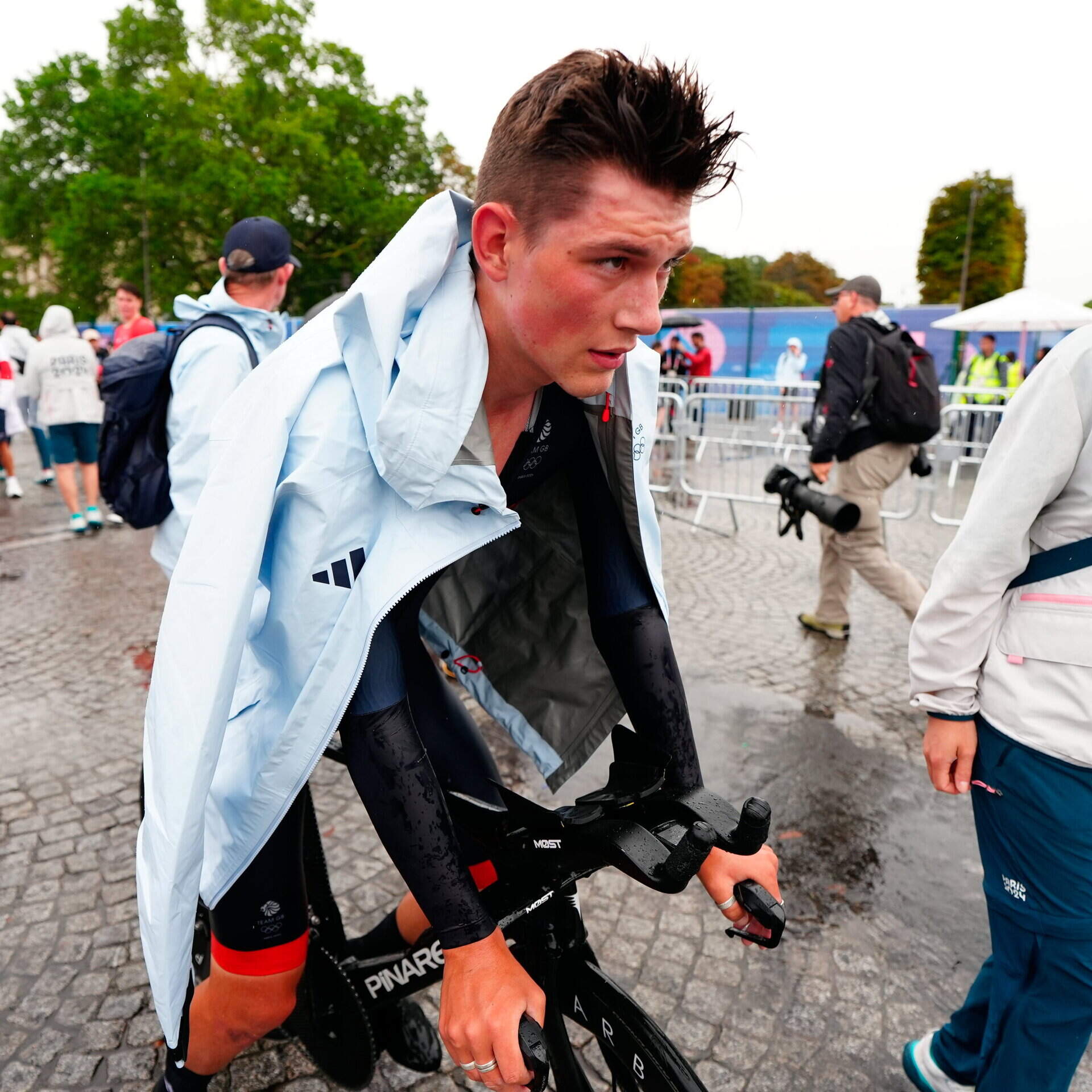
Josh Tarling’s decision to take part in the Vuelta came at a moment when his family was still mourning an unimaginable loss.
Finlay’s death brought the Volta a Portugal to a halt and prompted tributes from his team, British Cycling and cycling’s governing bodies. His NSN Development Team withdrew from the remainder of the race following his death.
Josh’s return to competition was never presented as an attempt to move past that grief.
Instead, it offered him a way to remain occupied, surrounded by teammates and immersed in the sport he shared with his brother.
His opening-stage performance showed that he was still capable of competing at the highest level.
But Tarling himself made clear that, at this moment, the stopwatch was not what mattered.
After losing Finlay only days earlier, simply being able to get back on his bike and focus on something else was enough.