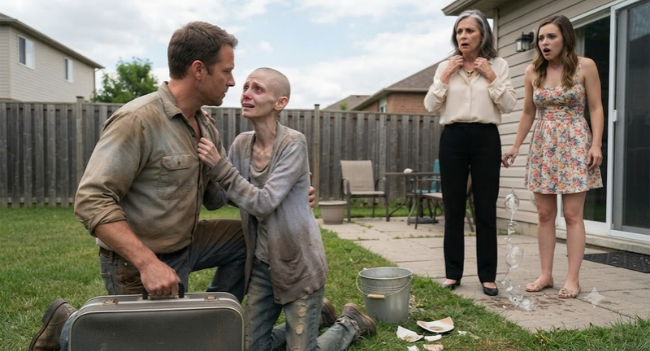
Three days later, I walked into my mother’s dining room carrying a folder and pretending I had forgiven everyone.
Theresa had prepared my favorite meal. Brianna arrived wearing an expensive new outfit and greeted me with more warmth than she had shown Lucy since I returned.
Neither asked how Lucy was doing at the hospital.
They asked about the million dollars.
That told me everything I needed to know.
“The settlement isn’t finalized in my account yet,” I said. “But my attorney wants me to decide how I’m going to manage it.”
Theresa immediately leaned forward.
“You’ve been gone four years. You need someone here you can trust.”
I almost smiled.
“Someone like you?”
“Exactly.”
Brianna began talking about investments. Her salon could expand. There was a commercial property nearby. Theresa thought the house needed more work and suggested replacing her SUV before maintenance became expensive.
I listened.
Then I asked casually, “If I transferred some of the settlement into the same account where I sent my wages, would that be easiest?”
They exchanged a glance.
It lasted barely a second.
But I saw it.
Theresa nodded. “That would make sense.”
“How much of the settlement would you need?”
My mother looked offended.
“Need? After everything I’ve managed for you?”
That was when I started asking about the previous four years.
Not accusing.
Just asking.
“How much did I send altogether?”
Theresa claimed she had never calculated it.
“What paid for the SUV?”
Silence.
“What paid for the new floors?”
Brianna looked at Mom.
“What paid the startup costs for the salon?”
Neither answered.
I opened the folder.
Inside were four years of transfer records.
Nearly $100,000 had passed through Theresa’s account, not including bonuses.
I had spent the previous three days working with my bank and an attorney to trace as much of it as possible.
The pattern was devastating.
Payments connected to Theresa’s vehicle.
House renovations.
Transfers associated with Brianna’s business.
Furniture.
Personal purchases.
Meanwhile, during the same period Lucy needed medical care, almost nothing had been spent on her treatment.
Theresa pushed the papers away.
“You gave me that money.”
“I sent it home for my wife and our future.”
“You never specified every dollar.”
“I specified enough.”
Brianna stood.
“This is Lucy poisoning you against us.”
I looked at her.
“Lucy doesn’t know I’m here.”
That stopped her.
Then I placed my phone on the table.
The recording had been running since dinner began.
Theresa stared at it.
Her face changed.
“You recorded your own mother?”
“I listened to my own mother admit she wanted control of another million dollars before asking whether my wife was alive.”
Nobody spoke.
Then Theresa reached for the folder.
I pulled it back.
“We’re not finished.”
My attorney had uncovered something else.
Several of the transfers I believed were being saved for Lucy and me had been moved again shortly after arriving in Theresa’s account.
Some went toward household expenses.
Others did not.
One substantial portion corresponded with the period Brianna launched her salon.
I looked at my sister.
“Where did your startup money come from?”
She crossed her arms.
“I saved.”
“From what?”
Nothing.
“You told everyone you got financing.”
“I did.”
“Then show me the loan.”
Her eyes moved toward Theresa.
There was the answer.
My mother finally snapped.
“So what if we used some of it? You were making good money. You didn’t need it.”
I stared at her.
“Lucy did.”
Theresa rolled her eyes.
“There was no guarantee treatment would even work.”
The room went completely still.
Even Brianna looked at her.
I could barely believe my mother had said it aloud.
“So you decided she wasn’t worth spending my money on?”
“That isn’t what I said.”
“It’s exactly what you said.”
Theresa stood and began shouting that Lucy had manipulated me, that cancer had turned her into a burden, and that the entire family had sacrificed while I lived comfortably in Canada.
Comfortably.
I rolled up my sleeve.
The scars from the machinery accident were still visible.
“You thought I was comfortable?”
My mother looked away.
I had slept in shared rooms, worked twelve-hour shifts, skipped holidays, and eaten whatever was cheapest because every extra dollar I saved meant getting home sooner.
And while I did that, Lucy had been slowly disappearing in the backyard of the home I was paying for.
I stood.
Theresa immediately changed her tone.
“Son, we’re angry. Everyone is emotional. Sit down.”
“No.”
“What about the settlement?”
There it was.
Even now.
The money.
I picked up my phone.
“The settlement is real.”
Brianna’s eyes widened.
“But neither of you will ever touch it.”
Theresa stared at me.
I explained that the money was being handled through my attorney and financial professionals. A substantial portion was being reserved for Lucy’s medical treatment, recovery, housing, and our future.
My mother’s name appeared nowhere.
Neither did Brianna’s.
Then I canceled the final recurring transfer I had been sending Theresa.
Her phone buzzed almost immediately with the notification.
She looked down.
“You can’t do this.”
“I just did.”
“How am I supposed to pay everything?”
I thought about Lucy telling Brianna she had not eaten since the previous day.
“How was Lucy supposed to pay for treatment?”
Theresa had no answer.
Before leaving, I held out my hand.
“The necklace.”
She instinctively touched the gold hummingbird around her neck.
“That was a gift.”
“It was my anniversary gift to Lucy.”
“She tried to sell it.”
“To see a doctor.”
Theresa slowly unclasped it.
I took it without another word.
When I returned to the hospital, Lucy was awake.
I sat beside her and placed the hummingbird necklace in her palm.
For several seconds, she simply stared.
Then she started crying.
“Where did you get this?”
“From the person who never had the right to take it.”
She closed her fingers around it.
I told her about the bank records.
The salon.
The SUV.
The renovations.
Then I told her about the settlement.
Lucy immediately shook her head.
“I don’t want your money.”
I took her hand.
“It isn’t about money.”
I had finally understood what four years away had cost us.
I had believed providing meant sending checks.
I had believed my mother because she was my mother.
And every time Lucy gave me an excuse for keeping the camera off, I had accepted it because trusting the explanation was easier than imagining something was terribly wrong.
“I should have known,” I whispered.
Lucy squeezed my hand.
“You know now.”
The following months were difficult.
There was no magical recovery waiting for us simply because money was available.
Lucy still needed treatment.
There were appointments, frightening test results, exhausting days, and nights when neither of us slept.
But one thing changed immediately.
Nobody controlled her access to food anymore.
Nobody decided whether she deserved treatment.
Nobody took her belongings.
Nobody told her illness was a punishment.
And nobody could use my absence to control her again.
I rented a small place near the hospital while we decided what to do permanently. I cooked badly. Lucy complained about my soup. I learned medication schedules and sat beside her during appointments.
Slowly, she began gaining weight.
Eventually, soft hair began appearing across her scalp again.
One morning, I caught her standing in front of the bathroom mirror touching it.
She smiled.
It was the first time I had seen that smile since coming home.
Theresa called repeatedly.
At first she apologized.
Then she demanded.
Then she blamed Lucy.
Finally, when the bills she had built around my income began arriving, she called me selfish.
“After everything this family has done for you,” she said, “you’re abandoning us.”
I looked across the room.
Lucy was curled beneath a blanket near the window, eating breakfast while sunlight touched the new growth of hair across her head.
For four years, I had thought home was the house I was sending money toward.
I finally understood I had been wrong.
“I’m not abandoning my family, Mom.”
I watched Lucy look up at me.
“I finally came home to her.”
Then I ended the call.