Penn State Fraternity Drug Investigation Traced to Venmo Account Using Student’s Own Name

A sprawling investigation into an alleged cocaine distribution network linked to Penn State fraternities began with a remarkably straightforward clue: investigators were told that one of the suspected dealers was accepting payments through a Venmo account bearing his own name.
Thomas Robinson, now 23, is accused of distributing cocaine from Penn State’s Delta Upsilon fraternity house in State College, Pennsylvania. According to court documents cited by NBC News, a confidential informant told authorities in 2024 that a man known as “T-Rob” was selling large quantities of cocaine from the property.
The informant provided another crucial detail. The person allegedly receiving payments was using a Venmo account with the username “Tom-Robinson.”
That information ultimately helped investigators identify Robinson and trace him to the fraternity house.
A Simple Online Search Led Investigators to the Fraternity House

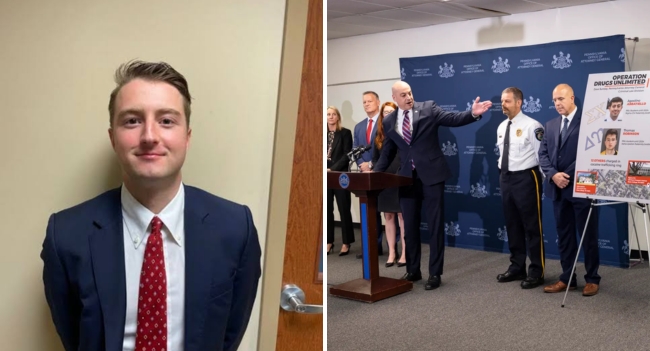
Attorney General Dave Sunday announces charges against 14 people involved in a campus drug ring.X / @PAAttorneyGen
Authorities searched databases for “Tom Robinson” and located a Thomas Robinson whose listed address was the Delta Upsilon house.
The investigation eventually led officers to raid the fraternity property in December 2024.
According to the criminal complaint, Robinson initially resisted arrest and appeared to believe the officers were actually fraternity brothers playing a prank on him.
Authorities used a Taser before taking him into custody.
Investigators alleged that a subsequent search of Robinson’s room uncovered more than eight grams of cocaine, nearly eight ounces of marijuana and more than 200 amphetamine and dextroamphetamine pills.
A Kimber .45-caliber handgun was also allegedly discovered inside a safe positioned above his mini-fridge.
Robinson Faces Multiple Charges

Robinson was charged in connection with several alleged incidents between September and December 2024.
The charges include drug manufacturing and delivery, criminal use of a communication facility, possession of a controlled substance and possession of drug paraphernalia.
It remains unclear whether Robinson has entered a plea. Court documents indicate that he is expected to appear for a pretrial hearing next month in connection with the 2024 case.
But investigators allege Robinson was only one part of a much larger operation.
Investigators Turn Their Attention to Alleged Supplier
Following his arrest, Robinson reportedly identified fellow Penn State student Agostino Abbatiello as an alleged supplier.
Abbatiello was associated with Penn State’s Sigma Chi fraternity.
According to a filing concerning Abbatiello that was reviewed by NBC News, Robinson allegedly became involved in the operation through another fraternity brother who was already dealing drugs.
That fraternity member allegedly approached Robinson in July 2023 about becoming business partners in distributing cocaine.
By December 2023, the unidentified student reportedly wanted to leave the operation. He later told a grand jury that Robinson bought out his share of their most recent cocaine supply.
Investigators allege Robinson subsequently made several large purchases from Abbatiello between January and September 2024.
Among the transactions cited were purchases valued at $18,000 and $22,000.
Investigation Expands Beyond Robinson
The case has since developed into a much broader investigation involving current and former Penn State students and fraternity members.
Robinson’s father, Paul Robinson, has also been charged in connection with the wider case.
Penn State announced that Delta Upsilon was being placed on interim suspension while the allegations are investigated. The university also noted that Sigma Chi is not recognized by Penn State and operates outside university oversight.
Andrea Dowhower, Penn State’s vice president for student affairs, said the university was “horrified” by the serious allegations involving current and former students.
For investigators, however, one of the most striking aspects of the case remains how the trail allegedly began: a confidential source pointed authorities toward “T-Rob,” and the digital payment account allegedly connected to the operation carried a username remarkably close to the suspect’s real name.