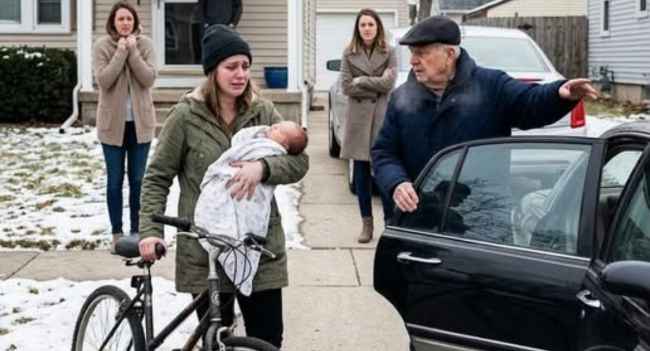
My grandfather found me outside in the freezing cold, holding my newborn tightly against my chest, standing beside an old bicycle with a flat tire.
His eyes moved slowly—from my baby, to the damaged wheel, then toward the driveway where my sister was driving the car that was supposed to be mine.
His voice stayed calm, but there was a sharp edge beneath it when he asked,
“Why aren’t you using the car I gave you?”
I gave him the only truth I had left.
“I don’t have it. Lauren’s the one driving the Cadillac.”
He went quiet for a moment before saying,
“Alright. I’ll deal with this tonight.”
I thought he meant a simple talk at home.
I was wrong.
The cold had already worked through my coat and into my fingers by the time his black sedan stopped beside me.
Noah slept against my chest beneath a thin blanket, warm and peaceful while I struggled to keep my hands from shaking around him. We were almost out of formula, and that was the only reason I had left the house.
I had no car, no keys, and no way to carry groceries except an old bicycle that had been leaning beside the garage for years. The tire went flat before I reached the corner, so I kept walking—one hand guiding the bike, the other pressed carefully against Noah’s back.
When the sedan window lowered, Grandpa did not look angry at first.
He looked confused.
Then his eyes settled on Noah, moved to the bent wheel, and crossed the yard toward the clean Cadillac sitting in our driveway.
“Madison,” he said, “didn’t I give you a car?”
My throat tightened because everyone inside that house had spent months pretending the answer was complicated.
Mom said Lauren needed the Cadillac more because she worked farther away. Dad said I was home with the baby most days anyway. Lauren said I would scratch it, spill formula inside it, or forget to maintain it.
Somehow, the car Grandpa had given me had become hers, and I had been trained to feel selfish for noticing.
“Why aren’t you driving it?” he asked again.
I looked down at Noah’s tiny hand resting against my coat.
“I only have the bike,” I said. “Lauren drives the Cadillac.”
Grandpa’s silence landed harder than shouting.
The curtain behind the front window shifted. Mom was watching.
A moment later, the door opened, and Lauren stepped onto the porch wearing the careful smile she used whenever she wanted cruelty to sound reasonable.
“Grandpa,” she called, “Madison tends to exaggerate. She doesn’t need the car all the time.”
Mom came out behind her and pulled her sweater closed against the wind.
“Dad, please,” she said. “Not out here. Madison’s been under a lot of stress lately.”
There it was again—stress.
The word they used whenever I asked about my missing bank card. The word they used when money disappeared from my account. The word they used when I asked for papers that belonged to me and was told I would only lose them.
Grandpa opened the sedan door and stepped into the cold.
He looked at Lauren beside the Cadillac, then at Mom on the porch, then at Dad standing silently in the doorway.
Nobody offered an explanation.
The bicycle wheel scraped softly against my leg, and Noah stirred beneath the blanket.
Grandpa turned back to me.
“Get in the car.”
Mom stiffened. “Dad, that isn’t necessary.”
He did not look at her.
“Madison. You and the baby. Now.”
I hesitated because hesitation was what that house had taught me.
Stay quiet. Keep the peace. Do not embarrass the family, even when the family is embarrassing you.
Then Noah made a small sound against my chest, and the decision stopped being about me.
I left the bicycle beside the curb and climbed into the sedan. Warm air moved over my frozen hands as I settled Noah against me.
Through the rear window, I saw Lauren standing beside the Cadillac with her smile gone, while Mom gripped the porch railing as though the ground had shifted beneath her.
Grandpa let the house disappear behind us before he spoke.
“This isn’t really about the car, is it?”