Congratulations!
You've earned 1 point
The dean paused before announcing the valedictorian.
I could hear programs rustling behind me, then my mother’s whisper.
“She better acknowledge us.”
For fifteen years, Linda and Richard Barrett had been almost completely absent from my life. Yet somehow, sitting in those reserved seats, they had convinced themselves that biology entitled them to the ending of a story they had walked out of at the beginning.
Then the dean spoke.
“Our valedictorian, graduating with highest honors, is Dr. Hannah Morgan.”
Silence.
Then applause erupted through the auditorium.
I stood.
Behind me, someone gasped.
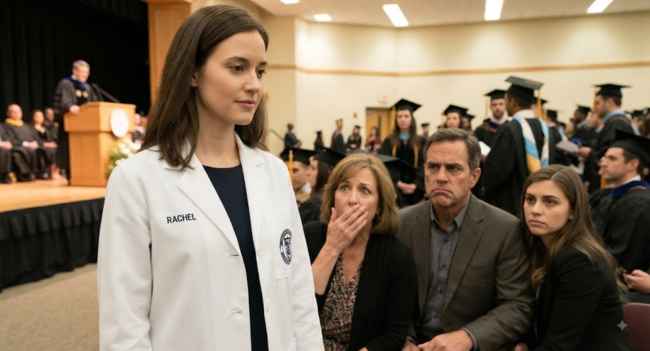
I slipped on my white coat.
The embroidery over my heart was finally visible:
HANNAH MORGAN, M.D.
Not Barrett.
Morgan.
I turned just enough to see Rachel standing near the aisle.
She was crying before I even reached her.
Rachel had started as my night nurse, but after becoming my foster mother, she rearranged her entire life around my treatment. She learned every medication schedule, drove me to appointments, sat beside me through the nights when I was sick, and never once made me feel as though survival were a debt I owed her.
When chemotherapy took my hair, Rachel shaved part of hers and let me laugh at how terrible it looked.
When I returned to school and classmates stared, she waited outside every afternoon.
When scans frightened me, she held my hand.
And when I finally entered remission, she celebrated by taking me to a diner and ordering an absurd stack of pancakes because I had spent months dreaming about being hungry again.
Two years after I entered her home, Rachel asked whether I wanted the placement to become permanent.
She never pressured me.
“You already have a mother and father,” she told me. “Whatever happened between you doesn’t disappear because I love you.”
I remember looking at her across our kitchen table.
“No,” I said. “I have biological parents.”
Then I asked her to adopt me.
I became Hannah Morgan at sixteen.
My biological parents were notified.
They did not contest it.
They did not attend the hearing.
Rachel did.
She wore the same blue dress she later wore to my high-school graduation.
Years passed.
Cancer left scars, but it also gave my life direction.
I wanted to become the kind of doctor Dr. Grant had been that afternoon in Room 314—the adult willing to protect a frightened child even when the people who should have protected her refused.
College came first.
Then medical school.
There were loans, scholarships, exhausting shifts, exams that made me question everything, and more nights studying at Rachel’s kitchen table than I could count.
Rachel never stopped showing up.
When I received my medical-school acceptance, she screamed so loudly that Muffin—the same overweight cat she had told me about during our first hospital night—ran upstairs.
When I matched into pediatric oncology, Rachel cried.
And when I learned I would graduate as valedictorian, there was only one person I wanted beside me.
I had not invited Linda, Richard, or Allison.
I still don’t know exactly how they learned about the ceremony.
But there they were.
After I crossed the stage, shook the dean’s hand, and received my diploma, the dean asked me to remain at the podium.
I unfolded the speech I had written the night before.
I thanked my professors.
My classmates.
Dr. Grant.
Then I looked directly at Rachel.
“When I was thirteen,” I said, “I learned that sharing DNA with someone does not guarantee they will choose you when choosing you becomes difficult.”
The auditorium became completely still.
“I also learned that family can begin with a stranger pulling up a chair beside a hospital bed and deciding that a frightened child should not face the night alone.”
Rachel covered her mouth.
I continued.
“Everything written after my name today exists partly because one nurse looked at a child everyone else had calculated as an expense and saw a daughter.”
People began standing.
Rachel shook her head through tears as applause filled the room.
I stepped away from the microphone, walked down from the stage, and hugged her.
That should have been the end.
It wasn’t.
Linda reached us in the lobby.
“You humiliated us.”
Those were her first words to me after fifteen years.
Not congratulations.
Not I’m sorry.
Not I’m glad you’re alive.
I looked at her.
“How?”
“You made everyone think we abandoned you.”
“You did.”
Richard stepped forward.
“We made an impossible financial decision.”
Rachel immediately moved beside me, but I touched her arm.
I wanted to answer this myself.
“You were offered assistance programs. Social services explained them to you. Dr. Grant asked you to stay. You chose Allison’s college fund and left.”
Allison’s face reddened.
“That wasn’t my decision.”
“No,” I said. “It wasn’t. You were sixteen.”
I had spent years being angry with her, but adulthood had eventually taught me something important: my sister had been another child living beneath our parents’ choices.
Richard interrupted.
“We’re still your parents.”
I looked at the name embroidered over my heart.
“No. You’re the people I was born to.”
Linda’s expression hardened.
Then she said something I hadn’t expected.
“We deserve some recognition. Without us, you wouldn’t even be here.”
Rachel inhaled sharply.
But I almost smiled.
Because that sentence finally freed me from the last tiny part of myself that had wondered whether my parents had changed.
I reached into my graduation folder and removed an envelope.
Inside was a copy of the adoption decree I had carried with me because Rachel and I planned to frame it beside my diploma.
I handed it to Linda.
At the bottom were the signatures from fifteen years earlier acknowledging termination of their parental rights.
Richard stared at his own signature.
Linda went silent.
“You already made your choice,” I said. “You signed it.”
Neither of them answered.
Then Dr. Michael Grant approached us.
His hair was almost completely gray now, but I recognized him immediately.
He shook Rachel’s hand first.
Then mine.
“Dr. Morgan,” he said.
Hearing him call me that nearly broke me.
He looked toward my biological parents and apparently recognized them too.
Richard tried to explain.
Dr. Grant stopped him.
“I remember Room 314.”
Four words.
That was all it took.
My father’s face changed.
Because suddenly there was another person standing there who remembered exactly what had happened.
I did not need revenge.
I did not need security to drag anyone away.
I did not need my parents publicly destroyed.
I had something better.
A life they had once decided wasn’t worth investing in.
I turned toward Rachel.
“Ready, Mom?”
She smiled through her tears.
“Ready, Doctor.”
We walked away together.
Months later, on my first morning as a pediatric oncology resident, I entered a hospital room where a frightened thirteen-year-old girl sat waiting for test results.
Her parents were beside her.
I pulled up a chair.
For a moment, I remembered another thirteen-year-old girl in Room 314 who believed she had been discarded because keeping her alive cost too much.
Then I introduced myself.
“Hi. I’m Dr. Hannah Morgan.”
The girl looked terrified.
So I stayed.
Because Rachel had taught me that sometimes changing a person’s entire life begins with something remarkably simple.
You don’t leave.