Many years have passed since I saw “SHINING THROUGH”. Many years. But after reading several reviews of the film over the years, I found myself wondering why I had enjoyed it in the first place. Why? Not many people really liked it.
Based upon Susan Isaac’s 1988 novel, “SHINING THROUGH” told the story of a woman of Irish and German-Jewish ancestry named Linda Voss and her experiences during World War II. The story begins when Linda applies for a job as a secretary at at prestigious Manhattan law firm. Linda is initially rejected, due to not being a graduate of a prestigious women’s college. But when she reveals her knowledge of German, she is hired on the spot. Linda serves as a translator to an attorney named Ed Leland, who is revealed to be an O.S.S. officer after the United States enter World War II. They also become lovers. Despite personal conflicts and separations, Linda and Ed resume their working relationship, until she volunteers to replace a murdered agent in Berlin on short notice. Much to Ed’s reluctance, Linda heads to Berlin and eventually becomes the governess to the children of a high-ranking Nazi officer named Franz-Otto Dietrich.
I eventually learned that “SHINING THROUGH” has developed quite a bad reputation over the years. Many consider it inferior to Isaac’s novel. It is even part of the “100 Most Enjoyably Bad Movies Ever Made” list by Golden Raspberry Award founder, John Wilson. This low opinion of “SHINING THROUGH” has led me to avoid it for years after I had first saw it. In fact, I became even more determined to avoid it after reading Isaac’s novel. Then I recently watched the movie again after so many years and wondered what was the big deal. I am not saying that “SHINING THROUGH” was a great movie. It was not. But I found it difficult to accept this prevailing view that it was one of the worst movies ever made. More importantly, my opinion of the novel is not as highly regarded as it is by many others. Basically, I have mixed feelings about the novel and the film.
The technical crew for “SHINING THROUGH” did a first-rate job. Production designer Anthony Pratt did an excellent job in re-creating both the eastern United States and Germany during the early 1940s. He was ably assisted by cinematographer Jan de Bont, whose photography struck me as particularly rich, sharp and colorful. I found Peter Howitt’s set decorations particularly effective in the Berlin sequences. I especially enjoyed the late Marit Allen’s costume designs for the film. I thought she did an excellent job in ensuring that the costumes effectively reflected the characters’ nationalities, gender, class and positions.
Before I discuss the movie’s virtues and flaws, I have to do the same for Isaac’s novel. I was very impressed by how the writer handled Linda Voss’ relationships with attorney John Berringer, his wife Nan Leland and the latter’s father, Ed Leland rather well. I found Isaac’s handling of Linda’s private life very romantic, complex, detailed, rather messy and very realistic. In fact, I remember being so caught up by Linda’s personal life that by the time the story jumped to the Berlin sequences, I realized that this segment had taken up over half of the novel. But once Isaac’s moved to the story to Linda’s wartime experiences as a spy in Berlin, I found myself feeling very disappointment. It seemed so rushed and unfulfilling. I was also surprised by how my feelings for the novel seemed to be the complete opposite of my feelings toward the movie.
Unlike Isaac’s portrayal of Linda’s private life, I was not impressed by how David Seltzer handled the character’s romance in the movie’s first half. I had no problems with Melanie Griffith and Michael Douglas. They had a decent chemistry, if not particularly spectacular. But the Linda/Ed romance lacked the detailed complexity and realism of the literary romance. Instead, I found it turgid, somewhat simple-minded and a bad rehash of clichéd World War II romances found in many past movies. I even had to endure a rendition of the old wartime standby, “I’ll Be Seeing You”, while Linda and Ed hash over his disappearance during the war’s first six months. I also noticed that Seltzer eliminated the John Berringer and Nan Leland characters, which reduced Linda and Ed’s romance into a one-note cliché. All I can is . . . thank God the movie shifted to Linda’s experiences in Berlin. I realize that many fans of Isaac’s novel would disagree with me, but I feel that Seltzer handled the story’s second half – both as the movie’s director and screenwriter – a lot better than Isaac. I realize that this revelation might seem sacrilege to many of the novel’s fans, but I stand by my opinion. Seltzer’s screenplay seemed to go into more detail regarding Linda’s mission in Germany – from the moment when the elderly, German-born Allied spy called “Sunflower” escorts her from Switzerland to Berlin; to Linda’s search for her Jewish relations; and finally to when Linda and Ed’s attempt to cross back into Switzerland. This entire sequence was filled with exciting action, drama, surprising pathos and some first-rate suspense – especially between Linda and two particular characters. My three favorites scenes from this entire sequence were the development of Linda’s friendship with Sunflower’s niece, Margrete von Eberstein; her outing to Berlin’s zoo with the Dietrich children; and her showdown with a Nazi spy after escape from Dietrich’s home. I found Linda’s developing friendship with Margrete fun to watch. The entire sequences regarding both the visit to the zoo and Linda’s showdown with a spy two very suspenseful, yet fascinating sequences.
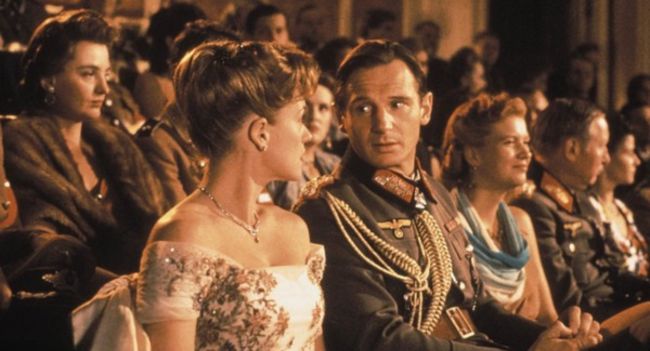
As I had earlier stated, Melanie Griffith and Michael Douglas did not exactly burn the movie screen as a romantic couple. But I thought they managed to create a solid romance . . . enough to rise above Selzer’s turgid writing that seemed to mar the movie’s first forty minutes or so. Griffith did a first-rate job as Linda Voss by conveying both the character’s passion and clumsy skills as a spy. My only problem with Griffith’s performance is that she did not seem to make an effective narrator. Her voice was too soft and Seltzer’s words struck me as over-the-top. Michael Douglas portrayed Ed Leland – Linda’s boss and eventual lover – and gave a very good performance. I thought he was very effective in conveying Ed’s no-nonsense personality. But in my opinion, the best performance came from Liam Neeson, who portrayed Linda’s second employer – Franz-Otto Dietrich. First of all, I have to give kudos to Neeson for portraying Dietrich without the usual negative overtones usually associated with on-screen Nazi officers. Neeson portrayed Dietrich as a soft-spoken and charming man, who also seemed to be a devoted father and very observant man. At the same time, Neeson took care to convey to audiences that Dietrich could also be very ruthless with great skill and subtlety.
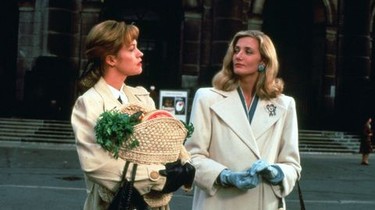
“SHINING THROUGH” was the second time I had become acquainted with Joely Richardson. I was very impressed by her portrayal of Linda’s only Berlin friend, Margrete von Eberstein, who happened to be Sunflower’s niece and also a spy for the Allies. Richardson gave a particularly effervescent performance as the very charming Margrete. She also clicked very well with Griffith on screen. John Gielgud probably gave the most crowd pleasing performance in the film as Sunflower, the German aristocrat-turned-Allied spy. Gielgud provided some memorable zingers, while his character delivered scathing criticism of Linda’s skills as a spy. The movie also featured brief appearances of veteran character actors Wolf Kahler and Thomas Kretschmann, who later became a rather busy character actor in the U.S. It also featured solid performances by Patrick Winczewski, Ronald Nitschke, Sheila Allen, Sylvia Sims, Francis Guinan; along with Anthony Walters and Victoria Shalet as the Dietrich children.

Do I believe that “SHINING THROUGH” deserved the movie critics’ contempt, along with the numerous Razzies awards it acquired? No. Not really. It is not the greatest World War II melodrama I have ever seen. And I certainly would not have placed it on a “best movies” list of any kind. “SHINING THROUGH” is basically a mixed bag, much like the Susan Isaac novel upon which it is based. Like the novel, the movie is a study in contradiction. Writer-director David Seltzer’s handling of the Linda Voss-Ed Leland romance could be called a cinematic embarrassment. It is only a miracle that Melanie Griffith and Michael Douglas’ performances were not marred by such bad writing. On the other hand, Seltzer did an excellent job in writing and directing the sequences featuring Linda’s adventures in Germany. If you are not expecting a cinematic masterpiece, I would suggest watching it . . . even if it means enduring the movie’s first forty minutes or so.