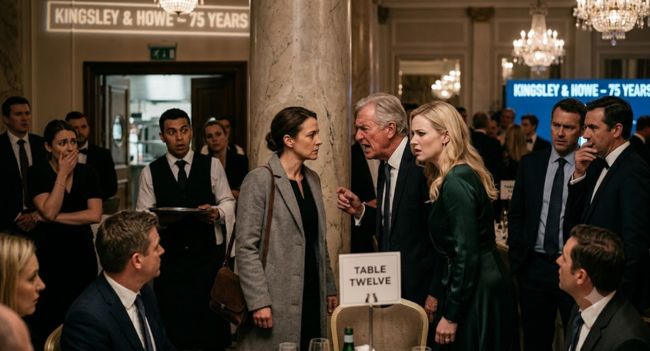
THE WOMAN IN THE GREY COAT
The first person to mistake Evelyn Hart for a waitress was the bride’s mother.
It happened less than five minutes after Evelyn entered the ballroom of the Langford Hotel in London.
“Excuse me,” the woman said, pressing an empty champagne glass into Evelyn’s hand without looking at her face. “Could you bring me another one? And tell the kitchen the salmon is dry.”
Evelyn looked down at the glass.
Then she looked at the woman.
She was perhaps sixty, dressed in a silver gown that probably cost more than most people earned in three months. Diamonds rested against her neck. Her expression carried the calm certainty of someone who had never been ignored by a waiter, refused by a bank, or told to wait outside.
“I’m afraid I don’t work here,” Evelyn said.
The woman finally looked at her.
Her eyes moved over Evelyn’s plain grey coat, simple black dress, flat shoes, and the leather bag she had owned for eleven years.
“Oh.”
There was no apology.
Only mild irritation.
“Well, you’re standing near the service entrance.”
“I was looking for the cloakroom.”
“It’s downstairs.”
The woman took her glass back and walked away.
Evelyn watched her disappear into the crowd.
Around her, two hundred guests moved beneath crystal chandeliers. Bankers, politicians, aristocrats, technology executives, and old families filled the ballroom. Conversations rose and fell beneath the music of a string quartet.
At the far end of the room stood a large illuminated sign:
KINGSLEY & HOWE — 75 YEARS OF BRITISH EXCELLENCE
The company was celebrating its anniversary.
By the following morning, it might no longer belong to the Kingsley family.
And Evelyn Hart—the woman in the grey coat—would decide its fate.
Kingsley & Howe had once been one of Britain’s most respected engineering firms.
The company designed rail systems, bridges, renewable-energy equipment, and security infrastructure. Its projects could be found from Manchester to Mumbai and from Edinburgh to New York.
But old prestige had hidden new problems.
The company was nearly bankrupt.
Its pension fund had a seventy-million-pound deficit. Several government contracts were behind schedule. Two major clients had threatened legal action. Thousands of employees were at risk of losing their jobs.
For six months, Kingsley & Howe had been searching for an investor.
Only one firm had offered enough money to save it.
Hartwell Global.
Very few people knew much about Hartwell’s founder.
They knew she was British-American.
They knew she had created a cybersecurity company in Boston at twenty-four and sold part of it seven years later for more than two billion dollars.
They knew she now controlled an investment group with offices in London, New York, Boston, and Singapore.
They knew she rarely appeared in newspapers and almost never attended business galas.
Most financial magazines used the same old photograph of her: a distant image taken at a technology conference nearly a decade earlier.
The executives at Kingsley & Howe had spent weeks preparing for her arrival.
They expected private security.
They expected assistants.
They expected designer clothing, a chauffeur, and perhaps a little arrogance.
They did not expect a thirty-six-year-old woman to arrive alone in a taxi, wearing a second-hand grey coat.
That misunderstanding was exactly what Evelyn had wanted.
“May I see your invitation?”
The young man at the registration desk gave her a professional smile.
Evelyn handed him the cream-coloured card.
He studied it, then checked the guest list.
“Ms Evelyn Hart?”
“Yes.”
His expression changed slightly.
Not recognition.
Confusion.
“You’re seated at Table Twelve.”
“Thank you.”
He gave her a gold name card.
It displayed only:
EVELYN HART — HARTWELL GLOBAL
The young man stared at the card again.
For a moment, Evelyn thought he might understand.
Then a woman in a headset rushed over.
“Tom, we need you at the main entrance. Sir Richard’s daughter has arrived.”
The young man placed Evelyn’s card on the desk and hurried away before giving it to her.
Evelyn left it there.
She wanted to know how people would treat her without it.
Table Twelve was beside the kitchen doors.
It was far from the stage and partly hidden behind a marble column.
The other tables were filled with executives, investors, celebrities, and senior government officials. Table Twelve seated junior employees, administrative staff, and two university students who had won company scholarships.
A young man stood when Evelyn approached.
He had curly brown hair, an inexpensive suit, and the nervous posture of someone who had not yet learned how to pretend he belonged in rooms like this.
“Would you like to sit here?” he asked.
“Thank you.”
He pulled out a chair for her.
“I’m Noah Reed.”
“Evelyn.”
“Do you work for Kingsley?”
“Not exactly.”
“I’m in structural analysis,” Noah said. “Well, technically I’m a graduate engineer. Mostly I correct spreadsheets and get blamed when senior managers use the wrong numbers.”
Evelyn smiled.
“That sounds like valuable training.”
“It’s certainly training me to find another job.”
“Is the company really that bad?”
Noah glanced around before lowering his voice.
“People are frightened. There are rumours about layoffs. The directors keep telling us everything is fine, but suppliers haven’t been paid. Last month, my team had to buy its own safety equipment.”
“Have you told anyone?”
“My manager knows.”
“And?”
“He told us to show loyalty.”
“What does loyalty mean to him?”
“Working unpaid weekends.”
Before Evelyn could respond, a woman approached their table.
She was tall, blonde, and dressed in dark green silk. A photographer followed her.
Noah immediately straightened.
“That’s Charlotte Kingsley,” he whispered.
Charlotte was the only daughter of Sir Richard Kingsley, the company’s chairman and chief executive. At thirty-two, she was officially Director of Strategic Development.
According to the documents Evelyn had reviewed, Charlotte’s department had spent fourteen million pounds in two years without producing a single profitable project.
Charlotte smiled for the photographer, greeted the scholarship students, and then noticed Evelyn.
Her smile faded.
“You’re in my seat.”
Evelyn looked at the name card beside her plate.
It said MR PETER DAWSON.
“I believe Table One is reserved for the Kingsley family,” Evelyn said.
“I’m not sitting here. I need this chair for a photograph with the students.”
“I’ll move.”
Evelyn stood.
Charlotte looked at her coat, which was folded over the back of the chair.
“Are you one of the scholarship parents?”
“No.”
“Staff?”
“No.”
Charlotte waited.
When Evelyn did not explain, Charlotte’s eyes narrowed.
“Then how did you get in?”
“I was invited.”
“By whom?”
“The board.”
Noah stared at Evelyn.
Charlotte laughed softly.
“The board?”
“Yes.”
“Which department are you from?”
“Hartwell Global.”
That name should have changed everything.
But Charlotte had spent most of the negotiations in Switzerland, attending what she described on social media as a leadership retreat.
She had never spoken to Evelyn.
“You’re part of the investor’s administrative team,” Charlotte concluded.
“That must be it.”
Charlotte turned to Noah.
“Take the chair and place it between the students.”
Noah hesitated.
“You can ask a member of the hotel staff,” he said.
Charlotte stared at him.
“I am asking you.”
“I’m an engineer.”
“You are an employee.”
Noah’s face reddened.
Evelyn picked up the chair herself.
“Where would you like it?”
Charlotte pointed without thanking her.
Evelyn carried the chair to the other side of the table.
The photographer took several pictures of Charlotte leaning between the two scholarship winners.
Then Charlotte moved away without speaking to them.
One of the students watched her leave.
“She didn’t ask our names,” the girl said.
“No,” Evelyn replied. “She didn’t.”
Dinner began at eight.
Sir Richard Kingsley stood on the stage beneath the company’s golden logo.
He was sixty-four, silver-haired, and handsome in the polished way of men who had been photographed beside prime ministers for decades.
“For seventy-five years,” he announced, “the Kingsley family has protected this company’s values.”
Applause filled the room.
“Excellence. Loyalty. Integrity.”
Evelyn looked at Noah.
He was staring at his untouched soup.
Sir Richard spoke about the company’s history, its workers, and its future.
He did not mention the missing pension money.
He did not mention that his personal aircraft had been charged to the company for three consecutive years.
He did not mention the twelve million pounds transferred to a consulting business controlled by his brother-in-law.
Instead, he praised sacrifice.
“Difficult times,” he said, “require every member of the Kingsley family to do more.”
The employees applauded because the cameras were watching.
Evelyn did not.
A man seated at the next table noticed.
He leaned toward her.
“If you dislike the speech, you don’t have to stay.”
He was in his late forties, with a red face and a bow tie that seemed too tight around his neck.
“I’m listening carefully,” Evelyn said.
“You’re not clapping.”
“Applause isn’t evidence of attention.”
The man frowned.
“Who are you?”
“Evelyn Hart.”
“Which division?”
“Hartwell Global.”
His expression changed.
Unlike Charlotte, he recognized the company name.
But he made the same assumption.
“Legal?”
“No.”
“Accounting?”
“No.”
“Personal assistant?”
Evelyn almost smiled.
“No.”
“I’m Martin Bell, Chief Financial Officer.”
“I know.”
He leaned back, pleased.
“Of course you do.”
Evelyn studied him.
Martin Bell had approved every suspicious transfer she had found.
“Do you think the company can survive?” she asked.
He glanced at her cheap shoes.
“I don’t discuss financial strategy with junior staff.”
“What do you discuss with them?”
“Whatever they need to know.”
“And who decides what they need to know?”
“I do.”
“How convenient.”
His eyes hardened.
“You should be careful.”
“Why?”
“You represent a potential investor. Your behaviour reflects on your employer.”
“I’ll remember that.”
“You should. Sir Richard values respect.”
“Does he value accurate financial reporting?”
Martin’s wineglass stopped halfway to his mouth.
“What did you say?”
“I asked whether Sir Richard values accurate reporting.”
“Of course.”
“Then I’m sure tomorrow’s meeting will go very well.”
Martin stared at her.
Before he could ask another question, the lights dimmed for a promotional film.
The film showed bridges, wind farms, trains, and smiling workers.
A deep voice described Kingsley & Howe as “a company built on trust.”
Halfway through the presentation, Noah leaned closer to Evelyn.
“The offshore wind platform in that video failed inspection.”
“When?”
“Three months ago.”
“Why?”
“The anchoring system was redesigned to reduce costs. My team warned management that the new calculations were wrong.”
“What happened?”
“They approved it anyway.”
“Who approved it?”
Noah hesitated.
“I shouldn’t be talking about this.”
“Probably not.”
“It could cost me my job.”
“Possibly.”
He studied her face.
“You ask a lot of questions for an assistant.”
“I’m not an assistant.”
“Then what are you?”
Before Evelyn could answer, the film ended and applause began.
Sir Richard returned to the stage.
“And now,” he said, “we are proud to announce that Kingsley & Howe is entering an exciting new chapter.”
A spotlight moved toward Table One.
“We have been in negotiations with Hartwell Global, one of the world’s most dynamic investment firms.”
Guests whispered.
Sir Richard smiled broadly.
“I had hoped to welcome Hartwell’s founder, Ms Evelyn Hart, this evening. Unfortunately, it appears that her schedule prevented her from joining us.”
Evelyn remained still.
Noah turned slowly toward her.
Across the room, Martin Bell was staring at Table Twelve.
His face had lost its colour.
Charlotte followed his gaze.
Sir Richard continued speaking, unaware.
“However, we look forward to meeting Ms Hart tomorrow morning, when I am confident we will finalize an agreement that protects our family legacy.”
Evelyn stood.
Noah’s eyes widened.
Every person at Table Twelve looked at her.
She removed her grey coat from the back of the chair and placed it over her arm.
Martin Bell was already moving toward her.
“Ms Hart,” he said breathlessly.
The guests nearest them fell silent.
Sir Richard stopped speaking.
Evelyn looked at Martin.
“You remembered my name.”
“I—there has been a misunderstanding.”
“Yes.”
Charlotte hurried over.
Her face was pale.
“You’re Evelyn Hart?”
“That is what I told you.”
“I thought you were—”
“Administrative staff?”
Charlotte opened her mouth but said nothing.
Sir Richard stepped down from the stage.
The crowd watched him cross the ballroom.
“Ms Hart,” he said, forcing a smile. “What an extraordinary surprise.”
“Is it?”
“We expected your office to notify us when you arrived.”
“My office did.”
“Our staff must have made an error.”
“Several people made errors tonight.”
Sir Richard lowered his voice.
“Perhaps we could discuss this privately.”
“We’re already scheduled to discuss everything tomorrow.”
“Of course. But I would hate for a minor hospitality issue to influence a transaction of this importance.”
“A minor hospitality issue?”
“Please understand. No one recognized you.”
Evelyn looked toward Table Twelve.
The junior employees sat in silence.
“That is precisely the problem,” she said.
Sir Richard’s smile disappeared.
“I beg your pardon?”
“You believe respect should depend on recognition.”
“I assure you—”
“You spoke about values tonight. Excellence, loyalty and integrity.”
“They are the foundation of this company.”
“Then tomorrow, you should be prepared to prove it.”
She turned to Noah.
“Thank you for the conversation.”
“What happens tomorrow?” he asked.
Evelyn glanced at Sir Richard, Martin, and Charlotte.
“The truth.”
Then she walked out of the ballroom.
No one tried to stop her.
At nine the following morning, the boardroom was full.
Sir Richard sat at the head of the table.
Martin Bell occupied the chair beside him. Charlotte sat near the window, dressed in a white suit and an expression of practiced calm.
Ten directors waited with folders, laptops, and cups of coffee.
At exactly nine, Evelyn entered with three members of her team.
She wore the same black dress.
The grey coat was folded over her arm.
No security guards followed her. No expensive jewellery announced her wealth.
She did not need any of it.
Everyone in the room stood.
“Please sit,” she said.
Sir Richard began immediately.
“Ms Hart, before we discuss the transaction, I would like to personally apologize for last night.”
“Which part?”
“The seating confusion.”
“Your CFO assumed I was junior staff and refused to discuss company finances with me.”
Martin shifted in his chair.
“My daughter thought you were a scholarship parent,” Sir Richard continued. “Our staff placed you at the wrong table. These were unfortunate mistakes.”
“You’re right.”
Sir Richard relaxed slightly.
“They were mistakes.”
Then Evelyn placed a thick folder on the table.
“But they were not the mistakes that brought me here.”
The doors opened.
Two lawyers entered, followed by an independent forensic accountant.
Martin’s face tightened.
Evelyn connected her laptop to the screen.
A financial chart appeared.
“Hartwell Global began reviewing Kingsley & Howe six months ago. We were told the company’s financial difficulties resulted from market conditions, delayed contracts, and rising material costs.”
“All accurate,” Martin said.
“Partly.”
She changed the slide.
A list of transactions filled the screen.
“Over the past four years, thirty-eight million pounds has been transferred from Kingsley & Howe to outside consultants.”
Martin crossed his arms.
“Standard industry practice.”
“Six of those consultants have no employees.”
Silence.
“Three are registered to addresses connected to members of this board. One is controlled by Sir Richard’s brother-in-law.”
Sir Richard’s jaw tightened.
“You are making serious allegations.”
“I’m presenting bank records.”
“These arrangements were approved.”
“By Martin Bell.”
The CFO leaned forward.
“They were legitimate strategic advisory fees.”
Evelyn displayed another document.
“This invoice charges Kingsley & Howe nine hundred thousand pounds for research on European rail expansion.”
“Yes.”
“The report was copied from a publicly available government website.”
Martin said nothing.
“The original document still contains the government department’s internal page numbers.”
One director removed his glasses.
Another looked down at the table.
Evelyn continued.
“Three million pounds from the employee pension fund was improperly used to secure a corporate loan. Company aircraft, private holidays, residential renovations, and personal drivers were listed as operational expenses.”
Sir Richard stood.
“That is enough.”
“No,” Evelyn said. “It isn’t.”
Her voice was quiet, but he stopped.
She displayed photographs of rusted equipment, damaged safety gear, and unfinished infrastructure.
“Employees were told to accept salary freezes. Engineers purchased safety equipment with their own money. Suppliers waited months for payment. Meanwhile, the executive team received eleven million pounds in bonuses.”
Charlotte’s face flushed.
“My compensation was approved by the board.”
“You received one-point-eight million pounds for directing a department that produced no completed projects.”
“You have no right to insult me.”
“I’m not insulting you. I’m reading the accounts.”
Sir Richard placed both hands on the table.
“Hartwell approached us as an investor, not as a prosecutor.”
“That is correct.”
“Then let us discuss the investment.”
“We are.”
He stared at her.
“You need this deal as much as we do. Kingsley & Howe owns valuable patents, facilities, and government contracts.”
“Yes.”
“You cannot simply walk away.”
“I have no intention of walking away.”
For the first time that morning, Sir Richard smiled.
Evelyn changed the slide.
A legal document appeared.
“Hartwell Global will not purchase Kingsley & Howe under the terms negotiated with its current leadership.”
His smile vanished.
“Instead, this morning, Hartwell acquired the company’s senior secured debt from its principal lenders.”
Martin’s chair scraped against the floor.
“What?”
“We now control seventy-three percent of the secured debt.”
“That’s impossible.”
“It was completed at eight fifteen.”
Sir Richard’s face turned grey.
Evelyn continued.
“Unless the company receives an immediate capital injection, it will breach its loan conditions at midnight.”
“You’re forcing us into insolvency,” Charlotte said.
“No. Your decisions brought the company here.”
Sir Richard looked around the room.
“You cannot destroy a seventy-five-year-old British institution.”
“I’m not going to destroy it.”
Evelyn placed another document on the table.
“I’m going to save it.”
No one moved.
“Hartwell will fund a restructuring. Every operational employee will keep their job. Outstanding supplier invoices will be paid. The pension deficit will be covered. The engineering and research divisions will receive new investment.”
Noah and thousands of other workers would be safe.
Sir Richard slowly sat down.
“And the board?”
“The current executive leadership will resign immediately.”
Charlotte laughed once, without humour.
“You expect my family to surrender its own company?”
“Your family owns less than twelve percent of the voting shares. Most of those shares were pledged as security for personal loans.”
Sir Richard looked at Martin.
The CFO avoided his eyes.
Evelyn closed the folder.
“You have two choices. Accept the restructuring, cooperate with the investigation, and allow the company to survive—or reject it and face insolvency proceedings before the end of the week.”
“You planned this,” Sir Richard whispered.
“I prepared for it.”
“Because of what happened at the gala?”
“No.”
Her answer surprised him.
“What happened at the gala merely confirmed something I already suspected.”
“And what was that?”
“You do not see people who cannot benefit you.”
Sir Richard’s face hardened.
“You know nothing about me.”
“I know that you asked workers to demonstrate loyalty while using their pensions to protect your loans.”
He looked away.
“I know your graduate engineers identified a dangerous design failure three months ago, and senior management ignored them.”
Martin turned sharply.
“Who told you that?”
Evelyn did not answer.
She did not need to.
Noah’s name would never appear in the investigation.
“The wind-platform redesign will be suspended,” Evelyn said. “A new engineering review begins today.”
One of the independent directors cleared his throat.
“What happens if we accept?”
“Hartwell provides four hundred million pounds in restructuring capital. A new board is appointed. Employees receive ten percent ownership through a trust. Executive bonuses are frozen until the pension fund is restored.”
“Employee ownership?” Charlotte asked.
“Yes.”
“Factory workers will own the company?”
“They already built it.”
The boardroom fell silent.
Evelyn pushed the agreement toward Sir Richard.
“You have one hour.”
He signed after thirty-seven minutes.
Martin Bell tried to leave through a private lift.
Two investigators were waiting downstairs.
Sir Richard resigned as chairman that afternoon. Charlotte released a statement claiming she had chosen to pursue new opportunities. By evening, financial news channels across Britain and the United States were discussing Hartwell Global’s takeover.
Photographs of Evelyn appeared everywhere.
In most of them, she wore the grey coat.
Commentators called her ruthless.
Others called her brilliant.
One newspaper described her as “the invisible billionaire who entered through the kitchen and left with the company.”
Evelyn disliked that headline.
She had not entered through the kitchen.
She had only been seated beside it.
There was a difference.
Three days after the takeover, Evelyn returned to the Kingsley & Howe headquarters.
Hundreds of employees had gathered in the central atrium.
Some looked hopeful.
Others looked terrified.
They had watched executives make promises before.
Evelyn stood on a small platform without music, banners, or a carefully produced film.
“I know many of you do not trust investors,” she began.
Several people exchanged glances.
“You have good reasons.”
The atrium grew quiet.
“I could stand here and promise that nothing difficult will happen. That would be dishonest. The company must change. Some projects will end. Some departments will be rebuilt. Every expense will be reviewed.”
She paused.
“But operational employees will not pay for decisions made by executives. Your pensions will be protected. No factory will be closed during the twelve-month restructuring period. Safety concerns may be reported directly to an independent committee without management approval.”
A hand rose near the front.
It was an older woman wearing a maintenance uniform.
“What happens after twelve months?”
“We review every facility based on performance, demand, and community impact.”
“So there could still be closures?”
“Yes.”
The honesty caused a murmur.
Evelyn continued.
“But workers will receive the same financial information as senior management. If a facility is in danger, you will know early enough to propose alternatives. You will not learn from a newspaper that your jobs have disappeared.”
The older woman nodded.
Another employee raised his hand.
“Why are you doing this?”
Evelyn looked at the balconies above them.
“My father repaired trains in Leeds.”
The room became still.
“He was an excellent engineer, but he did not have a university degree. For twenty-six years, managers took credit for his solutions. When his company was sold, an executive announced the closure of his workshop at a dinner in London.”
She remembered her father arriving home with a cardboard box.
She had been seventeen.
Inside the box were his work boots, a photograph of his team, and a metal model of the first braking system he had helped design.
“He lost his pension,” Evelyn said. “Our family lost our home six months later.”
No one moved.
“I did not create Hartwell because I loved money. I created it because money decides who gets heard.”
At the edge of the crowd, Evelyn saw Noah.
He was still wearing the same inexpensive suit.
“When people are ignored,” she continued, “companies lose more than morale. They lose knowledge. They lose warnings. Eventually, they lose everything.”
Her eyes met Noah’s.
“This company will listen to the people who understand the work.”
Applause began somewhere near the factory workers.
It grew slowly.
Then it filled the atrium.
Noah was summoned to the executive floor later that afternoon.
He entered the office looking certain that he was about to be dismissed.
Evelyn sat behind a desk covered with engineering reports.
“You wanted to see me?”
“Yes. Sit down.”
He remained standing.
“Am I in trouble?”
“Why would you be?”
“I spoke about the wind platform.”
“You told the truth.”
“In my experience, that usually causes trouble.”
“Your experience is about to change.”
She handed him a report.
“We reviewed your original calculations. They were correct.”
Noah looked at the document.
“My manager said the error margin was acceptable.”
“Your manager is no longer employed here.”
Noah looked up.
“What happens to the project?”
“It will be redesigned.”
“That could take eight months.”
“Then it takes eight months.”
“The client won’t like that.”
“The client will dislike a structural failure more.”
Noah almost smiled.
Evelyn placed a second folder in front of him.
“We are creating an independent engineering-risk unit. It will report directly to the new board.”
“Why are you telling me?”
“Because I want you on it.”
He laughed nervously.
“I’ve worked here for eleven months.”
“And you identified a multimillion-pound failure that people with twenty years of experience ignored.”
“I was doing my job.”
“Exactly.”
“I’m not qualified to lead a unit.”
“I did not ask you to lead it.”
His shoulders dropped slightly.
“I want you to be part of it. You will work with experienced engineers, auditors, and safety specialists. You’ll also complete a funded master’s degree at Imperial College.”
Noah stared at her.
“You’re paying for my degree?”
“The company is.”
“Why?”
“Because talent is expensive to waste.”
For several seconds, Noah said nothing.
Then he looked at her grey coat hanging beside the window.
“Did you really plan to attend the gala without anyone recognizing you?”
“I planned to arrive without an announcement.”
“That’s not the same thing.”
“No.”
“Were you testing everyone?”
“Noah, people reveal themselves without tests. You only have to let them believe there are no consequences.”
He thought about that.
“What will happen to Sir Richard?”
“The investigation will decide.”
“And Charlotte?”
“She has enough money to survive being unemployed.”
“That isn’t what I meant.”
“I know.”
“Did she apologize?”
“No.”
“Does that bother you?”
Evelyn looked out over London.
“No. An apology offered after someone discovers your power is not always an apology. Sometimes it is only fear wearing good manners.”
The restructuring lasted eighteen months.
It was more difficult than the newspapers understood.
Three major contracts had to be renegotiated. Two directors were charged with fraud. Martin Bell eventually pleaded guilty to financial misconduct.
Sir Richard was not imprisoned, but he lost his knighthood after a parliamentary inquiry exposed his misuse of the pension fund.
Charlotte moved to New York and launched a consultancy teaching “ethical leadership.”
It failed within a year.
Kingsley & Howe survived.
Its name changed to Howe Engineering, honouring Margaret Howe, the forgotten engineer who had co-founded the company in 1951 but had disappeared from its official history after marrying and leaving the board.
Employee representatives gained two permanent seats on the board.
The pension fund returned to stability.
The redesigned wind platform passed every safety test and became one of the company’s most profitable projects.
Noah completed his master’s degree and was promoted twice.
The maintenance worker who had questioned Evelyn during her first speech became chair of the employee council.
And the university student whom Charlotte had ignored at the gala joined the company as an apprentice engineer.
Two years after the takeover, Howe Engineering held a celebration at the Langford Hotel.
This time, there were no golden signs praising a family legacy.
The stage displayed photographs of engineers, factory workers, designers, drivers, cleaners, and apprentices.
Every table mixed executives with junior employees.
There was no Table Twelve beside the kitchen.
Evelyn arrived alone.
She wore the same grey coat.
At the entrance, a young waiter smiled.
“May I take your coat, Ms Hart?”
“You recognize me?”
He laughed.
“Everyone recognizes you now.”
“That sounds exhausting.”
He placed the coat carefully over his arm.
“Two years ago, my sister was one of the scholarship students at your table.”
Evelyn remembered the girl.
“She’s working for Howe now,” he continued. “She says you changed her life.”
“She earned her place.”
“Maybe. But someone had to see her first.”
Evelyn looked across the ballroom.
Noah was speaking onstage about the wind project. His parents sat in the front row, holding hands.
The former maintenance worker was arguing cheerfully with the new chief executive.
The room was louder and less elegant than it had been two years earlier.
It was also more honest.
A woman approached Evelyn.
It was the bride’s mother from the first gala.
She was wearing another expensive silver gown.
For a moment, neither of them spoke.
Then the woman glanced at the grey coat in the waiter’s arms.
“I believe I once mistook you for a member of staff.”
“You did.”
“I was terribly embarrassed when I realized who you were.”
Evelyn studied her.
“Would you have been embarrassed if I really had been a waitress?”
The woman’s smile disappeared.
She opened her mouth.
No answer came.
Evelyn nodded politely and walked away.
At the centre of the ballroom, Noah raised his glass.
“To the woman who saved this company,” he announced.
Applause erupted.
Evelyn shook her head and stepped onto the stage.
“I did not save this company.”
The room quieted.
“The people who built the bridges saved it. The people who checked the calculations saved it. The people who reported problems when management refused to listen saved it.”
She looked at the workers gathered before her.
“I only made sure their voices reached the boardroom.”
Noah handed her the microphone.
“What should we toast, then?”
Evelyn considered the question.
Then she lifted her glass.
“To every talented person who has been ignored because of their clothes, their accent, their age, their job title, their education, or the table where someone decided they belonged.”
Glasses rose across the ballroom.
“And to the day,” she continued, “when people no longer have to become rich or powerful before they are treated with dignity.”
The guests drank.
Later that evening, Evelyn stepped onto the hotel terrace.
London shone beneath her, its streets wet from the rain.
Noah joined her.
“You disappeared,” he said.
“I needed some air.”
“Everyone wants to speak to you.”
“That is why I needed air.”
He smiled.
For a moment, they stood in silence.
Then Noah looked at her coat.
“Why do you still wear it?”
Evelyn touched the worn sleeve.
“It belonged to my mother.”
“I thought you bought it second-hand.”
“She did.”
“Doesn’t a billionaire own another coat?”
“Several.”
“And you chose this one?”
“Yes.”
“Why?”
Evelyn looked through the windows at the crowded ballroom.
“Because it reminds me that the price of something and its value are rarely the same.”
Noah nodded.
Below them, buses moved through the London streets. A cleaner pushed a trolley through the hotel lobby. A driver opened a car door for a guest. A young woman in a service uniform hurried toward the kitchen carrying a tray of glasses.
Most people in the ballroom would never know her name.
But Evelyn noticed her.
She always noticed now.
Not because she had once been mistaken for a waitress.
Because her father had once been treated as though his intelligence ended where his uniform began.
Because she knew the most dangerous mistake a powerful person could make was assuming that ordinary-looking people lived ordinary lives.
Evelyn had entered the Langford Hotel as a stranger no one respected.
She returned two years later as the most powerful person in the room.
Yet the greatest victory was not that Sir Richard had lost his company.
It was that thousands of people had kept their jobs, their pensions, and their dignity.
Revenge would have destroyed what the Kingsley family built.
Justice had rebuilt it.
The woman in the grey coat had been underestimated because no one knew how rich she was.
In the end, she proved something far more important:
She had never deserved respect because of her money.
She deserved it before anyone knew her name.